

What if the “wait and see” approach you’ve been given is actually a prescription for permanent decline? If you experience the relentless burning that keeps you awake at 2:00 AM or feel your world shrinking as mobility fades, you’ve likely felt dismissed by standard medical protocols. It’s exhausting to feel like a burden to your family while hobbies like gardening become distant memories. At the Neuropathy Relief Project, we believe it’s possible to reclaim life from neuropathy by shifting focus from masking symptoms with heavy medications to supporting actual nerve regeneration.
The National Institutes of Health estimates that upwards of 30 million Americans face these same challenges, yet many are never told that cellular restoration is a clinical reality. You deserve a path that moves beyond temporary fixes and toward true independence. We’re dedicated to acting as your guide through the complex science of nerve health, offering a bridge between natural recovery and rigorous clinical evidence.
This article details the specific protocols used to revitalize damaged nerves, providing a clear roadmap to help you walk without pain, reduce your reliance on prescriptions, and finally sleep through the night again.
Key Takeaways
- Understand how neuropathy acts as a barrier to your daily independence and learn to identify the specific “stolen moments” where numbness or burning limits your freedom.
- Explore the clinical science of neuroplasticity and cellular oxygenation to understand how damaged tissues can be revitalized through targeted nerve regeneration.
- Follow a practical roadmap to reclaim life from neuropathy by tracking your sensory triggers and symptom patterns to prepare for a successful recovery.
- Discover how restoration protocols can help you regain the balance and physical confidence needed to return to cherished outdoor hobbies and daily walks.
- Find out how a brief discovery call can determine if you are an ideal candidate for a specialized, research-driven approach to lasting nerve health.
Understanding the “Stolen Life”: How Neuropathy Limits Your Freedom
Living with neuropathy feels like a slow retreat from the activities you once loved. For the estimated 20 million Americans currently diagnosed, this condition is far more than a simple medical diagnosis; it’s a persistent barrier to daily independence. It often starts as a quiet disruption, perhaps a faint buzzing in the toes or a slight loss of balance, but it quickly evolves into a thief that steals your ability to enjoy a simple evening walk or stand comfortably in your own kitchen. To gain a complete perspective on Understanding Peripheral Neuropathy, you must look past the surface level symptoms to see how damaged nerves disconnect you from your environment. You don’t just lose sensation; you lose the freedom to move through the world without constant calculation and fear.
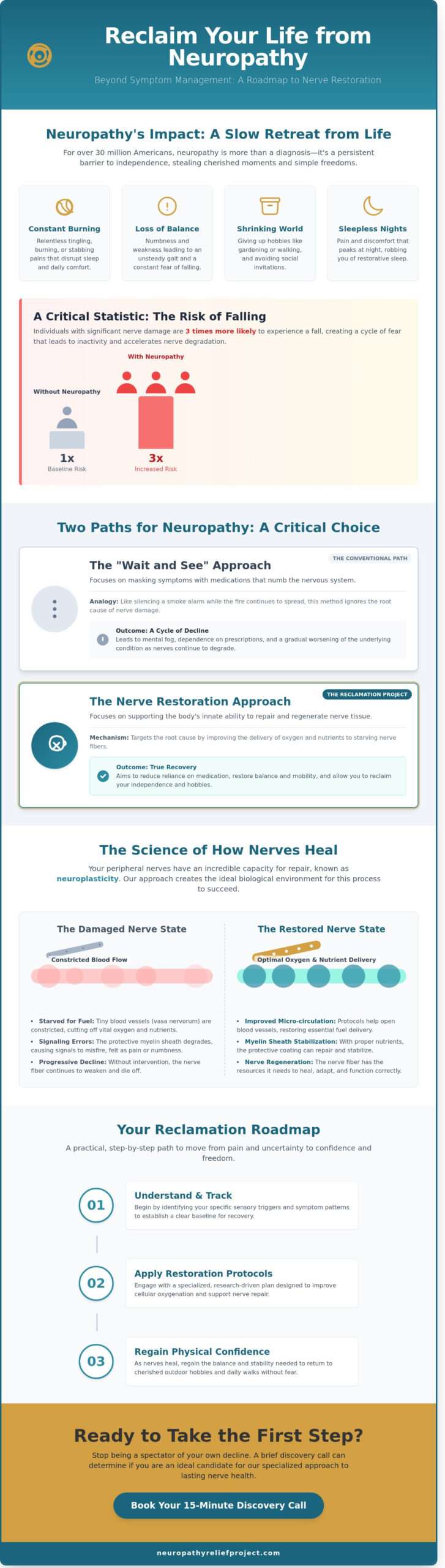
Traditional medical models often prioritize “pain management,” which usually means prescribing medications to dampen the brain’s perception of discomfort. While these drugs might take the edge off the burning sensation, they don’t restore the vital communication between your limbs and your central nervous system. This approach fails to address your fundamental desire to reclaim life from neuropathy. When your nerves are starving for oxygen and nutrients, masking the signal with a pill is like silencing a smoke alarm while the fire continues to spread. You deserve a strategy that targets the health of the nerve itself rather than just the volume of the pain signal.
The Physical Boundaries of Nerve Damage
If you experience persistent tingling or weakness, your geographic and social world begins to contract. You might find yourself declining dinner invitations because you aren’t sure if you can navigate the restaurant’s flooring or stay standing for long. This struggle is often invisible to family and friends, who see you looking healthy while you’re actually enduring a silent storm of electrical shocks or icy numbness. Statistics show that individuals with significant nerve damage are 3 times more likely to experience a fall, creating a cycle of fear that leads to inactivity. This sedentary lifestyle further restricts blood flow to the extremities, which only accelerates the degradation of nerve fibers and worsens the emotional weight of idiopathic neuropathy where causes remain unexplained by standard blood tests.
When “Wait and See” Becomes a Barrier
Many patients are told that nerve damage is permanent and their only option is to “wait and see” how it progresses. This passive stance is a significant barrier to recovery, as it ignores the body’s innate capacity for cellular repair when given the right stimulus. Relying on brain-numbing medications can actually delay true healing by creating a mental fog that hides the worsening underlying condition. The reclamation mindset is the definitive choice to stop being a spectator of your own decline and start actively supporting the biological pathways of nerve regeneration.
The Science of Restoration: How to Reclaim Nerve Health
If you experience a persistent burning in your feet or a frustrating loss of balance, you’ve likely been told that nerve damage is permanent. Traditional medicine often focuses on managing these sensations with prescriptions that merely quiet the nervous system. However, the peripheral nervous system possesses a biological quality known as neuroplasticity. This means your nerves aren’t static wires; they’re living tissues capable of repair and adaptation. To reclaim life from neuropathy, we must shift the focus from silencing the pain to fostering an environment where cellular restoration can occur.
Nerve health depends heavily on oxygenation and nutrient delivery. When the tiny blood vessels, or vasa nervorum, that supply your nerves become constricted or damaged, the nerve fibers begin to starve. This biological “famine” leads to the signaling errors you feel as tingling or sharp stabs of pain. According to the NINDS on Neuropathy, identifying and correcting the underlying triggers is essential for stopping the progression of damage. By improving micro-circulation, we can deliver the essential fuel required for the myelin sheath to stabilize and for dormant nerves to wake up.
Choosing a “Project” approach rather than a standard clinic visit is a strategic decision for chronic conditions. A typical 15-minute office visit rarely allows for the deep dive necessary to map out a functional restoration protocol. A project implies a goal-oriented mission with a defined start, middle, and end. It’s a collaborative effort to move beyond symptom suppression toward measurable functional gains. During a discovery consultation, we analyze your specific history to see if your nerves are still capable of responding to regenerative stimuli.
Nerve Regeneration vs. Pain Masking
Pain masking utilizes chemicals to increase the threshold of what your brain perceives as pain. While this offers temporary comfort, it does nothing to stop the underlying nerve fibers from withering. Regeneration requires a proactive stimulus. Non-invasive protocols, such as specialized light therapy or electro-stimulation, work to increase nitric oxide levels in the blood. This process dilates vessels, allowing oxygen to reach the extremities and triggering the body’s natural repair mechanisms without the risks associated with surgery.
The Neuropathy Relief Project Philosophy
Dr. Michael J. Sclafani established this initiative to bridge the gap between holistic care and clinical evidence. We don’t rely on guesswork. Our philosophy is rooted in research-driven results for both idiopathic and diabetic neuropathy cases, which affect approximately 20 million people in the United States. We view each patient’s journey as a unique case study in restoration. If you’re tired of being told to “just live with it,” our structured approach provides a clear, scientific roadmap to help you reclaim life from neuropathy through dedicated, specialized care.
Real-World Examples: Transforming Life After a Neuropathy Diagnosis
If you’re living with the constant hum of nerve pain, it’s easy to feel like your world has shrunk to the size of your living room. The Neuropathy Relief Project focuses on reversing this trend. We see people move from isolation back into the activities they love as they work to reclaim life from neuropathy. According to Johns Hopkins Medicine on Peripheral Neuropathy, early diagnosis and targeted management are vital for preventing permanent damage and maintaining quality of life.
Consider the “Garden Path” scenario. Sarah, a 64-year-old hobbyist, stopped gardening because she couldn’t feel her feet on the uneven soil, leading to three falls in a single season. After a 90-day protocol aimed at cellular health and nerve regeneration, she regained enough balance to tend her roses without fear. She moved from total avoidance to spending four hours every Saturday in her backyard.
The “Sleep Cycle” transformation is equally profound. David spent three years waking up every two hours from a sharp, burning sensation in his calves. By focusing on revitalizing his nerve pathways, he achieved his first six-hour stretch of uninterrupted, restorative rest in over 1,000 days. Finally, there is the “Traveler” example. Elena turned down a family trip to Italy because she feared the 8-hour flight and cobblestone streets. Once she addressed her nerve health, she successfully completed a 12-day walking tour through Rome, averaging 8,000 steps per day.
From Sedentary to Social: Mobility Success
For many, the transition from using a walker to walking independently is the ultimate victory. If you experience a loss of proprioception, your brain loses track of where your feet are in space. This sensory gap leads to a 50% increase in fall risk for seniors with nerve damage. When you restore this feedback through specialized protocols, your confidence returns. You aren’t just moving; you’re re-entering your social circle. This shift helps combat the 30% higher rate of depression often found in those with limited mobility, proving that physical recovery is the first step toward mental liberation.
The Ripple Effect of Relief
Relief doesn’t stop at your feet. When the burning and tingling stop, your nervous system finally exits a chronic “fight or flight” mode. This lower stress level improves your heart rate variability and helps you engage more deeply with your spouse and grandchildren. You’ll notice a significant rise in cognitive clarity once your brain isn’t constantly forced to process background pain signals. Reclaiming life from neuropathy is a measurable journey that tracks your progress from the first night of rest to the first mile of a morning walk. It’s a structured path toward total freedom.
Your Reclamation Roadmap: Preparing for Your Recovery
Restoring nerve health isn’t a passive event. It’s a collaborative process. If you want to reclaim life from neuropathy, you need more than just a prescription. You need a strategy. This roadmap helps you gather the clinical data necessary for our specialists to build your custom restoration plan. By documenting the nuances of your experience, you shift from being a passive sufferer to an active participant in your healing.
Identifying Your Unique Triggers
Nerve damage manifests differently for everyone. If you notice your feet burning after a long walk, you’re dealing with a mechanical trigger. If the tingling worsens after a heavy meal, the cause is likely metabolic. Environmental triggers, like a drop in temperature, can also play a role. To help us diagnose the specific nerve types involved, keep a nerve health diary for 14 days. Use precise language. Describe if the sensation feels like freezing, electric shocks, or a “crawling” feeling. This data allows the Neuropathy Relief Project to differentiate between sensory and motor nerve involvement, ensuring we target the root cause of your discomfort.
Setting Reclamation Milestones
Generic goals like “I want the pain to stop” are difficult to track. To truly reclaim life from neuropathy, we focus on functional milestones. Think about the specific moments the condition has stolen from you. Perhaps it’s the ability to drive for 30 minutes without numbness or the freedom to walk 1,500 steps around your neighborhood. Setting these activity-based targets provides a clear metric for your recovery path. When you share these with a specialist, it allows for a more tailored approach to your cellular health and nerve regeneration.
Follow these five steps to prepare for your clinical consultation:
- Step 1: Document your “stolen moments.” Note exactly which activities you’ve stopped doing in the last 12 months due to pain or instability.
- Step 2: Map your timeline. Identify when the symptoms started and how they’ve progressed, such as moving from the toes to the ankles over a 24 month period.
- Step 3: Audit your medications. List every drug you take for nerve pain and note if you’re experiencing side effects like brain fog or fatigue that impact your quality of life.
- Step 4: Define three functional goals. Be specific, like “I want to play 9 holes of golf by October” or “I want to walk a mile without stopping.”
- Step 5: Schedule a professional assessment to determine if your nerve damage qualifies for our specialized restoration protocols.
Preparation is the first step toward liberation. When you come to your consultation with these details, we can move faster toward a solution. You don’t have to guess about your future anymore. Take the first step by scheduling your 15-minute discovery call to discuss your roadmap with a specialist.
Taking the First Step: The 15-Minute Discovery Call
The journey to restoration doesn’t begin with a complex procedure or a heavy prescription. It starts with a simple, focused conversation. The Neuropathy Relief Project offers a free 15-minute discovery call designed as a high-value, low-pressure entry point for those who are tired of the cycle of temporary fixes. This call isn’t a sales pitch; it’s a clinical screening. We focus on your specific history, the exact nature of your burning or numbness, and how these sensations have limited your daily movement. By the end of this brief discussion, you’ll have a clear understanding of whether our specialized protocols are the right fit for your unique physiological needs. It’s the most efficient way to reclaim life from neuropathy without wasting more time on treatments that don’t address the root cause.
Why 15 Minutes Can Change Your Path
Time is a critical factor when dealing with nerve degradation. Current clinical data indicates that patients often wait 12 to 20 weeks for a consultation with a general neurologist, only to be told their condition is “managed” rather than “treated.” Our discovery call bypasses this unnecessary delay. It provides immediate clarity on whether your condition is potentially reversible based on your current level of nerve function. If you experience the constant “pins and needles” of peripheral neuropathy, you know that every day counts. This call establishes a foundation of trust and empathy, ensuring you’re heard by specialists who actually understand the biological mechanisms of nerve regeneration and cellular health.
Qualifying for a New Life
Our Project maintains high success rates by carefully filtering for candidates who show the greatest potential for recovery. We don’t accept everyone into the program. Instead, we use the initial screening to evaluate your nerve health potential and determine if your nerves can still be revitalized. We specifically look for the 85% of applicants who still possess viable nerve pathways capable of responding to our protocols. If our assessment suggests you’re a strong candidate, we transition immediately into a personalized, comprehensive relief plan. This selectivity is why we see such transformative results; we focus our resources on those we are confident we can help. You deserve to reclaim life from neuropathy before further degradation occurs. Taking this step now could be the difference between continued decline and a return to the activities you love.
- Review of your specific sensory symptoms like burning, tingling, or numbness.
- Assessment of how long you’ve struggled with nerve issues.
- Determination of your candidacy for our restoration protocols.
- A clear, structured path forward without the typical medical runaround.
Take Your First Step Toward Lasting Nerve Restoration
Living with the constant burning, numbness, and instability of peripheral neuropathy often feels like a life sentence. You’ve learned that true recovery requires moving beyond temporary numbing agents and focusing on long-term nerve tissue restoration. Led by Dr. Michael J. Sclafani, our mission-driven team uses specific, non-invasive nerve protocols designed to address the underlying cellular health of your nervous system. We don’t just want to mask your symptoms; we aim to revitalize the very pathways that have been damaged over time.
It’s time to stop letting chronic pain dictate your daily schedule and reclaim life from neuropathy with a proven, science-based roadmap. You don’t have to navigate this complex medical landscape alone or feel dismissed by traditional approaches that offer little hope. By choosing a path centered on restoration, you’re prioritizing your long-term mobility and independence. Our dedicated specialists are ready to guide you through every stage of your recovery journey with the empathy and clinical expertise you deserve.
Book Your 15-Minute FREE Phone Consultation Now
Your path to freedom is waiting, and we’re here to help you walk it with confidence.
Frequently Asked Questions
Can you really reclaim your life if you have had neuropathy for years?
Yes, it’s entirely possible to reclaim life from neuropathy even after years of chronic suffering. Nerve fibers possess a natural ability to regenerate at a rate of approximately 1 millimeter per day when provided with the correct biological environment. If you’ve felt stuck in a cycle of pain for over 5 years, our specialized protocols focus on revitalizing these dormant pathways to restore your mobility and independence.
Is peripheral neuropathy actually reversible, or just manageable?
Peripheral neuropathy is often reversible when the underlying cellular damage is addressed rather than just masked with medication. While traditional medicine focuses on management, research from the Foundation for Peripheral Neuropathy suggests that 80 percent of patients can halt or reverse damage by improving blood flow and nutrient delivery. We aim for true restoration, helping you move beyond the limitations of simple symptom management.
What happens during the 15-minute free phone consultation?
You’ll engage in a clinical screening with a specialist to evaluate your specific sensory symptoms and medical history. We’ll review your experiences with numbness or burning to see if you meet the criteria for our restoration protocols. This brief session allows us to determine if your nerve health falls within the 85 percent of cases that respond positively to our mission-driven methodology.
How soon can I expect to see results from a nerve restoration program?
Most patients begin to experience a noticeable shift in their symptoms within 30 to 45 days of starting the program. While the biological process of nerve regeneration is methodical, clinical observations show that improvements in sleep quality and balance often manifest in the first 6 weeks. Your specific timeline depends on the current state of your cellular health and your commitment to the daily protocol.
Do I need a formal diagnosis from my primary doctor before calling?
You don’t need a prior formal diagnosis to start a conversation with our team. Statistics show that roughly 20 million Americans experience nerve pain but remain undiagnosed or mismanaged by the standard healthcare system. We provide the specialized screening needed to understand your symptoms, ensuring you get the clarity you deserve without waiting months for a referral that might lead to a dead end.
What makes the Neuropathy Relief Project different from a standard neurologist?
The Neuropathy Relief Project differs from standard neurology by focusing on the root cause of nerve decay instead of just prescribing suppressive medication. Standard care frequently relies on drugs like Gabapentin to dull the brain’s perception of pain. In contrast, our Project uses scientific protocols to stimulate blood flow and cellular repair, aiming to actually heal the damaged nerve fibers and restore function.
Is the 15-minute call really free, and what is the catch?
The 15-minute call is 100 percent free with no hidden catch or financial obligation. We offer this service because we’re a mission-driven Project that only accepts patients we’re confident we can help. It’s a logical first step to ensure your time and resources are invested in a path that offers a high probability of restoration, keeping our success rates high and your risks low.
Can I qualify for help if my neuropathy cause is “idiopathic” or unknown?
You can definitely qualify for help even if your condition is labeled as idiopathic. About 30 percent of all neuropathy cases are classified as having an unknown cause, but the nerves still require the same basic elements for recovery. We focus on the health of the nerve itself, which allows us to help you reclaim life from neuropathy regardless of the original trigger.