

What if the burning sensation in your feet isn’t a mystery, but a case of mistaken identity happening deep within your own cells? If you experience persistent numbness or a pins and needles sensation only to have your standard blood work return a “normal” result, you know how isolating that silence feels. You deserve answers. A 2023 clinical review on autoimmune neuropathy links suggests that for the 20 million Americans living with nerve damage, the primary culprit is often an immune system that has lost its way. At the Neuropathy Relief Project, we recognize that these symptoms are measurable biological events where your body’s defenses target your peripheral nerves.
You’ll discover the biological connections behind these attacks and learn about the autoantibody tests that provide the answers your standard labs missed. We’ve designed this guide to help you identify hidden triggers for chronic pain and understand the science of nerve regeneration. By the end, you’ll have a clear path to address the root cause of your discomfort, bridging the gap between natural support and clinical evidence to help you reclaim your freedom.
Key Takeaways
- Understand the “mistaken identity” process where your immune system attacks the protective myelin sheath, causing the persistent numbness and burning you feel daily.
- Examine the critical autoimmune neuropathy links associated with Sjögren’s and Lupus to determine if systemic inflammation is the underlying driver of your nerve damage.
- Uncover why traditional Nerve Conduction Studies often miss small fiber damage, providing a clinical explanation for those who have previously received “normal” test results despite chronic pain.
- Learn how to identify specific environmental triggers and utilize anti-inflammatory nutrition to soothe your immune response and support long-term nerve regeneration.
- Discover how the Neuropathy Relief Project provides a collaborative, expert-led path to investigate your unique case and guide you toward a life of restoration and freedom.
What is the Link Between Autoimmune Disorders and Neuropathy?
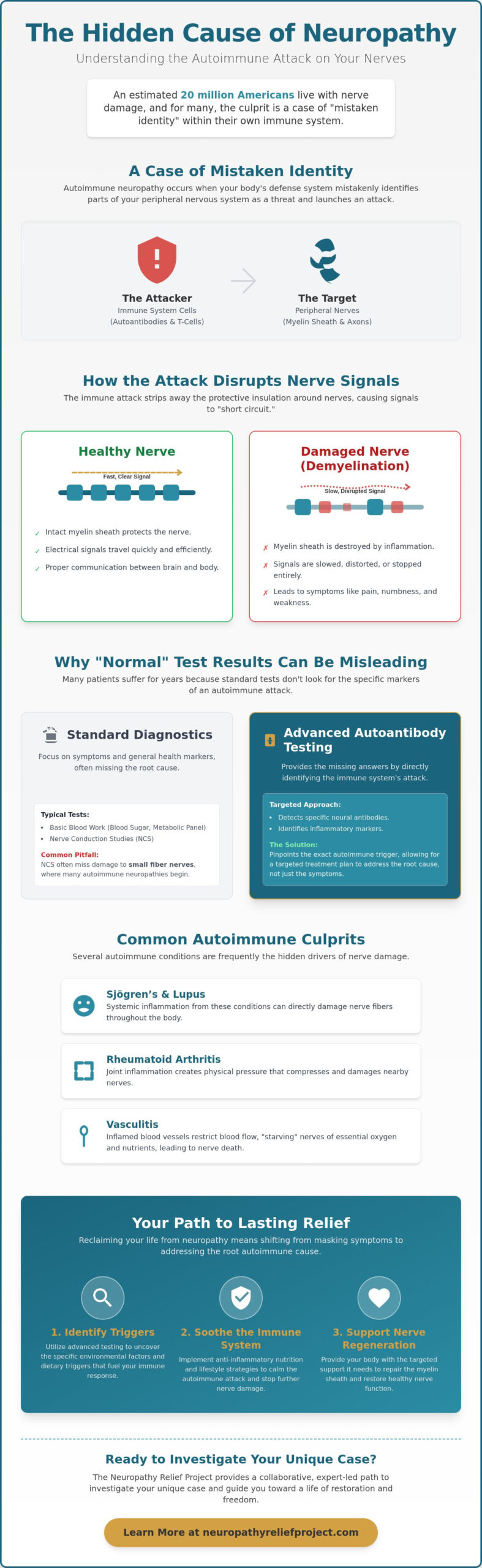
If you experience a persistent, burning sensation in your feet or a sudden weakness in your limbs, your immune system may be misidentifying your own tissue as a threat. Autoimmune neuropathy occurs when your body’s natural defense system suffers from a case of mistaken identity. Instead of neutralizing viruses or bacteria, your antibodies begin to attack the peripheral nervous system, specifically targeting the myelin sheath or the axons that carry electrical signals. This immune-mediated damage disrupts the vital communication between your brain and your body, leading to the debilitating symptoms that characterize nerve dysfunction.
The severity and speed of these attacks vary significantly between patients. Some individuals face acute conditions like Guillain-Barré Syndrome, which can cause rapid paralysis within days. Others struggle with chronic conditions such as Chronic Inflammatory Demyelinating Polyneuropathy (CIDP), where the damage accumulates over several months or years. These autoimmune neuropathy links are frequently overlooked in standard primary care screenings. Most routine blood tests focus on blood sugar or basic metabolic functions, often failing to detect the specific neural antibodies or inflammatory markers that signal an immune system in crisis.
The Biological Mechanism of Nerve Attack
The destruction begins when specialized white blood cells, known as T-cells, and pro-inflammatory proteins called cytokines gather at nerve sites. Under normal conditions, the Blood-Nerve Barrier (BNB) acts as a strict security gate, protecting your nerves from harmful substances in the circulation. However, during an autoimmune flare, this barrier breaks down, allowing aggressive immune cells to flood the nerve environment and trigger intense inflammation. Demyelination is the stripping of the protective fatty insulation that surrounds your nerve fibers. Without this insulation, your nerves “short circuit,” resulting in the tingling, numbness, and loss of motor control that define your daily struggle.
Why Autoimmune Links Matter for Your Recovery
Understanding the specific autoimmune neuropathy links in your case is the first step toward reclaiming your quality of life. If you only treat the symptom, such as using prescription painkillers to mask the burning, you aren’t stopping the underlying immune trigger. This approach is temporary and allows the immune system to continue its progressive destruction of your nerve health. Identifying the specific link is essential to prevent permanent disability and to shift your body from a state of attack to a state of restoration.
Many patients are told their condition is “idiopathic,” a clinical term meaning the cause is unknown. In reality, research into idiopathic neuropathy causes suggests that a significant portion of these “unknown” cases are actually driven by undiagnosed autoimmune activity. By uncovering these hidden triggers, we can move past the frustration of traditional medicine and begin a targeted protocol designed to revitalize your cellular health and provide lasting relief.
Common Autoimmune Conditions Linked to Peripheral Nerve Damage
If you’ve spent years searching for the cause of your burning feet or numb hands, you aren’t alone. Understanding the autoimmune neuropathy links is a critical step toward reclaiming your health. When your immune system becomes overactive, it mistakenly identifies healthy nerve tissue as a foreign threat. This internal conflict leads to the degradation of the protective myelin sheath or the nerve fibers themselves, resulting in the chronic pain you feel every day.
At the Neuropathy Relief Project, we recognize that several specific autoimmune conditions are frequently the hidden culprits behind this damage. For instance, Rheumatoid Arthritis affects roughly 1.3 million Americans. In these cases, joint inflammation doesn’t just cause stiffness; it creates physical pressure that compresses nearby nerves. Similarly, Vasculitis involves inflamed blood vessels that effectively “starve” nerves of oxygen and vital nutrients. This lack of blood flow leads to rapid nerve death if the underlying inflammation isn’t managed. Even Celiac Disease shows a surprising connection, as about 10% of people with gluten sensitivity experience neurological symptoms, often without any digestive distress at all.
For a broader look at how these conditions fit into the wider spectrum of nerve health, the Peripheral Neuropathy Information Page provides essential context for understanding these complex interactions.
Sjögren’s and Small Fiber Neuropathy
Sjögren’s Syndrome is the most frequent autoimmune driver of small-fiber neuropathy. Research indicates that 10% to 15% of patients feel nerve burning or tingling before they ever notice dry eyes or a dry mouth. Because standard EMGs often miss damage to these tiny nerve fibers, doctors typically require a skin punch biopsy to confirm the loss of nerve endings. Many patients suffer for 5 to 7 years without an accurate diagnosis, treating only the “nerve pain” while the underlying immune attack continues to progress.
Lupus and Systemic Nerve Involvement
Systemic Lupus Erythematosus (SLE) causes widespread inflammation that targets both central and peripheral nerves. If you feel “Lupus Fog” alongside peripheral tingling, these are often two sides of the same coin. Sensory-focused symptoms like freezing or burning sensations are common in Lupus patients. It’s also vital to monitor for “Toxic Neuropathy Triggers,” as certain medications used to manage Lupus can occasionally stress the nerves. Identifying these autoimmune neuropathy links allows for a more targeted approach to cellular health and recovery.
We believe that identifying these triggers is the first step toward long-term relief and freedom from pain. You can learn more about our approach to restoring nerve function through our specialized protocols designed to revitalize your nervous system.
The “Invisible” Connection: Autoantibodies and Small Fiber Nerves
If you’ve ever walked out of a neurologist’s office feeling more confused than when you entered, you aren’t alone. One of the most common frustrations for patients is receiving a “normal” result on a Nerve Conduction Study (NCS) or Electromyography (EMG) while still suffering from excruciating burning or tingling. This happens because these standard tests only evaluate your large, myelinated nerve fibers. These are the “heavy hitters” responsible for muscle strength and balance. They don’t see the small fiber nerves that transmit pain and temperature signals to your brain.
The emotional toll of having invisible nerve damage is heavy. When a clinical test fails to catch the source of your distress, it can feel like your symptoms are being dismissed. However, the pain you feel is a biological reality. In many cases, the immune system produces specific autoantibodies, such as TS-HDS (trisulfated heparin disaccharide) or FGFR3 (fibroblast growth factor receptor 3), which specifically target and degrade these small fibers. Understanding these autoimmune neuropathy links is often the first step toward regaining control of your life.
When Standard Tests Fail
Large fiber nerves and small fiber nerves serve different roles. If you experience weakness or a loss of coordination, your large fibers are likely involved. If you feel “pins and needles,” burning, or extreme sensitivity to touch, the damage is often localized in the small fibers. Research from 2020 suggests that 50% of neuropathy cases previously labeled as “idiopathic” actually have an underlying autoimmune basis. When exploring Common Autoimmune Conditions Linked to Peripheral Nerve Damage, we see how the body’s defenses can mistakenly identify nerve tissue as a threat. It’s also helpful to screen for toxic neuropathy triggers that might be aggravating your immune system’s hyper-reactive state.
Specialized Testing for Autoimmune Links
To bridge the gap left by standard testing, we look to more sophisticated diagnostics. The Washington University (WashU) neuropathy panel is a specialized blood test that identifies specific autoantibodies linked to small fiber damage. Another gold-standard tool is the skin punch biopsy. This simple procedure allows a pathologist to count the number of nerve endings in a small sample of skin. By quantifying your epidermal nerve fiber density, we can confirm the presence of neuropathy even when an NCS is perfect. These results provide the clarity needed to shift your recovery program from temporary symptom management to targeted cellular restoration. Identifying these autoimmune neuropathy links through data ensures you are no longer guessing about the cause of your pain.
Managing Inflammation and Supporting Nerve Health
If you’re experiencing a relentless burning sensation or the feeling of “pins and needles” in your feet, your body is likely caught in a state of chronic inflammation. Understanding the autoimmune neuropathy links means recognizing that your immune system is currently misidentifying your own nerve tissue as a threat. To find lasting relief, we must shift the internal environment from one of attack to one of repair. This starts with calming the systemic fire that fuels nerve damage.
Damaged nerves require specific conditions to heal. When the immune system is hyper-reactive, it creates a toxic soup of cytokines that prevents nerve regeneration. By utilizing non-invasive protocols, such as photobiomodulation or targeted electrotherapy, we can stimulate the production of adenosine triphosphate (ATP) within the cells. This cellular fuel is what allows a damaged nerve to begin the slow process of rebuilding its structure. Hydration plays a vital role here too. Nerves rely on a precise balance of electrolytes like magnesium and potassium to send signals. Even a 2% drop in cellular hydration can increase the intensity of nerve pain and lead to more frequent misfiring.
Anti-Inflammatory Protocols for Nerve Relief
Your diet is the most powerful tool for modulating your immune response. Nutrients like Omega-3 fatty acids are essential because they help rebuild the myelin sheath, the protective coating that insulates your nerves. Research indicates that high-quality Omega-3 supplementation can reduce C-reactive protein, a key marker of inflammation, by as much as 30%. We also focus on B-complex vitamins, specifically B12 and B6, which act as the building blocks for nerve repair.
Many patients don’t realize that their gut health is directly tied to their nerve pain. A condition known as “leaky gut” allows undigested food particles and toxins to enter the bloodstream, which keeps the immune system on high alert. This constant state of readiness is a primary driver of the autoimmune neuropathy links that cause symptom flares. Because of this, any effective peripheral neuropathy reversal program must prioritize gut health and systemic inflammation to be successful.
Lifestyle Adjustments to Reduce Immune Stress
Stress is a physical trigger for nerve pain. When you’re under chronic stress, your body pumps out cortisol. While cortisol is meant to be anti-inflammatory in short bursts, long-term high levels actually dysregulate the immune system and can lead to a “flare” of autoimmune activity. Managing your nervous system is just as important as managing your nerves. Consider these daily habits to support your recovery:
- Gentle Movement: Walk for 15 minutes at a steady pace. This increases blood circulation to your extremities by approximately 20%, delivering vital oxygen to starving nerve endings.
- Environmental Awareness: If you have numbness, check your limbs twice daily for small cuts or blisters. Since you can’t feel the injury, a small wound can lead to an infection that triggers a massive immune response.
- Temperature Control: Avoid extreme heat or cold, as sudden temperature shifts can shock sensitive nerves and provoke a pain cycle.
By addressing these environmental and internal triggers, you take the pressure off your immune system. This creates the space necessary for your body to move out of survival mode and into a restorative phase. If you’re ready to take the next step in your recovery, explore our comprehensive guide to choosing a reversal program today.
Navigating Your Recovery Path with the Neuropathy Relief Project
If you have spent years chasing symptoms without finding the source, you aren’t alone. The autoimmune neuropathy links that connect your immune system to your nervous system are complex; they often involve multiple biological pathways that traditional protocols overlook. We don’t just treat the surface-level burning or numbness. We look for the specific triggers that keep your body in a state of self-attack. Our mission is to move you beyond temporary symptom management toward the genuine restoration of function.
A Mission-Driven Approach to Nerve Health
Dr. Michael Sclafani established the Neuropathy Relief Project to bridge the gap between natural healing and clinical science. We view your recovery as a collaborative mission rather than a standard clinical transaction. Because autoimmune issues are systemic, we focus on identifying your specific triggers through a comprehensive review of your health history. We prioritize non-invasive care that supports your body’s innate ability to heal. This isn’t about masking pain with medication. It’s about achieving liberation from the constant weight of chronic nerve damage. Our philosophy centers on three core pillars:
- Individualized Investigation: We analyze the specific autoimmune neuropathy links unique to your biology.
- Cellular Support: We focus on the health of the nerve cell to encourage natural regeneration.
- Empathetic Advocacy: We act as your guide through a medical system that often leaves patients feeling dismissed.
Your Next Step: The 15-Minute Discovery Call
Finding a path forward in a fragmented medical system feels exhausting, especially if you have already consulted 3 or 4 different specialists without relief. You deserve a dedicated advocate who listens to your story and understands the daily frustration of living with limited mobility. During our free 15-minute consultation, we review your current symptoms and health history to determine if our specific protocols fit your needs. It’s a low-pressure environment designed to provide clarity and hope.
Prepare your unanswered questions before the call. Are you struggling with balance? Does the tingling in your feet keep you awake at night? We’ll discuss these realities openly. If we determine you’re a candidate for our program, we’ll outline a clear, methodical strategy to revitalize your cellular health. You can Schedule your 15-Minute FREE phone Consultation today to begin your journey toward recovery. This is your opportunity to move from a state of constant pain to a life of renewed freedom and function.
Take the Next Step Toward Lasting Nerve Relief
If you’re struggling with the persistent burning, tingling, or numbness that defines nerve damage, understanding the autoimmune neuropathy links is a vital first step toward reclaiming your quality of life. Research identifies that when the immune system mistakenly produces autoantibodies, it can lead to significant damage in both large and small fiber nerves. This often results in a diagnosis of “idiopathic” neuropathy, leaving many patients feeling lost in a cycle of temporary fixes. At the Neuropathy Relief Project, led by Dr. Michael J. Sclafani, DC, we specialize in these complex cases by utilizing non-invasive protocols that prioritize cellular health and nerve regeneration.
Our mission-driven “Project” approach moves beyond traditional medicine’s limitations to address the root causes of inflammation. We focus on providing a clear, scientific path for those who’ve felt dismissed by the standard healthcare system. By combining clinical authority with compassionate advocacy, we help you navigate the nuances of your specific condition. You don’t have to accept chronic pain as your permanent reality. It’s time to shift your focus from simply managing symptoms to actively revitalizing your health. Book your 15-minute FREE phone Consultation to discuss your nerve symptoms and start your journey toward recovery today. You have the strength to heal, and we’re here to guide you every step of the way.
Frequently Asked Questions
Can an autoimmune disease cause peripheral neuropathy?
Yes, an autoimmune disease can cause peripheral neuropathy when your immune system mistakenly identifies nerve proteins as foreign invaders. In these cases, the body’s natural defenses attack the myelin sheath or the axon itself. Research published in the Journal of Neurology, Neurosurgery & Psychiatry indicates that 20% of chronic inflammatory neuropathies have a primary autoimmune trigger. Understanding these autoimmune neuropathy links is the first step toward reclaiming your cellular health and finding lasting relief.
What autoimmune diseases are most commonly linked to nerve damage?
Systemic Lupus Erythematosus (SLE), Rheumatoid Arthritis (RA), and Sjögren’s Syndrome are the most frequent culprits. According to the Johns Hopkins Vasculitis Center, 15% of patients with SLE develop some form of peripheral nerve damage. Sjögren’s Syndrome is particularly aggressive; studies show that 10% to 20% of patients experience sensory symptoms like burning or tingling before they even receive a formal diagnosis. These conditions require a specialized approach to protect your nerve fibers from further erosion.
Why do my nerves hurt if my autoimmune blood tests are normal?
Standard blood panels often fail to detect specific autoantibodies that target the peripheral nervous system. If you experience burning or numbness but your ANA (Antinuclear Antibody) test is negative, you might have “seronegative” neuropathy. A 2021 study in the journal Brain found that 30% of patients with autoimmune-mediated nerve damage don’t show markers on routine screens. This is why the Neuropathy Relief Project looks deeper into the clinical symptoms rather than relying solely on basic lab results.
Is autoimmune neuropathy reversible?
Recovery is possible through nerve regeneration and targeted clinical protocols that halt the immune attack. While damage to the nerve cell body is permanent, the peripheral nerves have a unique ability to heal their protective coating. Clinical data from the GBS/CIDP Foundation International shows that 80% of patients with acute autoimmune triggers like Guillain-Barré Syndrome achieve a full or near-full recovery within 12 months when treatment begins early. We focus on this potential for restoration to help you find your path back to freedom.
What is the difference between CIDP and regular peripheral neuropathy?
Chronic Inflammatory Demyelinating Polyneuropathy (CIDP) is a specific, chronic autoimmune condition, while peripheral neuropathy is a broad term for any nerve damage. CIDP specifically targets the myelin sheath, which is the insulation around your nerves. While regular neuropathy might stem from 100 different causes like diabetes or vitamin deficiencies, CIDP is strictly immune-mediated. It requires specialized IVIG or plasma exchange therapies to revitalize the communication between your brain and your limbs.
How can I tell if my nerve pain is caused by inflammation?
Inflammatory nerve pain typically presents with sudden flares, redness, or a sensation of intense heat in the affected limbs. If you experience symptoms that fluctuate in intensity or migrate between different areas of the body, inflammation is a likely driver. The Neuropathy Relief Project emphasizes tracking these patterns; a 2019 report in Frontiers in Immunology notes that C-reactive protein (CRP) levels above 3.0 mg/L often correlate with heightened neuropathic pain. Identifying these spikes is crucial for your recovery.
What should I ask my doctor if I suspect an autoimmune neuropathy link?
You should ask for a comprehensive Neuropathy Panel that includes tests for Ganglioside antibodies (GM1, GD1a) and a skin biopsy for small fiber density. Many general practitioners only run basic glucose tests, missing the underlying autoimmune neuropathy links that drive your discomfort. Requesting a referral to a neuromuscular specialist can reduce your diagnosis time by an average of 14 months, according to data from the American Academy of Neurology. Don’t let your symptoms be dismissed by standard testing.
Can lifestyle changes help manage autoimmune-related nerve pain?
Yes, specific lifestyle adjustments can significantly revitalize your nervous system by lowering the body’s overall inflammatory load. Adopting a Mediterranean-style diet has been shown to reduce inflammatory markers by 20% in clinical trials. At the Neuropathy Relief Project, we combine these natural strategies with scientific evidence to help you move away from frustration. By focusing on cellular health and clean nutrition, you can create an internal environment that supports long-term nerve repair and reduces daily pain levels.