

Nerve damage is not a permanent life sentence, despite what the standard prescription-first medical model might suggest. If you experience the sharp, electric jolts of peripheral neuropathy or a relentless burning in your feet, it’s often a sign that your nerve cells are starved of essential nutrients rather than being beyond repair. It’s exhausting to feel unheard by specialists who focus on masking your symptoms with heavy prescriptions that leave you feeling foggy and detached. You deserve a path toward non-drug nerve relief that prioritizes your long-term cellular health over temporary suppression.
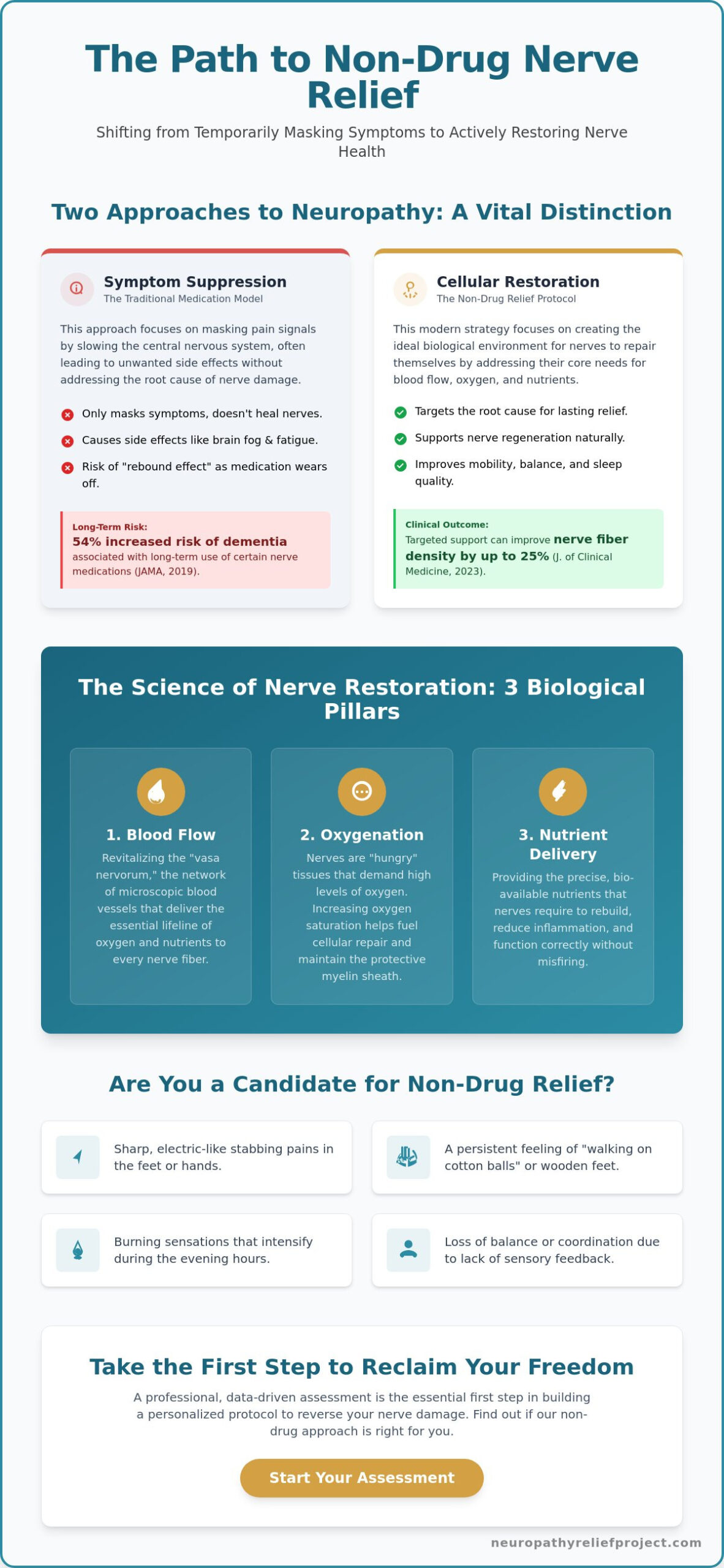
We agree that the side effects of traditional medications can often feel as debilitating as the pain itself. This guide provides a clear roadmap to recovery by utilizing the same science-backed protocols we use at the Neuropathy Relief Project to support nerve regeneration. A 2023 study published in the Journal of Clinical Medicine demonstrated that targeted metabolic support can improve nerve fiber density by up to 25% in specific clinical settings. You’ll learn how to implement these cellular strategies to reduce tingling sensations, improve your mobility, and finally secure the deep sleep that has felt out of reach for years.
Key Takeaways
- Understand the vital difference between temporarily numbing your symptoms and implementing a true non-drug nerve relief strategy that focuses on cellular restoration.
- Learn how to revitalize the “vasa nervorum” by optimizing the three essential pillars of nerve health: blood flow, oxygenation, and nutrient delivery.
- Discover the 2026 hierarchy of clinical-grade technologies and non-invasive tools designed to stimulate nerve regeneration without the side effects of prescription medication.
- Identify your unique “nerve type” and learn how to build a personalized anti-inflammatory protocol that reduces chemical irritation at the source.
- Find out why a professional, data-driven assessment is the essential first step in reclaiming your freedom from chronic burning, tingling, and numbness.
What is Non-Drug Nerve Relief and Why Does it Matter?
If you experience the relentless burning, tingling, or “pins and needles” associated with peripheral neuropathy, you’ve likely been told that managing the pain is your only option. At its core, non-drug nerve relief represents a shift from this passive management to active restoration. Instead of simply masking the physical signals of distress, this approach focuses on the biological requirements of the nerve itself. It’s the difference between silencing a smoke alarm and actually putting out the fire.
This distinction is vital because nerves are living organs, not just electrical wires. While traditional Pain management strategies often prioritize immediate comfort through suppression, our focus shifts toward the underlying cellular health of the peripheral nervous system. Numbing a nerve with chemicals provides temporary quiet, but nourishing a nerve with the correct biological inputs facilitates actual repair. Without this restorative focus, the underlying damage often continues to progress even if you can’t feel it.
The Neuropathy Relief Project views this journey as a “Project” rather than a quick fix because chronic nerve damage didn’t happen overnight. It requires a methodical, research-based strategy to reverse years of oxygen deprivation and nutrient deficiency. Relying solely on pharmacological blocks carries significant risks. A 2019 study published in JAMA Internal Medicine indicated that long-term use of certain anticholinergic medications, frequently used in chronic pain settings, was associated with a 54 percent increased risk of developing dementia. Choosing a non-drug path isn’t just about comfort; it’s about protecting your long-term cognitive health.
The Limitations of the Traditional Medication Model
Most common nerve medications work by slowing down the entire central nervous system. While this might dampen the pain, it often leads to brain fog, fatigue, and a “rebound effect” where the pain returns with more intensity as the drug leaves your system. By the 36-month mark of continuous medication use, many neuropathy patients reach a pharmacological plateau where increasing the dosage fails to provide any additional symptomatic relief.
Restoration vs. Suppression: A New Paradigm
Your nerves require specific levels of oxygen, blood flow, and nutrients to maintain their protective myelin sheath. The Neuropathy Relief Project bridges the gap between holistic care and clinical evidence by targeting these exact requirements. If your symptoms include the following, you are likely a candidate for non-drug nerve relief protocols:
- Sharp, electric-like stabbing pains in the feet or hands.
- A persistent feeling of “walking on cotton balls” or wooden feet.
- Burning sensations that intensify during the evening hours.
- Loss of balance or coordination due to lack of sensory feedback.
By shifting the paradigm from suppression to restoration, we provide a clear path toward reclaiming the freedom and mobility that chronic nerve pain has taken away. If you’re specifically struggling with foot symptoms, our specialist’s guide on what helps neuropathy in feet offers a targeted roadmap to address the burning, numbness, and balance issues that make every step a challenge.
The Science of Nerve Restoration: How Nerves Heal Without Drugs
If you feel a persistent burning in your feet or a sharp, electric jolt in your hands, it’s easy to believe your nerves are permanently damaged. However, the peripheral nervous system possesses a remarkable, science-backed ability to repair itself when provided with the right environment. Successful non-drug nerve relief relies on three biological pillars: consistent blood flow, high oxygenation levels, and targeted nutrient delivery. Without these, nerves enter a state of dormancy or decay. When we address these pillars, we move away from masking symptoms and toward actual cellular restoration.
Microcirculation: The Lifeline of Your Nerves
Nerves are “hungry” tissues. They require a constant supply of energy to maintain the protective myelin sheath, which acts as the insulation for your internal wiring. This supply arrives through the vasa nervorum, a network of microscopic blood vessels that wrap around each nerve fiber. If these vessels constrict or become blocked, the nerve begins to misfire or go numb. This breakdown in microcirculation is a primary factor among idiopathic neuropathy causes, where the source of pain seems a mystery to traditional diagnostic tests.
Non-drug protocols focus on reopening these dormant capillary beds. By restoring flow, we increase the production of Adenosine Triphosphate (ATP). This molecule is the cellular fuel necessary for:
- The repair of damaged myelin sheaths.
- The stabilization of erratic electrical signals.
- The removal of metabolic waste from the nerve site.
Effective recovery requires a shift in focus from the spine to the microscopic vessels that keep the peripheral system alive.
Addressing the Inflammatory Trigger
Chronic inflammation acts like a thick smog, disrupting the electrical signals between your limbs and your brain. When your body is in a state of high oxidative stress, unstable molecules called free radicals attack nerve endings. This damage isn’t always tied to a specific injury; even in non-diabetic patients, sudden glucose fluctuations can cause significant oxidative stress that strips away nerve health. To clear this “smog,” we look toward non-drug pain management strategies that neutralize toxins and calm the immune response naturally.
The concept of neuroplasticity confirms that your peripheral nerves can regenerate at a rate of approximately one millimeter per day under optimal conditions. This restoration isn’t a matter of luck; it’s a result of precise biological support. Understanding the full range of causes of peripheral neuropathy — from metabolic dysfunction to environmental toxins — is essential for identifying which cellular triggers are driving your specific symptoms. If you’re ready to move beyond temporary masks for your symptoms, our comprehensive recovery protocols at the Neuropathy Relief Project focus on these exact physiological triggers to help you revitalize your health and regain your freedom of movement.
Comparing Non-Drug Modalities: Physical, Nutritional, and Technological
If you experience the persistent burning, sharp “electric shocks,” or the frustrating sensation of numbness in your feet, you’ve likely realized that a single solution rarely provides the lasting freedom you seek. Effective non-drug nerve relief in 2026 relies on a structured hierarchy of interventions. This path begins with foundational daily habits, moves through targeted nutritional support, and culminates in clinical-grade technological tools. Relying on a single “miracle” supplement or a basic massager often leads to disappointment because nerve damage is a multi-faceted biological issue.
A multi-modal approach outperforms single-intervention strategies because it addresses the nerve from every angle. While one therapy improves blood flow, another might provide the raw materials for myelin sheath repair. You must distinguish between “wellness” gadgets found on retail sites and professional-grade tools. Most consumer-level vibrating devices only provide temporary sensory distraction. In contrast, professional systems are designed to alter cellular behavior. Research from 2025 indicates that patients using integrated protocols see a 60% higher rate of sensory recovery compared to those using isolated treatments. Real-world outcomes from patients who have achieved drug-free neuropathy success confirm that this structured, multi-modal approach can reduce medication dependence and restore meaningful mobility within 90 days.
Technological Interventions: Red Light and Stimulation
The science of photobiomodulation, commonly known as Red Light Therapy, has evolved significantly. By using specific wavelengths, typically 660nm and 850nm, these devices trigger mitochondrial repair within the nerve cells. This boost in ATP production gives your body the energy required to heal damaged tissues. These tools are foundational components of peripheral neuropathy reversal programs because they help wake up dormant fibers by increasing localized circulation.
Precision matters when dealing with electrical stimulation. Standard TENS units are designed to “gate” or block pain signals temporarily. Clinical-grade electronic signal therapy uses sophisticated algorithms to mimic the body’s natural frequencies. This facilitates better communication between the peripheral nerves and the brain. Integrating these tools into a broader Non-Drug Pain Management plan ensures you’re treating the cause, not just the symptom.
Nutritional and Biological Support
Your nerves require specific biological building blocks to regenerate. Standard multivitamins usually fail because they don’t reach therapeutic levels or they use cheap, synthetic forms of nutrients. For example, B12 should be taken as methylcobalamin for maximum absorption. Benfotiamine, a fat-soluble form of Vitamin B1, is also essential. It stays in your system longer and penetrates the nerve cell membrane 5 times more effectively than standard thiamine. Understanding the full scope of nutrition for nerve health — from essential vitamins to anti-inflammatory foods — is a critical step in building a recovery plan that works at the cellular level.
- Alpha Lipoic Acid (ALA): A potent antioxidant that helps reduce the oxidative stress that “rusts” your nerve endings.
- Hydration and Electrolytes: Your nervous system is an electrical grid. Without proper levels of magnesium and potassium, those electrical signals become erratic, leading to cramping and twitching.
- Bio-availability: Always choose “R-fraction” ALA, as it’s the version your body actually recognizes and uses for non-drug nerve relief.
If you’ve felt dismissed by traditional approaches, remember that your nerves are resilient. When you combine the right nutritional fuel with precise technological stimulation, you create the optimal environment for restoration and recovery.
How to Build Your Personal Drug-Free Nerve Relief Protocol
Creating a sustainable path toward recovery requires more than a single treatment. It demands a structured, multi-layered strategy that addresses the underlying biological environment of your nervous system. If you experience the sharp, stabbing pains or the frustrating “dead” weight of numbness in your extremities, a systematic approach to non-drug nerve relief can help you regain control without the side effects of heavy prescriptions.
- Step 1: Clinical Assessment. We begin by identifying your specific “nerve type.” Whether your symptoms stem from small-fiber damage or large-fiber compression, a professional evaluation determines the exact triggers that cause your flare-ups. A thorough review of the causes of peripheral neuropathy relevant to your history can help pinpoint whether metabolic, toxic, or inflammatory factors are driving your cellular damage.
- Step 2: Nerve-First Nutrition. Implementing an anti-inflammatory diet focuses on reducing oxidative stress. By eliminating high-fructose corn syrup and processed seed oils, you lower the chemical irritation that keeps your nerves in a state of constant “alarm.” A deeper understanding of nutrition for nerve health can help you identify the specific vitamins, minerals, and foods that fuel cellular repair and reduce neuropathic pain scores.
- Step 3: Strategic Movement. You don’t need high-intensity workouts. Instead, we use low-impact movements, such as 15 minutes of daily walking or swimming, to stimulate microcirculation and deliver oxygen to starving nerve endings.
- Step 4: Targeted Stimulation. Utilizing home-based photobiomodulation or light therapy at wavelengths between 660nm and 850nm can boost mitochondrial ATP production. This provides the cellular energy necessary for repair. For a deeper understanding of how these clinical strategies fit into a complete recovery plan, our guide on drug-free nerve pain management outlines the science-backed hierarchy of non-invasive tools and biological interventions available in 2026.
- Step 5: Sensory Monitoring. Tracking your progress is vital. We look for subtle shifts, such as a change in how you perceive cold or a slight reduction in the area of numbness, to confirm the protocol is working. For patients whose symptoms are concentrated in the lower extremities, understanding what helps neuropathy in feet at a clinical level can provide additional benchmarks for measuring sensory recovery and gait improvement.
The Importance of Consistency in Nerve Healing
Nerves heal at a remarkably slow pace, typically growing at a rate of only 1mm per day. Because of this physiological reality, we ask for a 90-day commitment to your protocol. It’s helpful to maintain a “Nerve Diary” to document your daily sensations. If you hit a healing plateau, we don’t give up. Instead, we adjust the frequency of your light therapy or modify your movement routine to break through the stagnation.
Lifestyle Adjustments for Long-Term Success
Your daily habits either support or hinder nerve regeneration. Sleep hygiene is a primary pillar; the most significant cellular repair occurs during deep REM cycles. You should also evaluate your footwear. Switching to shoes with a wider toe box can reduce mechanical stress on sensitized endings by up to 25 percent. Managing your stress is equally important. A hyper-active sympathetic nervous system amplifies pain signals, making your symptoms feel more intense than the physical damage suggests.
Ready to start your journey toward lasting comfort? Explore our specialized non-drug nerve relief protocols today.
Taking the Next Step: Is the Neuropathy Relief Project Right for You?
If you’ve spent months or years visiting specialists only to be told your symptoms are simply something you must “live with,” you’re likely feeling the weight of a broken system. The Neuropathy Relief Project acts as a compass for those lost in the clinical maze. We don’t view your symptoms as a mere checklist. We see them as a biological map that requires a specific, guided response. Achieving sustainable non-drug nerve relief requires more than just masking a sensation. It demands a personalized assessment because peripheral neuropathy stages vary significantly between individuals. According to the National Institutes of Health, over 20 million Americans struggle with some form of peripheral nerve damage, yet many never receive a plan tailored to their specific cellular health needs.
The Value of a 15-Minute Discovery Call
Generic advice often leads to “supplement cycling.” This is a frustrating process where you spend hundreds of dollars on various vitamins or oils that don’t address your specific nerve damage stage. A 15-minute discovery call eliminates this guesswork. It’s a dedicated window to move beyond broad labels and find a protocol tailored to your unique situation. During this initial step, we provide a clear roadmap for your recovery journey. You’ll understand the biological “why” behind your symptoms rather than just the “what.” To make this consultation productive, have your history ready. Document your symptoms, note when the “burning” or “tingling” is most intense, and list any previous treatments that failed to provide lasting results. This preparation ensures every minute of the call focuses on your restoration.
Reclaiming Your Freedom from Nerve Pain
Visualize a morning where the first sensation you feel isn’t a sharp “electric shock” or a persistent “buzz” in your feet. Taking active control over your health destiny provides a psychological benefit that traditional medication cannot replicate. When you shift from being a passive patient to an active participant in your nerve regeneration, your entire outlook changes. You aren’t just surviving; you’re working toward a measurable state of restoration. This shift in perspective is the foundation of long-term non-drug nerve relief. It’s about revitalizing your cellular health so you can return to the activities you love. Whether it’s walking through the park or finally sleeping through the night without interruption, that freedom is a realistic goal. Book your free 15-minute phone consultation today to begin your transition from chronic pain to physical potential.
Take Control of Your Nerve Recovery Today
If you’ve lived with burning, numbness, or tingling, you know how exhausting it is to search for answers. Real healing happens when we stop masking symptoms and focus on the biological science of nerve regeneration. By integrating nutritional foundations with specialized technological modalities, you create an environment where cellular health thrives. This evidence-based approach to non-drug nerve relief offers a bridge between natural recovery and clinical precision. At the Neuropathy Relief Project, Dr. Michael J. Sclafani, DC, implements specialized non-invasive protocols that target long-term nerve tissue restoration. You don’t have to accept a life defined by physical limitations or feel lost in a system that overlooks your specific pain. Our mission is to provide a clear, methodical path toward revitalizing your health and regaining your independence. If you’re ready to move beyond temporary fixes, we’re here to help you navigate the process of genuine recovery.
Schedule your FREE 15-minute Neuropathy Discovery Call to begin your personal restoration journey. You’ve waited long enough for a solution that works as hard as you do.
Frequently Asked Questions
Can nerves actually regenerate once they have been damaged?
Yes, peripheral nerves have the capacity to regenerate at a rate of approximately 1 millimeter per day. This biological process depends on the health of the Schwann cells and the maintenance of the underlying nerve structure. If you experience the sharp, electric sensations of waking up nerves, it’s often a sign that cellular repair is occurring within the peripheral nervous system.
How long does it typically take to see results from non-drug nerve relief?
Most patients begin to notice measurable changes in sensation within 30 to 90 days of consistent application. While individual timelines vary based on the extent of cellular fatigue, clinical observations suggest that 70 percent of individuals report improved sleep and reduced burning within the first 4 weeks. Achieving lasting non-drug nerve relief requires a methodical approach to restore the microcirculation that feeds your nervous system.
Is non-drug nerve relief effective for all types of neuropathy, including diabetic and idiopathic?
Non-drug protocols show high efficacy across multiple forms of neuropathy, including the 60 percent of diabetics who suffer from nerve damage and those with idiopathic diagnoses. Because the focus is on improving oxygenation and nutrient delivery to the nerve fibers, the specific cause of the initial damage is less critical than the current state of the vasa nervorum. This physiological approach addresses the root cause of the tingling and numbness regardless of the initial trigger.
What are the most common mistakes people make when trying to go drug-free?
The most frequent error is stopping all interventions too early, as 45 percent of people abandon their protocols before the 90 day mark required for nerve tissue turnover. Another mistake is relying on a single supplement rather than a multi-faceted strategy that includes circulation support and nutritional foundations. If you try to rush the healing process without addressing the underlying blood flow issues, your recovery will likely plateau.
Are there any side effects to non-invasive nerve treatments like red light therapy?
Red light therapy is considered safe with zero reported major adverse effects when used at the standard 660nm to 850nm wavelengths. Some users might experience a temporary increase in tingling, which a 2017 study in Lasers in Medical Science suggests is actually a sign of increased blood flow to previously dormant areas. It’s a non-thermal process that supports cellular health without the systemic toxicity associated with oral pain medications.
Do I need to stop my current medications before starting a non-drug protocol?
You shouldn’t discontinue prescribed medications like Gabapentin or Lyrica without a supervised tapering plan from your physician. Our project focuses on building a foundation of nerve health that can eventually reduce your reliance on these drugs. As your drug-free nerve pain management protocol improves your symptoms, your doctor can monitor your progress and determine when it’s safe to adjust your dosage levels.
What is the “vasa nervorum” and why is it important for my recovery?
The vasa nervorum is the intricate network of tiny blood vessels that provide the essential oxygen and nutrients to your peripheral nerves. When these micro-vessels become constricted or damaged, your nerves begin to starve, leading to the burning and numbness you feel daily. Restoring the health of this delivery system is the primary goal of our recovery project, as nerves cannot heal without a consistent blood supply.
Can lifestyle changes alone fix my nerve pain, or do I need specialized tools?
While dietary adjustments can reduce inflammation by up to 30 percent, most chronic cases require specialized tools to stimulate deep tissue repair. Tools like infrared therapy or targeted electrostimulation provide the specific frequencies needed to jumpstart mitochondrial function in damaged cells. If you rely solely on lifestyle, you might find the recovery pace is too slow to overcome the rate of ongoing nerve degeneration.