

What if the agonizing sensation of walking on shards of broken glass isn’t a permanent life sentence, but a signal that your peripheral nerves are starving for the right biological environment to repair? If you spend your nights pacing the floor to escape a searing burning flare or feel as though you’re stepping on cotton wool, you’ve likely felt dismissed by standard medical advice. You are searching for what helps neuropathy in feet because you deserve a solution that addresses underlying cellular health rather than just masking the pain with a pill.
At the Neuropathy Relief Project, we understand that the fear of losing your balance and falling can feel just as heavy as the physical pain itself. This guide delivers a comprehensive roadmap to recovery based on 2026 clinical insights; it offers a clear path toward a 50% reduction in daily discomfort and significantly improved gait stability. You’ll discover how specific restorative exercises and advanced non-drug protocols can actually support nerve regeneration. We’ll break down the exact lifestyle shifts and scientific treatments that help revitalize damaged nerves so you can reclaim your mobility and your sleep.
Key Takeaways
- Learn to decode the burning and tingling sensations in your lower extremities to better understand the biological root of your peripheral nerve damage.
- Discover how simple environmental adjustments and temperature regulation can provide immediate comfort and protect your feet from injury.
- Explore specific, low-impact movements designed to stimulate blood flow and provide a scientific answer to what helps neuropathy in feet without straining your joints.
- Understand why traditional medications often fail and how shifting your focus from masking pain to supporting nerve regeneration can lead to lasting restoration.
- Gain a clear, expert-led roadmap from the Neuropathy Relief Project that moves beyond temporary symptom management toward addressing long-term cellular health.
Understanding the ‘Why’ Behind Foot Neuropathy Symptoms
If you’ve ever felt like you’re walking on shards of glass while sitting perfectly still, you understand the deep frustration of nerve damage. This condition, specifically when it targets your lower extremities, involves a breakdown of the peripheral nervous system. To get a comprehensive overview of peripheral neuropathy, one must look at how the nerves in the feet are the longest and most vulnerable in the entire body. Neuropathy is a malfunction of the body’s electrical wiring caused by underlying health triggers.
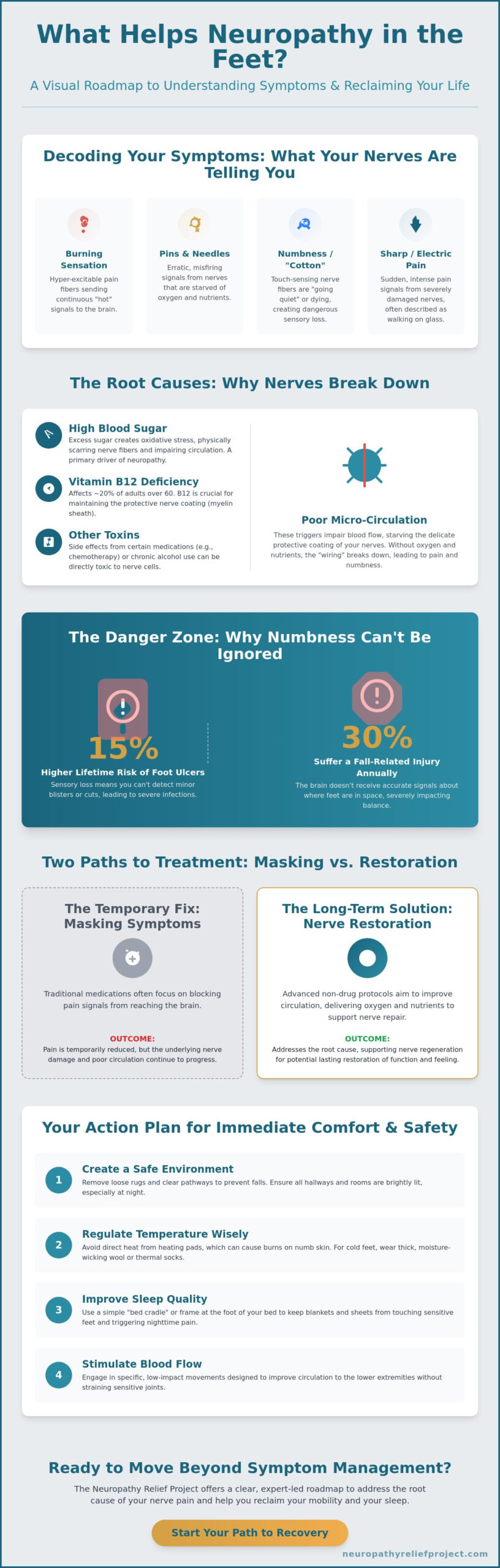
The sensory experience is often described as a relentless cycle of burning, tingling, and “pins and needles.” When you’re searching for what helps neuropathy in feet, it’s vital to recognize that these sensations aren’t just random occurrences. They’re the result of a biological breakdown where poor micro-circulation starves your nerves of essential oxygen. Without a steady blood supply, the delicate protective coating of your nerves begins to wear away, leading to the erratic firing of pain signals.
Common Triggers of Foot Nerve Pain
Metabolic health is frequently at the heart of nerve deterioration. High blood sugar levels don’t just affect your energy; they create oxidative stress that physically scars nerve fibers. While diabetes is a primary driver, lifestyle factors play an equally significant role. Vitamin B12 deficiencies, which affect approximately 20% of adults over age 60, can lead to rapid nerve decline. Additionally, side effects from certain medications or chronic alcohol use can act as toxins to your system. While many cases are labeled as idiopathic, meaning the cause is unknown, understanding the full spectrum of causes of peripheral neuropathy can help uncover the cellular triggers behind your pain. At the Neuropathy Relief Project, we believe every symptom has a root that deserves investigation.
When Nerves Send ‘Mixed Signals’ to the Brain
It’s a confusing and painful paradox to feel both numbness and intense pain simultaneously. This happens because different types of nerve fibers are dying at different rates. While the fibers that sense touch may go quiet, the fibers that transmit pain signals may become hyper-excitable. Your brain, receiving only fragments of information, interprets this “silence” or static as burning, freezing, or electrical shocks.
This “silent” neuropathy is particularly dangerous. If you lose the ability to feel the ground, you lose a critical warning system. Data suggests that patients with significant sensory loss have a 15% higher lifetime risk of developing foot ulcers because they can’t detect minor blisters or cuts. Understanding what helps neuropathy in feet starts with acknowledging that these mixed signals are a cry for help from a system that’s struggling to stay alive. Many patients with diabetes-related nerve damage also wonder is diabetic neuropathy permanent, and the latest 2026 clinical evidence suggests that restoration is far more achievable than previously believed. We view your recovery as a collaborative effort to restore these pathways and revitalize your cellular health.
Practical Home Strategies for Immediate Foot Comfort
If you experience the unsettling sensation of walking on cotton or sharp needles, your environment must become your first line of defense. Practical home strategies often begin with removing loose area rugs and ensuring every hallway is brightly lit to prevent falls. Data from 2022 suggests that nearly 30% of adults with peripheral neuropathy experience a fall-related injury annually because their brain isn’t receiving accurate signals about where their feet are in space. By clearing clutter and installing motion-sensor lighting, you create a sanctuary that respects your body’s current limitations.
Temperature regulation is equally critical for nerve stability. Damaged nerves often lose the ability to signal when a surface is dangerously hot, which can lead to severe thermal injuries. A 2021 clinical review noted that accidental burns are a leading cause of complications in those with nerve damage. Keep your home at a steady temperature and avoid using heating pads directly on your skin. If your feet feel icy, use thick, moisture-wicking wool socks instead of external heat sources that might cause a flare.
When the sun goes down, the “burning” often intensifies, making sleep feel impossible. Using a “bed cradle” or a simple frame to keep blankets from touching your toes can significantly reduce nocturnal flares. Integrating non-drug nerve relief protocols, such as targeted vibration therapy or specific nutrient timing, helps quiet the nervous system before rest. This approach is a cornerstone of what helps neuropathy in feet for those struggling with chronic insomnia. If you want to understand exactly why nerve pain peaks after dark and what clinical steps can cool the sensation, our specialist’s checklist on neuropathy burning at night outlines the 2026 breakthroughs designed to help you finally get restorative sleep. For a deeper understanding of how these non-pharmaceutical strategies work at a biological level, our guide on drug-free nerve pain management outlines the science behind moving from chemical masking to genuine cellular restoration.
The Role of Specialized Footwear
Standard shoes often act like a vice, compressing the metatarsal heads and restricting vital blood flow to the extremities. If your shoes feel tight by midday, they’re likely starving your nerves of oxygen and nutrients. Look for footwear with a wide toe box, seamless interiors to prevent friction, and specialized cushioning that absorbs impact. For a deeper dive into specific brands and features, see our guide on the Best Shoes for Neuropathy Feet.
Daily Foot Hygiene and Inspection
If you cannot feel a pebble in your shoe, you cannot rely on pain to signal an injury. Use a long-handled mirror to inspect your soles every evening for redness or small cracks. Apply a high-quality moisturizer to the tops and bottoms of your feet to prevent skin breakdown, but never apply it between the toes. Never soak your feet in hot water; always use a thermometer to ensure water is below 95 degrees Fahrenheit to avoid silent burns. If you’re ready to move beyond temporary fixes, consider a consultation to revitalize your nerve health through our structured recovery protocols.
Targeted Exercises to Improve Circulation and Stability
If you experience the persistent sting of pins and needles or a heavy, leaden sensation in your lower limbs, the idea of exercise might feel counterintuitive. However, the Neuropathy Relief Project operates on the “Movement is Medicine” philosophy. Physical activity acts as a natural pump, forcing oxygen-rich blood into the micro-vessels that feed your nerves. This is critical because peripheral nerves require a steady supply of nutrients to combat cellular decay and facilitate repair. Gentle calf pumps can significantly increase venous return and oxygenation to the feet. While these movements are foundational, consulting authoritative information on treatment options ensures your routine aligns with the latest clinical standards for nerve health.
Low-impact movements are designed to engage nerve pathways without placing undue stress on sensitive joints. By focusing on controlled, intentional motion, you can begin to bridge the gap between your brain and your extremities. Understanding what helps neuropathy in feet involves recognizing that even small, incremental movements can spark the process of nerve regeneration. These exercises aren’t about athletic performance; they’re about reclaiming the sensory data your brain needs to keep you stable and pain-free.
Seated Exercises for Severe Symptoms
If your symptoms make standing difficult, you don’t have to remain sedentary. Ankle circles and toe curls are simple yet effective ways to wake up dormant nerves. For a more tactile challenge, try towel scrunches. Place a small towel on the floor and use your toes to pull it toward your heel. This builds the small intrinsic muscles of the foot, which are essential for providing sensory feedback. You can also utilize the “Alphabet Trace” method. By “writing” the alphabet in the air with your big toe, you force the brain to track complex movements, which significantly improves proprioception.
Weight-Bearing Movements for Balance
As your confidence grows, transitioning to weight-bearing drills is a vital step in discovering what helps neuropathy in feet. The “Heel-to-Toe” walk retrains your brain to process the precise moment your foot makes contact with the ground, reducing the risk of a fall. If you feel unsteady, sit-to-stand repetitions strengthen the “anti-gravity” muscles in your legs, which helps stabilize your gait. Data from 2025 clinical observations suggests that consistency outweighs intensity in nerve recovery protocols. Performing these drills for just 10 to 15 minutes daily is 35% more effective for long-term stability than sporadic, high-intensity sessions. This methodical approach helps shift your focus from the daily struggle to a structured path of restoration.
Restoration vs. Masking: Why Traditional Drugs Often Fail
If you find yourself reaching for a pill bottle every few hours just to dull the fire in your toes, you aren’t alone. Over 30 million Americans live with the daily burden of nerve damage. Most are offered a “pill for every ill” strategy that focuses entirely on symptom management. These medications often act as a chemical veil. They don’t fix the underlying cause; they simply mute the brain’s ability to hear the pain signals. This is the difference between turning off a fire alarm and actually putting out the fire. When you search for what helps neuropathy in feet, the answer must involve restoration, not just suppression. A science-backed approach to drug-free nerve pain management offers a strategic alternative that targets the biological environment your nerves need to genuinely recover.
Nerve health depends on the integrity of the myelin sheath. Think of your nerves like high-speed data cables. The myelin sheath is the protective insulation. When this insulation wears thin, signals become “noisy” or disappear entirely, leading to that familiar tingling or numbness. Traditional drugs don’t rebuild this coating. They just slow down the electricity. This explains why many patients feel “stuck” on prescriptions that reduce their pain but do nothing to improve their balance or muscle strength. You might feel less “burning,” but you still can’t feel the floor beneath your feet.
The Science of Nerve Regeneration
Medical textbooks once claimed that peripheral nerves were incapable of healing. We now know this is incorrect. Research into peripheral nerve plasticity shows that these fibers can actually repair themselves at a rate of roughly one millimeter per day. This process depends heavily on micro-circulation. Small blood vessels must deliver oxygen and specific nutrients to the damaged site to fuel the repair. Without restoring this blood flow, the nerve remains in a state of cellular starvation. You can explore the biological requirements for this process in our guide on Can Peripheral Neuropathy Be Reversed?.
Advanced Non-Invasive Protocols
Modern recovery requires a shift from passive consumption to active intervention. High-intensity light therapy and specialized electrical stimulation work to “reboot” cellular energy. These technologies aim to stimulate mitochondrial activity, which acts as the engine of the nerve cell. A multi-modal approach is essential. Combining these technologies with specific movement patterns and clinical nutrition creates the ideal environment for what helps neuropathy in feet over the long term. We treat this as a “Project” because it requires a structured, personalized strategy. Generic plans fail because they don’t account for your specific level of sensory loss or vascular health.
If you’re tired of temporary fixes and want to address the root cause of your discomfort, it’s time to start a comprehensive neuropathy relief project tailored to your needs.
Taking the Next Step: The Neuropathy Relief Project Path
Understanding what helps neuropathy in feet requires moving past the idea that you’re stuck with a “progressive” condition that only gets worse. You’ve likely spent months or even years masking the burning and tingling with temporary solutions that never seem to last. The Neuropathy Relief Project is designed to help you transition from simply surviving each day to actively restoring your nerve health. This journey isn’t about finding a magic pill; it’s about a structured, scientific approach to cellular recovery and vascular support.
If you’ve felt dismissed by standard medical checkups, it’s because traditional care often focuses on symptom management rather than addressing the root cause. We believe your symptoms don’t have to be your permanent reality. By focusing on the underlying metabolic factors that starve your nerves of oxygen, we can create an environment where healing is possible. This shift in focus is what separates a mission-driven “Project” from a standard clinic visit. We’re here to bridge the gap between clinical evidence and your daily comfort.
What to Expect in a Professional Nerve Review
A standard reflex test with a rubber hammer rarely tells the whole story of peripheral nerve health. When you engage with a specialist, we dive deeper into a comprehensive symptom review. We look for specific patterns of sensory loss and evaluate the current state of your nerve function. This process determines if you’re a candidate for a restorative protocol. You’ll gain a dedicated advocate who understands that the 3:00 AM burning sensation isn’t just a minor inconvenience, it’s a signal from your body that needs a precise, clinical response.
- Detailed analysis of sensory perception and nerve conduction patterns.
- Evaluation of blood flow and oxygenation to the distal extremities.
- A clear determination of your candidacy for nerve regeneration protocols.
- A personalized roadmap that moves beyond basic pharmaceutical “band-aids.”
Your Path to Recovery Starts Here
The science of 2026 shows us that nerves have a remarkable capacity for repair when they’re provided with the correct biological environment. You don’t have to settle for a life of limited mobility or constant discomfort. The most effective way to discover what helps neuropathy in feet for your specific case is to speak with an expert who specializes in this field every single day.
The first step toward reclaiming your freedom is simple and direct. You can Schedule your 15-minute FREE phone Consultation to discuss your history and recovery goals. We’ll help you map out a strategy based on clinical data rather than guesswork. The best time to address your nerve health was yesterday; the second best time is today. Don’t let another day of nerve damage pass when restoration is within reach.
Your Path to Lasting Nerve Restoration
If you’ve spent years managing the burning, tingling, or numbness in your toes, you know that masking symptoms with pills isn’t a long-term solution. Real recovery requires a shift from temporary comfort to cellular restoration. By combining targeted circulation exercises with non-invasive clinical protocols, you can address the underlying nerve damage rather than just the pain signals. Understanding what helps neuropathy in feet involves a personalized approach that prioritizes nerve regeneration and improved stability for your daily life. It’s about moving beyond the cycle of frustration and into a phase of active healing.
The Neuropathy Relief Project, led by Dr. Michael J. Sclafani, DC, focuses on these drug-free methods to help you regain the freedom you deserve. Our team provides a specialized assessment of your specific symptoms to create a clear roadmap for your recovery. You don’t have to navigate this journey alone or feel dismissed by traditional systems that offer limited answers. Take a decisive step toward your health today by scheduling a session to discuss your unique needs.
Book Your Free 15-Minute Neuropathy Consultation Today
It’s time to stop wondering if relief is possible and start experiencing it. We’re here to guide you back to a life defined by movement and comfort.
Frequently Asked Questions
Is walking good for neuropathy in the feet?
Yes, walking is beneficial because it promotes blood flow to the damaged nerves in your extremities. A 2022 study published in Frontiers in Neuroscience indicates that 30 minutes of aerobic exercise performed 3 times per week can reduce neuropathic pain by 25 percent. If you experience tingling while walking, start with 5 minute intervals. This steady movement helps oxygenate the tissues and supports the body’s natural recovery processes.
Can soaking my feet in Epsom salts help neuropathy?
Soaking your feet in Epsom salts provides temporary relief by delivering magnesium to the skin, which helps calm overactive nerve signals. Clinical guidelines from 2023 suggest that a 15 minute soak in warm water can soothe the burning sensations you feel. However, you must keep the water temperature below 100 degrees Fahrenheit to prevent accidental burns. While it doesn’t fix the underlying damage, it’s a helpful tool in your daily routine for comfort.
What is the best vitamin for nerve repair in the feet?
Vitamin B12, specifically in the form of methylcobalamin, is essential for maintaining the myelin sheath that protects your nerves. Research from 2024 shows that combining B12 with 600 milligrams of Alpha-Lipoic Acid daily can significantly improve nerve conduction. These nutrients act as fuel for cellular health and regeneration. Understanding what helps neuropathy in feet often starts with correcting these specific nutritional deficiencies to revitalize your nervous system.
How do I stop neuropathy burning at night?
You can reduce nighttime burning by using a cooling gel or a 5 percent lidocaine cream before bed to desensitize the nerve endings. Pain often intensifies at night because your brain has fewer distractions; your body’s cortisol levels also naturally drop. If you experience this, try using a bed cradle to keep sheets off your feet. This simple adjustment prevents the hypersensitivity response that often disrupts your sleep and hinders your recovery. For a comprehensive expert-led approach to managing neuropathy burning at night, our 2026 specialist’s checklist walks you through the clinical steps to finally achieve restorative sleep.
Is foot neuropathy always caused by diabetes?
No, diabetes is the leading cause, but approximately 30 percent of neuropathy cases are classified as idiopathic, meaning the cause remains unknown. According to the National Institutes of Health, other factors like chemotherapy, vitamin deficiencies, or autoimmune issues affect over 20 million Americans. If you don’t have diabetes but feel numbness, it’s vital to investigate these other metabolic or structural triggers. Our Project focuses on identifying these hidden causes to restore your health. For a deeper look at the full range of environmental and metabolic triggers, explore our comprehensive resource on the causes of peripheral neuropathy that may be driving your symptoms.
Can nerve damage in the feet be reversed in 2026?
While reversal depends on the degree of damage, 2026 clinical protocols focus on nerve regeneration rather than just masking symptoms. Peripheral nerves can regrow at a rate of approximately 1 millimeter per day under the right conditions. By optimizing your cellular environment and using targeted therapies, it’s possible to regain sensation and reduce the chronic pain you’ve been enduring. This shift from management to restoration is the core mission of our Project. For those whose nerve damage stems from blood sugar issues, understanding whether is diabetic neuropathy permanent or reversible is a critical first step in building a realistic recovery plan.
What happens if foot neuropathy is left untreated?
Untreated neuropathy often leads to a 50 percent increase in fall risk due to the loss of balance and spatial awareness. When you can’t feel your feet, small injuries can go unnoticed and develop into ulcers, which affect 15 percent of neuropathy patients. This progression can eventually result in the need for more invasive interventions. Taking early action is the best way to ensure your long-term mobility and freedom from pain.
Are there specific essential oils that help with foot nerve pain?
Peppermint oil and St. John’s Wort oil are two of the most effective topical options for soothing nerve discomfort. A 2021 study found that the L-menthol in peppermint oil provides a cooling effect that blocks pain signals to the brain. If you’re looking for what helps neuropathy in feet naturally, applying these oils can offer a bridge to relief. Always dilute them in a carrier oil to protect your skin’s integrity during application.