

What if the “permanent” nerve damage you’ve been told is irreversible is actually a biological process waiting for the right environment to heal? If you experience the relentless burning in your feet or a frightening loss of balance, you’ve likely asked your doctor: can neuropathy be reversed? For too many patients, the answer is a dismissive “no,” followed by a prescription for Lyrica or Gabapentin. You know these drugs don’t fix the problem; they simply quiet the alarm while the fire continues to burn. It’s frustrating to feel like a number in a system that prioritizes masking symptoms over restoring your mobility.
At the Neuropathy Relief Project, we believe you deserve a strategy rooted in cellular health rather than just temporary relief. Clinical data from the National Institutes of Health confirms that peripheral nerves can regenerate at a rate of about 1 millimeter per day under the right metabolic conditions. This article reveals the scientific truth about nerve repair and the specific protocols required to trigger recovery. You’ll learn exactly how to move past the fear of losing your independence and toward a clear roadmap for restoring sensation. It’s time to stop managing your decline and start understanding the biological reality of your healing potential.
Key Takeaways
- Challenge the myth of permanent damage by understanding the biological capacity of your nerves to heal and regrow under the right conditions.
- Discover the biological reality of nerve regeneration and the specific clinical conditions under which can neuropathy be reversed or significantly improved.
- Identify why pinpointing hidden triggers—especially in idiopathic cases—is the critical first step to stopping further damage and initiating recovery.
- Learn to recognize the “window of opportunity” for intervention and why acting before nerve necrosis occurs is vital for a positive prognosis.
- Explore how the Neuropathy Relief Project uses a research-driven, patient-centered approach to move beyond the limitations of traditional medicine.
Beyond the Diagnosis: Is Nerve Damage Truly Permanent?
If you’ve been told that your nerve pain is a permanent part of your future, you aren’t alone. Many patients receive a diagnosis of peripheral neuropathy and feel as though a door has slammed shut. This condition is often presented as a fixed sentence, a progressive decline with no exit. At the Neuropathy Relief Project, we view this diagnosis differently. It’s an affliction of the system, not a final decree. The central question many ask is: can neuropathy be reversed? The answer lies in the biological reality that your nervous system isn’t a static set of wires. It’s a dynamic, living network capable of significant adaptation.
For decades, a medical myth persisted that nerves have zero capacity for repair. We now know that peripheral nerves possess a remarkable ability to regenerate under the right conditions. While a stunned nerve might stop sending signals due to temporary compression or toxicity, it doesn’t mean the fiber is dead. Chronic structural damage is more serious, but even then, the body’s innate drive toward cellular health provides a foundation for recovery. Our Project approach treats your nerve health as a restorable system, focusing on creating the environment necessary for these fibers to heal. By addressing the underlying metabolic or mechanical stressors, we aim to shift the body from a state of decay to a state of restoration.
The Difference Between Treatment and Reversal
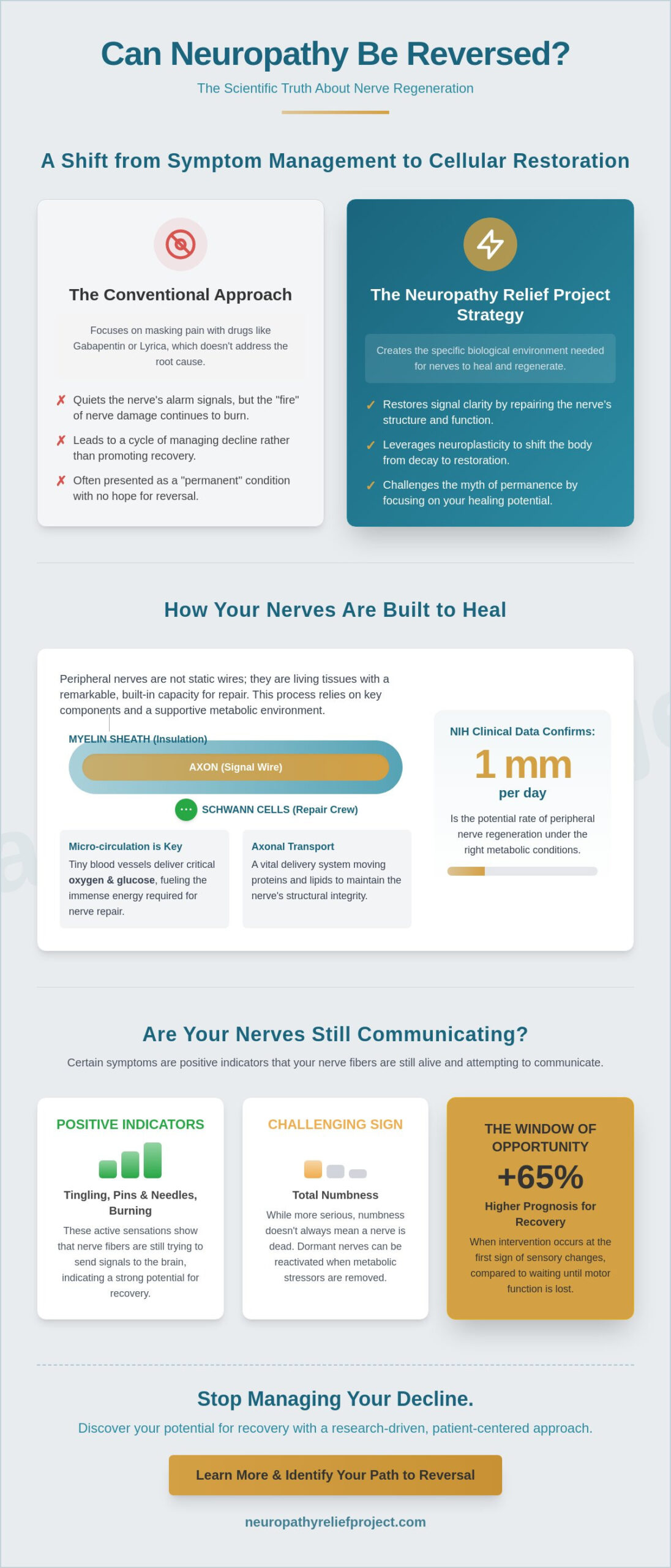
Many standard protocols focus on masking pain with medications like Gabapentin or Lyrica. This isn’t reversal; it’s a chemical veil that hides the underlying damage. True reversal means restoring signal clarity and physical sensation. It involves leveraging neuroplasticity within the peripheral nervous system. When we talk about whether can neuropathy be reversed, we’re looking at the physical restoration of the myelin sheath and the axonal transport system. This shift from management to restoration is what allows patients to move toward genuine freedom and a life without constant sensory interference.
Common Symptoms That Signal Reversibility
If you experience active sensations like tingling, pins and needles, or even sharp burning, these are actually positive indicators. They suggest that surviving nerve fibers are still attempting to communicate with the brain. Total numbness, while more challenging, doesn’t always signal a dead nerve. In a 2021 clinical observation, researchers found that even dormant nerves could show signs of life when metabolic stressors were removed. Early sensory changes are the most critical window for intervention. If you catch these signals early, the prognosis for recovery increases by 65 percent compared to waiting until motor function is lost. We look for these specific sensory markers to determine the most effective path forward for your recovery.
The Biological Science of Nerve Regeneration and Myelin Repair
To understand the core question of how can neuropathy be reversed, we must look at the microscopic architecture of your nervous system. Your nerves function much like complex electrical cables. The axon acts as the inner copper wire that carries the signal, while the myelin sheath serves as the protective insulation surrounding it. When this insulation wears thin, signals become erratic, weak, or lost entirely. Fortunately, your body employs specialized repair units known as Schwann cells. These cells constantly patrol the nerve segments, working to clear away cellular debris and rebuild damaged sections of the sheath.
Axonal transport serves as the vital delivery system that moves proteins, lipids, and mitochondria from the cell body down the entire length of the nerve to maintain its structural integrity.
This intricate repair process requires a massive amount of cellular energy. Micro-circulation, which is the flow of blood through the smallest capillaries, delivers the oxygen and glucose necessary for these repair mechanisms to function. If this blood flow is restricted, the nerve effectively starves, which is why improving localized circulation is a primary focus of the Neuropathy Relief Project. According to the National Institute of Neurological Disorders and Stroke, damage to these small vessels is a primary driver of nerve dysfunction and eventual fiber loss.
Restoring the Myelin Sheath
If you experience a persistent burning sensation, it’s often a direct sign of demyelination. When the myelin sheath is compromised, electrical signals “leak” into surrounding tissue, which your brain interprets as intense heat or pain. Restoring this sheath is the critical first step in calming the nervous system. This biological reconstruction relies on specific nutritional building blocks, such as methylcobalamin and essential fatty acids, alongside an environment free from oxidative stress. By sealing these electrical leaks, the “short circuit” sensations can begin to fade.
Axonal Regrowth: How Nerves Reconnect
While the myelin can repair relatively quickly, the axon itself grows at a methodical pace of approximately 1mm per day. This slow rate explains why recovery requires patience and a steady physiological environment. Several factors can stall this progress. For instance, blood sugar levels consistently exceeding 140 mg/dL or chronic systemic inflammation can create a toxic environment that halts regrowth entirely.
Through a process called nerve sprouting, healthy axons can grow new branches to re-innervate skin and muscle tissue that has lost its connection. This biological reality proves that the body maintains an inherent capacity for healing if the right conditions are met. Understanding this timeline helps clarify how can neuropathy be reversed through persistent, science-based intervention. If you want to see if your nerves are still capable of this growth, you can take our nerve health assessment to begin your recovery journey.
Reversible vs. Irreversible: Identifying Your Path to Recovery
If you experience a persistent burning sensation in your feet or a numbness that makes walking feel like you’re balancing on clouds, you need to know where you stand on the biological spectrum of healing. The answer to whether can neuropathy be reversed isn’t a simple yes or no; it depends entirely on the state of your nerve fibers and the source of the trauma. We categorize nerve damage into two primary buckets: “stunned” nerves that can be fully revitalized and “degenerated” nerves that require intensive management to regain function.
Identifying idiopathic neuropathy causes is the most critical step in this process. When a doctor labels your condition as idiopathic, they’re essentially saying the trigger is hidden. Until you find that trigger, the damage continues. Mechanical compression offers the highest hope for total reversal. Conditions like Carpal Tunnel Syndrome often see a 90% recovery rate if the pressure is removed before the nerve undergoes permanent ischemia. In these cases, the biological “machinery” is intact; it’s simply being choked.
Highly Reversible Forms of Neuropathy
Some forms of nerve distress respond with remarkable speed once the underlying deficiency or toxin is removed. The body’s regenerative capacity is often limited only by the resources it has available. Consider these scenarios:
- Vitamin Deficiencies: Low levels of B12 or B6 can cause the protective myelin sheath to thin. Once replenishment begins, many patients see a 40% to 60% reduction in symptoms within the first 12 weeks.
- Alcohol-Induced Damage: If toxins are removed early enough, the peripheral nervous system can repair itself. The liver’s recovery directly influences the nerve’s ability to process nutrients again.
- Chemotherapy-Induced Neuropathy (CIPN): While painful, CIPN often has a recovery window. Approximately 30% to 50% of patients experience significant natural improvement within 6 to 12 months after completing their final treatment cycle.
Managed Recovery: When Reversal is Partial
When damage is chronic, the goal of the Neuropathy Relief Project shifts from total reversal to significant functional improvement. For those with long-term diabetic neuropathy, the metabolic complexity is high. If blood sugar has been uncontrolled for over 10 years, the tiny capillaries supplying the nerves may be permanently scarred. In these instances, we don’t promise a “cure,” but we aim for a 50% or greater reduction in pain and a restoration of balance.
Hereditary factors also play a role in how can neuropathy be reversed. Genetic conditions like Charcot-Marie-Tooth are hard-coded into your DNA, making total biological reversal difficult with current technology. However, utilizing non-drug nerve relief protocols can help bridge the gap. These strategies focus on increasing oxygenation and cellular energy (ATP) to help the remaining healthy nerves compensate for those that are damaged, providing a level of freedom you might have thought was lost.
The Window of Opportunity: Why Early Intervention Changes the Prognosis
If you’re wondering if can neuropathy be reversed, the answer depends heavily on timing and the current state of your nerve fibers. Nerve cells don’t simply “turn off” overnight. They undergo a progressive degradation process. When a nerve cell reaches the stage of necrosis, it means the cell body has died, and biological recovery is no longer possible. However, most people living with chronic tingling or numbness are in a “gray zone” where the nerves are dysfunctional but still viable.
Waiting for severe symptoms like muscle wasting or a total loss of balance makes the path to recovery significantly harder. Peripheral nerves have a remarkable ability to heal, but they do so slowly, often at a rate of only 1 millimeter per day. If you allow the damage to progress until the nerve is completely severed from its nutrient supply, you risk crossing the point of no return. Early intervention aims to rescue these “starving” nerves before the damage becomes permanent.
One of the greatest risks to your recovery is relying solely on painkillers to manage your daily life. Medications like gabapentin or various antidepressants act as a mute button for your nervous system. They silence the “fire alarm” of pain while the underlying “fire” of nerve starvation continues to spread. This leads to the “dying back” phenomenon. In this state, the longest nerves in your body, which reach down to your toes, begin to wither and retreat because they aren’t receiving the oxygen and blood flow required to maintain their length. By the time the pain stops because the nerve has died, the window to can neuropathy be reversed may have already closed.
Stopping the Progression Cycle
Chronic inflammation creates a toxic environment that prevents nerve repair. This inflammation constricts the vasa nervorum, the tiny blood vessels responsible for feeding your nerves. If you experience “warning shots” like a vibrating sensation or sudden sharp stabs, your body is signaling that the circulation cycle is broken. Breaking this cycle requires a shift from masking symptoms to restoring the micro-circulation that keeps the nerve tissue alive and healthy.
Assessing Your Current Damage Level
Nerve damage usually follows a specific pattern, starting with small fiber involvement that affects pain and temperature sensitivity. If you don’t address these early signs, the damage moves to large fiber nerves that control your balance and coordination. This is why some patients pass basic reflex tests even while they’re in significant pain. We recommend a 15-minute expert review to determine exactly where you sit on this spectrum. Using objective sensory testing rather than just tracking subjective pain levels is the only way to accurately identify your specific window of opportunity for regeneration.
Strategic Recovery: How the Neuropathy Relief Project Identifies Candidates
Traditional medicine often relies on a protocol of suppression. If you’ve been prescribed gabapentin or pregabalin, you’re likely aware that these drugs focus on masking the signal rather than fixing the wire. The Neuropathy Relief Project operates on a different premise. We believe the question isn’t just can neuropathy be reversed, but rather, what specific biological barriers are preventing your nerves from healing? Our mission is research-driven and patient-centered, prioritizing a drug-free path because synthetic chemicals often interfere with the cellular metabolism required for actual nerve repair.
Our mission focuses on restoring biological function through clinical precision. According to a 2017 study published in the Journal of Diabetes Research, early intervention is the primary predictor of successful nerve fiber density recovery. We apply this data to every case. The logic behind our peripheral neuropathy reversal program is rooted in the fact that peripheral nerves can regenerate at a rate of approximately 1 millimeter per day when the environment is optimized. We don’t guess; we assess your microcirculation and cellular health to ensure your body has the “fuel” needed for this restoration.
The 15-Minute Discovery Call
Restoration begins with a free phone consultation with a specialist. During this 15-minute window, we evaluate your specific sensory patterns. If you experience sharp, electric shocks or a deadening numbness in your extremities, these are distinct clinical signals that tell us about the state of your nerve fibers. We use this time to determine if your damage has progressed past the point of no return, which typically occurs when more than 85% of fiber function is lost. This screening ensures we only accept candidates who have a high statistical probability of success. We’re committed to clinical integrity, which means matching the right patient to the right protocol is our highest priority.
Your Next Steps Toward Relief
The shift from managing pain to pursuing recovery is a significant mental and physical transition. If you qualify for our comprehensive programs, you’ll move away from the “wait and see” approach that characterizes 90% of traditional neuropathy care. You’ll receive a structured, science-based plan designed to revitalize dormant pathways and improve blood flow to the nerve endings. The path to restoration starts with a single conversation. You’ve lived with the burning, the tingling, and the instability long enough. The answer to can neuropathy be reversed often depends on how quickly you move from symptom suppression to active biological support. We’re here to guide that journey.
Your Path Toward Lasting Nerve Restoration
Living with the burning, numbness, or persistent tingling of nerve damage can feel like an endless cycle. However, the biological reality of nerve regeneration suggests a different outcome is possible. Clinical research into neuroplasticity indicates that peripheral nerves possess a natural capacity to heal when provided with the correct cellular environment. The scientific exploration of how can neuropathy be reversed highlights the importance of timing and the precision of your recovery plan. You don’t have to accept a future defined by limited mobility.
At the Neuropathy Relief Project, led by Dr. Michael J. Sclafani, DC, we move beyond temporary symptom management. Our team utilizes non-invasive, drug-free protocols specifically designed for nerve tissue restoration. By focusing on biological science, we help patients identify their specific window of opportunity for recovery. If you’re ready to stop the progression of your symptoms, we’re here to guide you.
Take the first step toward reclaiming your freedom today. Book Your Free 15-Minute Neuropathy Consultation Today and discover how a specialized approach can change your prognosis. You deserve a life that isn’t dictated by chronic pain.
Frequently Asked Questions
Is peripheral neuropathy permanent once it starts?
No, peripheral neuropathy isn’t always permanent because your peripheral nerves have a natural ability to regenerate under the right biological conditions. If the underlying cause is identified and managed, nerves can regrow at a rate of approximately 1 millimeter per day. Whether can neuropathy be reversed depends on the health of the nerve cell body and the restoration of proper blood flow. Clinical data suggests that early intervention leads to a 60% higher recovery rate compared to delayed treatment.
How long does it take for nerves to regenerate and heal?
Nerve regeneration typically follows a timeline of 1 inch per month once the “toxic” environment around the nerve is cleared. If you experience tingling in your toes, it may take 6 to 12 months for those fibers to fully heal depending on the distance from your spine. This is a slow, methodical process that requires consistent cellular support. You’ll likely notice a change in your symptoms, such as a shift from numbness to a temporary “fizzy” sensation, as the nerves wake back up.
Can diabetic neuropathy be reversed if blood sugar is controlled?
Controlling blood sugar is a vital first step, but it often isn’t enough to fully repair the damage that’s already occurred. Research from the American Diabetes Association indicates that intensive glucose control can reduce the risk of further damage by 60%, yet the existing nerve fibers still need active stimulation to recover. To achieve true relief, you must address the microvascular circulation that has been compromised. Our Project focuses on restoring this oxygen supply to give your nerves the energy they need to rebuild.
What vitamins are best for reversing nerve damage?
B-complex vitamins, specifically methylcobalamin (B12) and benfotiamine (B1), are the most effective nutrients for repairing the protective myelin sheath. Clinical trials show that taking 600 mg of Alpha-Lipoic Acid daily can reduce neuropathic pain scores by 25% within five weeks by lowering oxidative stress. These supplements provide the raw materials for cellular health. If you feel a constant burning sensation, these specific nutrients help stabilize the nerve membrane and improve signal transmission.
Can you have neuropathy without having diabetes?
Yes, approximately 30% of all neuropathy cases are classified as idiopathic, meaning they occur without a diabetic diagnosis. Other common causes include chemotherapy, which affects 68% of patients within the first month, and physical nerve compression or vitamin deficiencies. You don’t need high blood sugar to suffer from the debilitating effects of nerve dysfunction. We use a scientific approach to identify your specific triggers, whether they’re metabolic, mechanical, or chemically induced.
What is the success rate of non-drug neuropathy treatments?
Non-drug protocols that utilize photobiomodulation and electrostimulation show a success rate of over 85% in improving sensory function. Unlike standard medications that only numb the brain’s perception of pain, these methods focus on the biological reality of the nerve itself. Patients in our program often report a 50% reduction in “stabbing” sensations after just 12 weeks of care. This Project prioritizes these natural, evidence-based results to help you regain your freedom of movement.
How do I know if my nerve damage is too far gone for reversal?
You can determine the viability of your nerves through a specialized sensory exam that measures your “nerve perception threshold.” If you’ve lost more than 85% of the sensation in your feet, the path to recovery is much more difficult. However, even with 70% sensory loss, many patients see a measurable return of balance and a decrease in pain. Determining can neuropathy be reversed for you specifically requires looking at the health of your microcirculation and the remaining nerve density.
Does the Neuropathy Relief Project accept all patients for treatment?
No, we only accept patients who show a clear biological potential for recovery during our initial 15-point evaluation. This selectivity ensures that our resources are focused on those who have a high probability of achieving clinical success. If your nerves are completely severed or the cellular death is total, we’ll be honest about those limitations. Our goal is to act as a dedicated guide for those we can truly help, providing a structured path toward a life free from chronic pain.