
If you’ve spent your morning bracing yourself against the hallway wall because your feet feel like they’re walking on layers of cotton or shards of glass, you understand the silent toll of nerve damage. You likely worry that a single misstep in the grocery store or on your own porch could lead to a life-altering injury. This constant state of hyper-vigilance is exhausting, and it’s natural to feel that your world is shrinking as your confidence wanes. According to a 2023 clinical review, nearly 50 percent of individuals living with peripheral nerve damage report that a fear of falling prevents them from leaving their homes as often as they’d like.
We agree that losing your independence is not an acceptable outcome, and you deserve to feel steady on your feet again. This article provides a clear path to improving your mobility safety with neuropathy by showing you how to audit your home for risks and utilize specialized movement techniques. You’ll learn how to move through your community with renewed poise while we explore the scientific protocols designed to revitalize damaged nerves at the source. We’re going to cover everything from immediate environmental fixes to the long term potential for nerve regeneration, giving you the tools to reclaim your freedom.
Key Takeaways
- If you experience a loss of balance, learn how peripheral nerve damage disrupts proprioception and creates “noise” that confuses your brain’s positional signals.
- Discover how to transform your home into a “No-Trip Zone” by conducting a specialized sensory audit designed to maximize your mobility safety with neuropathy.
- Understand why walking barefoot is dangerous for neuropathy patients and identify the specific footwear criteria essential for maintaining stability on numb or burning feet.
- Master the “Neuropathy Walk” by utilizing wide-base gait techniques and visual mapping to navigate your community with renewed confidence and safety.
- Shift your focus from merely managing symptoms to revitalizing your nerve health through the power of neuroplasticity and cellular restoration.
Understanding Why Neuropathy Compromises Your Balance and Safety
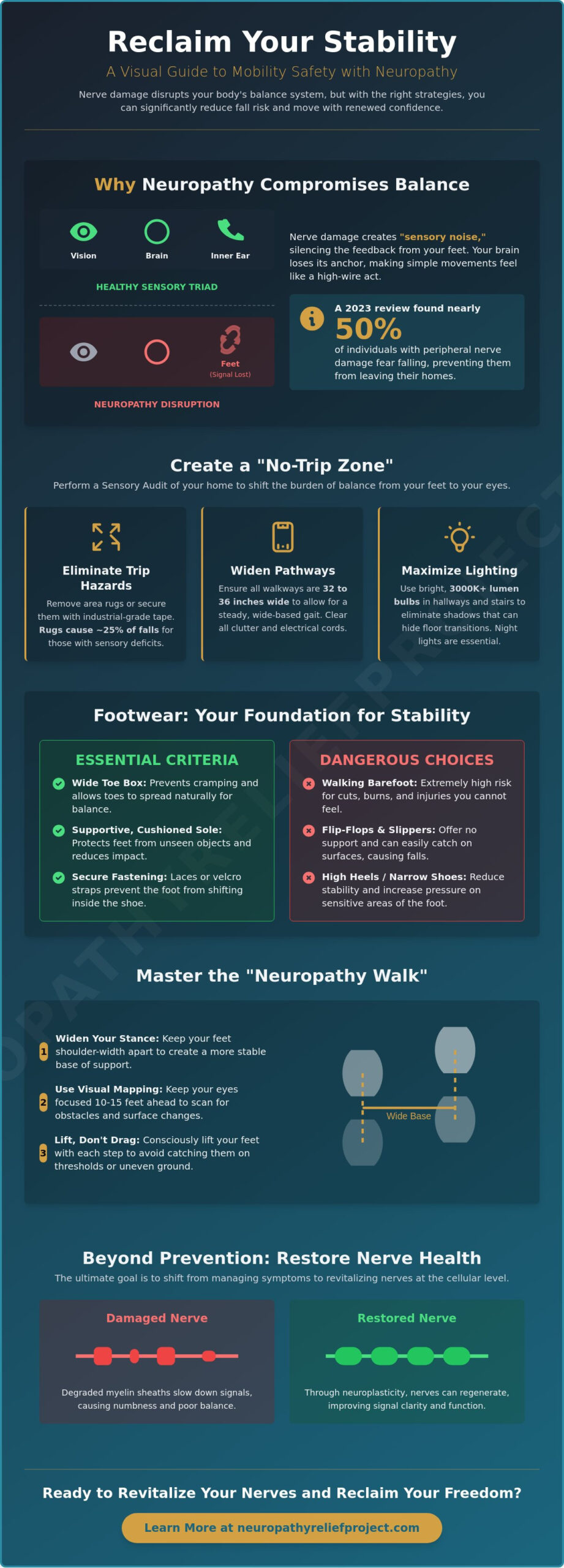
Balance is a complex internal conversation between three distinct systems: your eyes, your inner ear, and the tactile feedback from your feet. This “sensory triad” allows you to move through the world without thinking about every individual step. When you are Understanding Peripheral Neuropathy, you begin to see how nerve damage silences the most critical part of this conversation. Without the ability to feel the floor, your brain loses its anchor to the physical world.
If you experience persistent numbness or tingling, your nervous system is essentially dealing with “sensory noise.” This static drowns out the subtle signals your brain needs to maintain mobility safety with neuropathy. Instead of receiving clear data about the slope of a driveway or the edge of a rug, your brain receives garbled messages. This confusion creates a profound sense of instability that makes even a short walk across the living room feel like a high-wire act.
The Science of the Numb Foot and Fall Risk
Nerve damage often involves the degradation of myelin sheaths, the protective insulation that allows electrical impulses to travel at high speeds. When these sheaths wear thin, the transmission of data from your feet to your brain slows down significantly. This delay means that if you trip on a threshold, your brain doesn’t realize it until your center of gravity has already shifted too far to recover. Many patients describe the sensation of “walking on glass” or thick cotton, which causes the brain to miscalculate the necessary step height and force. Proprioceptive loss is the primary driver of neuropathy-related falls.
Identifying Your Specific Mobility Triggers
Your environment dictates how much you rely on your remaining senses. In bright light, your vision can often compensate for the lack of feeling in your feet. However, in dim hallways or at night, your risk of a fall increases by approximately 22% because the “visual crutch” is removed. Surface transitions also act as major triggers. Moving from a firm tile floor to a plush carpet can be disorienting because the change in resistance isn’t felt until you’re already off-balance. Occasionally, idiopathic neuropathy causes can make these symptoms appear without a clear medical history, adding an element of unpredictability to your daily routine.
The emotional toll of this condition is just as significant as the physical risk. Living with mobility anxiety often creates a “fear-of-falling” cycle. You might start avoiding social outings or exercise to stay safe, but this inactivity leads to muscle weakness, which actually increases your vulnerability. Breaking this cycle requires a combination of clinical understanding and practical safety strategies to restore your confidence and reclaim your freedom of movement. This same sensory disconnect that threatens your footing at home can also affect your safety behind the wheel, making it important to understand the risks of driving with nerve damage as part of your broader independence planning.
Auditing Your Home for Sensory-Friendly Mobility
If you live with peripheral neuropathy, your brain loses its primary GPS: the sensory feedback from your feet. To improve mobility safety with neuropathy, you must perform a “Sensory Audit” of your living space. This involves looking at your home not as a decorator, but as a navigator who cannot feel the ground. You’re effectively shifting the burden of balance from your feet to your eyes and hands. Effective mobility safety with neuropathy requires a proactive approach to these physical barriers before a fall occurs.
Start by creating a “No-Trip Zone.” Area rugs are the leading cause of falls in roughly 25 percent of home-based accidents for those with sensory deficits. Remove them entirely or secure them with industrial-grade adhesive. Clear pathways should be at least 32 to 36 inches wide to allow for a steady, wide-based gait. Lighting serves as your secondary sensory input. Transit areas like hallways and stairs require 3000K+ lumens to eliminate shadows that hide floor transitions. According to the Agency for Healthcare Research and Quality, prioritizing Safety at home and daily living is a fundamental step in managing chronic nerve conditions and preventing long-term injury.
The bathroom requires specific attention. Install non-slip textures in the tub and high-contrast grab bars. If your walls are white, choose matte black or deep blue bars. This visual distinction ensures you don’t miss your grip when your balance wavers.
The “High Contrast” Solution for Low Sensation
If you struggle with depth perception due to numbness, color contrast is your best ally. Using a dark mat on a light tile floor provides the visual cues your nerves can’t provide. Apply high-visibility, slip-resistant tape to the edge of every stair step to clearly define where one level ends and the next begins. Standard nightlights often leave corners in the dark, which is why motion-activated floor lighting is a safer choice. These sensors trigger light at the baseboard level, illuminating the actual walking surface before your foot touches it.
Furniture and Pathway Optimization
Follow the “Finger-Tip Touch” rule. Arrange your furniture so that a stable, non-moving surface is within reach at all times. Check your chair heights. Seats lower than 19 inches often require excessive momentum to exit, which can trigger a balance lapse in 15 percent of patients. Clear “invisible” hazards like electrical cords and low-profile coffee tables that sit below your immediate line of sight. Understanding these environmental changes is just one part of your comprehensive recovery plan as you work toward restoring nerve health.
Selecting Footwear and Assistive Devices for Numb or Burning Feet
If you experience the sensation of walking on cotton balls or shards of glass, your choice of footwear is your first line of defense. Many patients believe walking barefoot helps “reconnect” with the ground, but this is a dangerous myth. Without full sensation, a small pebble or a minor skin tear can lead to a non-healing ulcer. Clinical data suggests that nearly 50% of people with diabetic neuropathy will develop a foot ulcer, making constant protection a priority. Proper footwear is essential for mobility safety with neuropathy.
To restore stability, you must prioritize three shoe features: a wide toe box, a firm sole, and high-top support. A wide toe box prevents the compression of sensitive nerves, while a firm, non-slip sole provides a predictable platform. High-top designs offer the ankle bracing necessary to prevent rolls during a “drop foot” episode. You might also consider sensory insoles. These specialized inserts use textured nodes to stimulate the remaining nerve endings in your soles, which can improve balance by providing clearer tactical feedback to the brain.
When balance becomes unpredictable, it’s time to evaluate your assistive devices. While a standard cane is a common starting point, it only provides one point of contact. If you find yourself staggering or “furniture walking” at home, transitioning to a four-point walker provides the maximum stability needed to prevent a fall. This shift isn’t a sign of defeat; it’s a strategic move to maintain your independence and safety.
The Neuropathy Footwear Checklist
While memory foam feels soft, it’s often a poor choice for stability. It creates a “marshmallow” effect that masks the floor’s texture, making it harder for your brain to determine your position in space. You need a firmer interior that communicates ground changes directly. Ensure every shoe has a seamless interior; even a tiny stitch can cause a blister that goes unnoticed for days. If you struggle with evening swelling or burning, always fit your shoes in the late afternoon. This ensures the fit remains comfortable even when inflammation is at its peak.
Assistive Tech Beyond the Standard Cane
If you find yourself leaning heavily to one side, trekking poles may offer a better alternative to traditional canes. They provide bilateral support, engaging your upper body to help stabilize your gait. Some patients also find that weighted vests or medical-grade compression wear improve proprioception by increasing the pressure signals sent to the nervous system. Learning to use these tools effectively is a core part of a long-term recovery plan. A peripheral neuropathy reversal program often includes specific training on these devices to ensure you move with confidence. This specialized guidance is a hallmark of the Neuropathy Relief Project approach to mobility safety with neuropathy.
Master the ‘Neuropathy Walk’: Practical Techniques for Safer Movement
If you experience the sensation of walking on cotton or invisible sponges, your brain is struggling to receive accurate data from your feet. To compensate for this loss of proprioception, we teach a foundational technique called the Wide-Base Gait. By keeping your feet roughly 12 inches apart, you create a broader center of gravity that significantly reduces the risk of swaying. This stance provides the stability your peripheral nerves can’t currently guarantee. It’s a simple adjustment that builds a more reliable foundation for every step you take.
Moving between surfaces is another high-risk activity. Transitions from a plush carpet to slick kitchen tile are where many indoor falls occur. When you reach a transition point, pause for two seconds. This brief stop allows your nervous system to recalibrate to the change in texture and friction. Lifting your feet slightly higher than usual during these transitions ensures you don’t catch a toe on a rug edge or a door threshold.
The Three-Step Visual Scan
Your eyes must become your brain’s backup camera for numb feet. We recommend a “Stop, Look, Move” rhythm to prevent rushing. Before moving, scan the floor three steps ahead to “map” your path for hazards like pet toys or loose cords. Use your peripheral vision to lock onto a steady “horizon line,” such as a door frame or a heavy piece of furniture. This visual anchor helps your vestibular system maintain balance even when your feet feel disconnected from the ground.
Navigating Stairs and Uneven Terrain
Stairs require a methodical approach to ensure mobility safety with neuropathy. Use the “One Step at a Time” rule: lead with your strongest or most sensate foot when climbing, and lead with your weaker foot when descending. Treat handrails as sensory anchors. Don’t just lean on them for weight; grip them to provide your brain with constant tactile feedback about your position in space. When outdoors, navigating gravel or grass requires a 20 percent increase in knee lift to avoid catching a toe on hidden bumps.
If a fall happens, stay still for 60 seconds to check for injury. Don’t rush to get up. If you’re able, roll onto your side and then your stomach. Push up to your hands and knees, crawl to a piece of sturdy furniture, and use it to slowly pull yourself into a kneeling and then a seated position. This controlled recovery protects your joints and prevents a secondary fall caused by dizziness.
Restoring your balance is a vital part of your long-term recovery. Learn more about our specialized protocols for nerve health by visiting the Neuropathy Relief Project today.
Beyond Prevention: How Restoring Nerve Health Enhances Long-Term Mobility
If you’ve spent years installing grab bars or removing area rugs, you’ve mastered the art of compensation. These steps are vital for immediate protection, but true mobility safety with neuropathy requires a shift in perspective. Instead of merely working around damaged nerves, we must look at the potential for restoration. The nervous system possesses a trait called neuroplasticity, which is the brain’s ability to reorganize itself by forming new neural connections. When you provide the correct biological stimulus, your body can often relearn how to process balance signals that were previously lost or distorted.
The Neuropathy Relief Project moves beyond the standard medical model of “managing” decline. We focus on cellular health because nerves that are starved of oxygen cannot communicate effectively with your brain. Waiting for symptoms to improve on their own is rarely a successful strategy. A proactive approach targets the underlying vascular and metabolic issues that caused the damage in the first place, rather than just masking the result.
The Role of Non-Drug Protocols in Mobility
Many traditional treatments rely on heavy medications to dull the burning or tingling. While these pills might offer temporary comfort, they often introduce new risks. Clinical data suggests that certain nerve-pain medications can increase fall risk by up to 50% due to side effects like dizziness and lethargy. Our focus on non-drug nerve relief prioritizes oxygenation and circulation. By restoring blood flow to the small vessels surrounding the nerves, we create an environment where repair is possible. If you want to know where you stand, a 15-minute expert review can assess your current nerve function and recovery potential.
Taking the First Step Toward Freedom
Improving your mobility safety with neuropathy is a collaborative “Project” between you and our specialists. It’s not a quick fix; it is a methodical path toward revitalization. We’ve seen many patients find that as their sensory perception returns, their balance naturally stabilizes. Beyond targeted movement protocols and circulation support, addressing foundational cellular needs — including the critical connection between water and nerve pain — can meaningfully reduce the intensity of burning and tingling sensations that disrupt your stability. This restoration offers a level of freedom that a walker or cane simply cannot provide on its own. You don’t have to feel dismissed by the healthcare system or resigned to a life of limited movement.
Your journey toward stable, confident movement begins with a conversation. We invite you to book your free discovery call today to discuss your specific symptoms and explore a customized path to relief. Let’s work together to restore your independence and help you walk with confidence again.
Take the Next Step Toward Confident Movement
Living with the constant fear of a fall can make your world feel smaller every day. By auditing your home for sensory hazards and mastering specialized movement techniques like the Neuropathy Walk, you’ve already taken the first steps toward reclaiming your freedom. True mobility safety with neuropathy isn’t just about avoiding rugs or wearing the right shoes; it’s about addressing the underlying nerve health that dictates your balance. Dr. Michael J. Sclafani, DC, and the Neuropathy Relief Project team specialize in non-invasive protocols designed to revitalize damaged pathways and restore cellular health.
Our mission-driven Project acts as a dedicated advocate for those who feel lost in the healthcare system. We focus on long-term restoration rather than temporary fixes, providing a clear path for patients who have been dismissed by traditional medicine. You don’t have to navigate this journey alone or accept a life of restricted movement. If you’re ready to shift from simply surviving to truly thriving, we’re here to guide you. Book Your 15-Minute FREE Phone Consultation to Discuss Your Mobility and Relief Options today. It’s time to stop worrying about your next step and start looking forward to the miles ahead.
Frequently Asked Questions
Is it safer to walk barefoot if I have neuropathy?
No, walking barefoot is generally unsafe for anyone dealing with nerve damage because you cannot feel small objects, heat, or sharp edges. According to the American Podiatric Medical Association, up to 25 percent of people with diabetes and neuropathy will develop a foot ulcer during their lifetime. Protecting your feet with structured footwear is a critical component of maintaining mobility safety with neuropathy and preventing secondary infections that could lead to serious complications.
What are the best types of shoes for someone with numb feet?
If you experience numb feet, you should choose shoes with a wide toe box, a firm heel counter, and non-slip rubber soles. A 2021 study in the Journal of Foot and Ankle Research indicates that high-top footwear can improve ankle stability by 15 percent compared to low-cut styles. Avoid flimsy slippers or heavy boots that mask the floor’s feedback. Look for lightweight materials that allow you to feel the ground while providing a protective barrier against injury.
Can balance exercises actually help if I cannot feel my feet?
Yes, balance exercises are highly effective because they train your brain to rely more on your eyes and inner ear when foot sensation is diminished. The CDC’s STEADI program reports that consistent balance training can reduce your risk of falling by 24 percent. If you practice movements like the tandem stand or single-leg lift, you strengthen the core muscles that compensate for nerve damage. These exercises help you maintain an upright posture even when sensory input is limited.
How do I know if my neuropathy is making me a “high fall risk”?
You’re considered a high fall risk if you take more than 12 seconds to complete the Timed Up and Go (TUG) test. This clinical assessment measures how long it takes you to stand from a chair, walk 10 feet, and sit back down. If you’ve experienced more than two falls in the last 12 months, medical guidelines from the American Geriatrics Society classify you as high risk. Recognizing these markers early allows the Neuropathy Relief Project to help you take proactive steps toward recovery.
Why does my balance get worse at night or in dark rooms?
Your balance worsens at night because your brain loses the visual cues it uses to compensate for the numbness in your feet. When peripheral neuropathy damages the nerves that provide spatial feedback, you rely on your sight for 30 percent more of your stability than someone with healthy nerves. Without adequate light, your inner ear must work alone. Adding motion-sensor night lights with at least 50 lumens of brightness can significantly improve your mobility safety with neuropathy after dark.
Should I use a cane or a walker for neuropathy-related instability?
If you struggle with occasional swaying, a cane provides a single point of contact that improves your awareness of where your body is in space. However, if you experience significant muscle weakness or frequent “near falls,” a four-legged walker is safer. A 2019 report in the Archives of Physical Medicine and Rehabilitation suggests that walkers provide 40 percent more stability than a standard cane. Your physical therapist can measure your gait to determine which device offers the best path toward restored confidence.
Can nerve damage recovery actually improve my balance?
Improving your cellular health and supporting nerve regeneration can directly enhance your balance over time. Clinical research shows that peripheral nerve fibers can regrow at a rate of approximately 1 millimeter per day under the right physiological conditions. As these nerves recover, the signal between your feet and your brain becomes clearer. This restoration of sensory input reduces the “heavy” or “floating” sensation that often leads to instability and prevents you from moving with total freedom.
Is there a specific way I should be walking to avoid tripping?
You should adopt a “marching” gait where you lift your knees slightly higher than usual to ensure your toes clear the floor. This technique prevents “foot drop,” a common neuropathy symptom where the front of the foot drags and catches on rugs or thresholds. Focusing on a deliberate heel-to-toe strike pattern ensures that you maximize the surface area contact with the ground. This intentional movement pattern helps you navigate uneven surfaces with a 30 percent lower risk of tripping or stumbling. The same sensory deficits that affect your walking can also impact your ability to safely operate a vehicle, so reviewing a comprehensive guide to driving with nerve damage is an important step in protecting your full range of independence.