

You’re approaching a busy intersection, but as you prepare to slow down, a familiar pang of anxiety hits because you can’t quite feel the position of your right foot on the brake. If you experience this sensory disconnect, you understand that driving with nerve damage is a heavy emotional burden that threatens your fundamental sense of freedom. With 13.5% of U.S. adults over age 40 now navigating peripheral neuropathy in 2026, you aren’t alone in wondering if your next trip to the store puts yourself or others at risk.
It’s natural to feel dismissed by a healthcare system that suggests you simply “give up the keys,” but your safety on the road requires a more methodical, clinical approach. This guide provides a clear framework to assess your driving fitness, explains how to utilize 2026 Advanced Driver-Assist Systems (ADAS), and offers a path toward restoring the cellular health required for total vehicle control. We’ll explore how the Neuropathy Relief Project bridges the gap between natural recovery and scientific evidence to help you reclaim your independence. To help you move from anxiety toward a revitalized life, we also offer a 15 minute FREE phone Consultation to discuss your specific path to recovery.
Key Takeaways
- Understand how peripheral neuropathy disrupts proprioception, the essential “sixth sense” that allows you to feel pedal pressure without looking down.
- Learn to perform a “5-Minute Nerve Audit” every morning to objectively measure your sensory accuracy before you ever put the car in gear.
- Discover how specific footwear choices and modern cruise control settings make driving with nerve damage more manageable and less fatiguing.
- Identify the clinical and legal red flags that indicate when it’s time to transition from self-management to professional vehicle adaptations.
- Explore the science of nerve regeneration and how focusing on cellular health can help you move toward restoring the sensation you need for the road.
Understanding How Nerve Damage Impacts Driving Safety
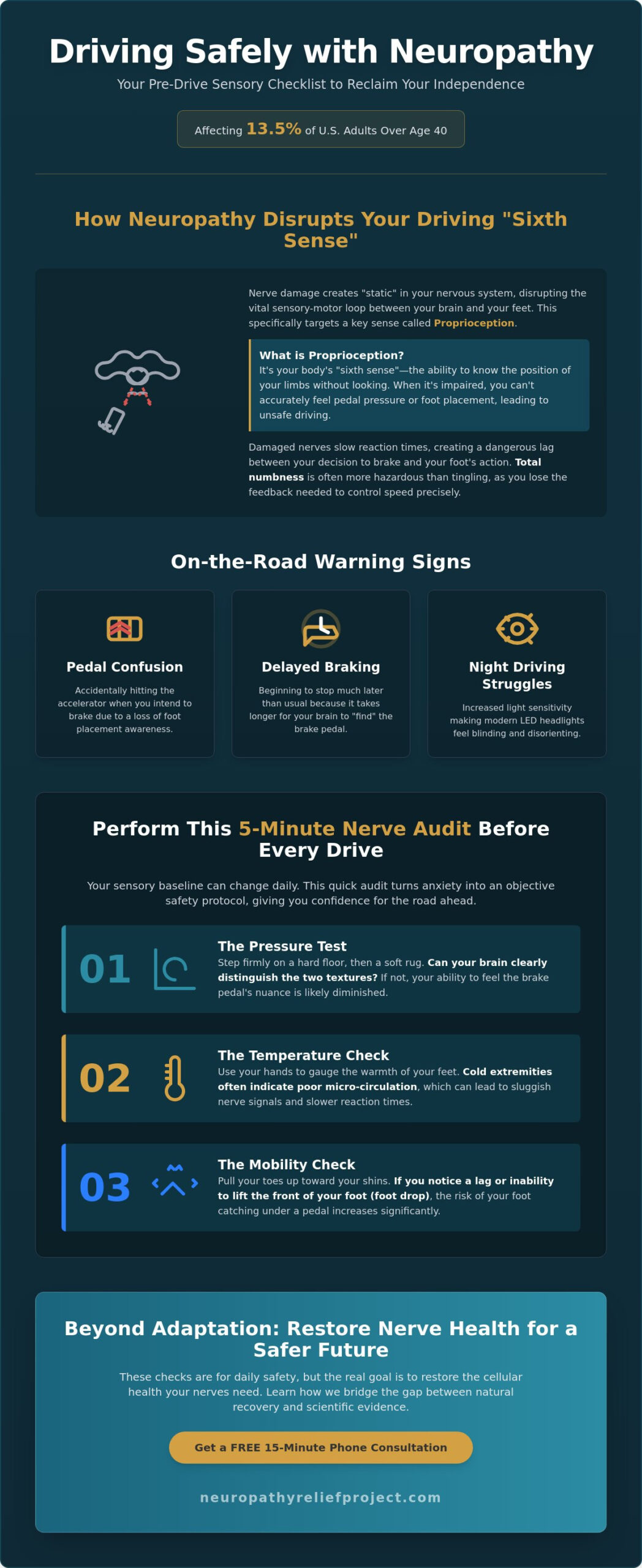
The prospect of losing your car keys often feels like a loss of your very identity. For many, the vehicle represents a bridge to the community and a symbol of self-reliance; however, safety must remain the primary focus. When you are driving with nerve damage, your ability to operate a vehicle safely isn’t a permanent “yes” or “no” status. It’s a variable state that can fluctuate based on your daily inflammation levels and sensory clarity. Understanding Peripheral Neuropathy is essential because it highlights how the breakdown in communication between your brain and your extremities changes your physical reality behind the wheel. This disruption often targets proprioception, the “sixth sense” that allows you to know exactly where your foot is located without looking at the floorboard.
The Sensory-Motor Loop: From Pedal to Brain
If you experience constant burning or tingling, your nervous system is essentially processing “static” that interferes with clear communication. This sensory noise can easily drown out the subtle physical signals coming from the brake or accelerator pedals. There is a specific biological cause for the hesitation you might feel during a quick stop. Damaged myelin sheaths slow reaction times by milliseconds, creating a dangerous lag between your brain’s decision to stop and your foot’s actual movement. While the “pins and needles” sensation is frustrating, clinical experience shows that total numbness is often more hazardous in a driving context. If you can’t feel the resistance of the pedal, you lose the vital feedback loop required to modulate your vehicle’s speed with precision.
Common Warning Signs While on the Road
Recognizing the early indicators of sensory decay can prevent a tragedy before it occurs. Many drivers with nerve damage develop “heavy foot” syndrome, where they apply excessive pressure to the gas because they can’t feel the pedal’s initial engagement. You should monitor your daily habits for these specific red flags:
- Pedal Confusion: This happens when the brain loses track of foot placement, causing you to accidentally hit the accelerator when you intended to brake.
- Delayed Braking: You might notice you’re starting your stops much later than usual because it takes longer for your brain to “find” the brake pedal.
- Night Driving Struggles: Neuropathy is frequently linked to increased light sensitivity, making the glare from 2026 LED headlights feel blinding and disorienting.
With 40.1 million Americans currently living with diabetes, roughly half of whom will develop some form of nerve damage, these challenges are becoming a significant public health concern. If you recognize these patterns in your own driving, it’s a sign that your cellular health needs a structured restoration plan to keep you safely on the road. For a broader perspective on what this condition means for your daily life, our guide on living with peripheral neuropathy in 2026 explores how restoration-focused protocols can help you move beyond symptom management toward genuine nerve recovery.
The Pre-Drive Self-Assessment: A Daily Sensory Checklist
Establishing a ritual before you ever put the car in gear helps transform anxiety into an objective safety protocol. This “5-Minute Nerve Audit” isn’t about restriction; it’s about gaining the confidence to know your body is ready for the task. If you are driving with nerve damage, your sensory baseline changes from day to day based on sleep, stress, and inflammation levels. By taking these few moments, you ensure that driving with nerve damage remains a calculated and safe activity rather than a gamble with your independence.
Start with the “Pressure Test.” Step firmly on a hard surface, like your garage floor, then transition to a soft rug or carpet. If your brain can’t clearly distinguish between the two textures, your ability to feel the nuance of a brake pedal is likely diminished. Follow this with a “Temperature Check” by using your hands to gauge the warmth of your feet. Cold extremities often indicate poor micro-circulation, which can lead to sluggish nerve firing. Finally, perform a “Mobility Check” by pulling your toes toward your shins. If you notice a lag or an inability to lift the front of your foot, the risk of foot drop catching on the edge of a pedal increases significantly. For those who find these tests challenging, the National Highway Traffic Safety Administration offers resources on Adaptive Driving Equipment to help you maintain your mobility safely.
Testing Your Lower Extremity Feedback
Sit in the driver’s seat with the engine off and perform the “Wiggle and Press” test. Flex your toes and press against the floorboard to confirm you have both motor control and sensory feedback. If you’re experiencing an active flare of burning pain or intense electric shocks, it’s safer to wait. These high-intensity signals act as “neurological noise” that can distract you during critical split-second decisions. It’s also worth noting that stress induced neuropathy pain can intensify these flares by triggering cortisol-driven reductions in blood flow to your extremities, making your pre-drive sensory baseline even more unpredictable on high-stress days. Maintaining optimal nerve health also requires internal balance, so ensure you’re following a proper hydration checklist to keep your electrolyte levels stable for clear signal transmission.
Upper Extremity and Steering Control
Hand neuropathy is just as critical for safety as foot sensation. Before pulling out of the driveway, grip the steering wheel and ensure you can feel its texture and the subtle vibrations of the vehicle. You can assess your endurance with the “Soda Can Test.” If you can’t comfortably hold and squeeze a full soda can for 30 seconds without cramping or losing your grip, you may lack the strength for evasive maneuvers. While some find that driving gloves provide better grip, they can also strip away the tactile feedback you need. If these daily assessments leave you feeling uncertain about your safety, scheduling a 15 minute FREE phone Consultation with the Neuropathy Relief Project can help you explore ways to revitalize your nerve health and stay on the road longer.
Essential Vehicle Adjustments and Adaptive Strategies
If you find that your feet frequently lose contact with the pedals, you don’t have to surrender your independence immediately. Small, methodical changes to your vehicle can bridge the gap between your current sensory state and the road. When driving with nerve damage, the equipment you choose is just as important as the health of your nerves. By adapting your environment, you reduce the physical and cognitive load required to operate your vehicle safely.
Footwear is a primary consideration that many overlook. While thick, cushioned soles are helpful for walking, they act as a sensory barrier that muffles the feedback from your vehicle. Switching to thin-soled shoes, such as driving loafers or minimalist footwear, allows for better tactile engagement with the brake and accelerator. Similarly, your seat position plays a vital role in nerve health during transit. If your seat is too low, it can compress the sciatic nerve and exacerbate numbness in your toes. Adjusting your seat to a higher, more upright position maximizes your physical leverage and helps maintain consistent blood flow to your lower extremities.
For long journeys, strategic use of adaptive cruise control can reduce foot fatigue and prevent the cramping that often accompanies sustained pedal pressure. If foot sensation has reached a point where pedal control feels unreliable, hand controls offer a clinical solution that transfers the motor tasks to your upper body. This adaptation ensures that driving with nerve damage remains a viable option for those committed to staying mobile while they work on their long-term recovery.
Simple Modifications for Immediate Safety
You can enhance your safety by installing wide-angle mirrors to reduce the need for torso twisting, which often pinches nerves in the neck and back. Adding textured or rubberized pedal covers provides a mechanical grip that compensates for a lack of sensation in the soles of your feet. Additionally, 2026 Automatic Emergency Braking (AEB) systems serve as a critical safety net, providing an extra layer of protection if your reaction time is slowed by damaged nerve pathways. These technologies act as a partner in your safety, allowing you to drive with a reduced sense of anxiety.
Environmental Management
Managing your environment is just as crucial as managing your vehicle. Plan your routes to include fewer left turns; this reduces the need for complex motor coordination and quick acceleration during high-stress maneuvers. Many drivers also adopt a “Daylight Only” rule to minimize the cognitive load and light sensitivity issues often associated with neuropathy. Finally, your safety doesn’t end when you park. Integrating mobility safety tips for exiting the car helps prevent falls and ensures you move with confidence from the driver’s seat to your destination.
Recognizing When It’s Time for Professional Intervention
There is a significant psychological difference between managing your symptoms and ignoring them. While the pre-drive audits discussed earlier provide daily clarity, they cannot replace the clinical insight of a formal medical evaluation. If you find that your sensory baseline is consistently deteriorating, driving with nerve damage transitions from a manageable challenge to a significant liability. True safety requires you to acknowledge when your internal “warning lights” are stayng on permanently rather than just flickering during a flare.
Legal obligations regarding driving with nerve damage are managed at the state level rather than through federal mandates. In 2026, many states have specific requirements for reporting medical conditions that affect motor control. For example, Alabama requires drivers to be free of any episode involving a loss of bodily control for 6 months before licensing, while Wisconsin sets this requirement at 3 months. While there is no federal law requiring your physician to report your condition to the DMV, you have a personal and legal responsibility to ensure you meet your state’s specific fitness standards to avoid repercussions if an accident occurs.
The Threshold for “Pulling Over”
The “Red Zone” of nerve damage is defined as the point where your neurological lag exceeds your vehicle’s mechanical ability to compensate for your slowed reactions. You must stop driving immediately if you experience frequent “foot drop” where your toes catch on the carpet, or if you lose the ability to distinguish between heat and cold on your feet. These symptoms indicate that the sensory-motor loop is severely compromised. Having the conversation with family about these changes is difficult, but framing it around the “Project” of your long-term recovery helps shift the focus from what you’re losing to the cellular health you’re working to regain.
Clinical Evaluations vs. Road Tests
A standard road test with the DMV often fails to capture the nuances of peripheral neuropathy. A Certified Driver Rehabilitation Specialist (CDRS) or an Occupational Therapist (OT) performs a much more rigorous assessment that focuses on your proprioception and reaction times under stress. It’s vital to understand that traditional painkillers or “numbing” creams don’t fix the underlying issue; in fact, they can make driving more dangerous by further masking the tactile feedback you need to feel the pedals. A professional assessment can determine if your current struggles are due to a temporary inflammatory flare or more advanced nerve degeneration. If you’re unsure where you stand on this spectrum, you can schedule a 15 minute FREE phone Consultation to discuss your symptoms and discover if a path toward nerve restoration is still possible for you.
Beyond Adaptation: Restoring Nerve Health for Safer Driving
While previous sections focused on checklists and vehicle modifications, the Neuropathy Relief Project operates on a philosophy of restoration over resignation. If you feel that driving with nerve damage is an inevitable decline, it’s time to shift your focus toward cellular health. Most traditional advice assumes your nerves are static or permanently broken, but the science of nerve regeneration suggests otherwise. By improving micro-circulation and providing the body with the specific nutrients it needs, you can begin rebuilding the myelin sheath. This is the protective coating that ensures your brain’s signals reach the pedals without delay. When this sheath is restored, the “biological lag” we discussed earlier begins to vanish, returning your reaction times to a safer, more natural state.
The Science of Nerve Tissue Restoration
Regenerating nerve tissue requires a targeted, non-invasive approach that addresses the root cause rather than masking symptoms. If you rely on heavy medications to manage your pain, you may be trading sensation for drowsiness. This side effect significantly increases your risk on the road and can lead to the “pedal confusion” mentioned in previous sections. A drug-free protocol is safer for drivers because it avoids the cognitive fog and slowed reflexes associated with many nerve-pain drugs. It’s also essential to identify idiopathic causes that may be stalling your progress. When you address these hidden triggers, you move from merely “managing” a disability to actively revitalizing your motor function and regaining the proprioception required for complex traffic maneuvers. Understanding the full scope of what living with peripheral neuropathy in 2026 means for your overall health can help you build a more complete recovery strategy that extends well beyond the driver’s seat.
Taking the First Step Toward the Road
If you are currently restricted to daylight driving or feel like you’re “walking on glass” every time you step into the car, don’t accept this as your permanent reality. A “no” to driving today doesn’t have to be a “no” for 2027. Reclaiming your freedom behind the wheel starts with a methodical plan to restore the sensory-motor loop. We believe that everyone deserves the right to travel without fear or anxiety. We invite you to Schedule your 15-minute FREE phone Consultation to discuss your nerve health and driving safety. This brief conversation can help you map out a recovery path that aims to put the “feel” of the road back under your feet. By focusing on nerve restoration, you aren’t just adjusting your car; you are revitalizing your life and your independence.
Reclaiming Your Freedom on the Road
The transition from feeling like a hazard to feeling like a driver again begins with the daily sensory audits and adaptive technologies we’ve explored. Safely driving with nerve damage in 2026 is no longer just about mechanical workarounds; it’s about actively revitalizing the biological pathways that connect your brain to your vehicle. By prioritizing cellular health and myelin sheath restoration, you move away from the frustration of numbness and toward a state of genuine road confidence.
At the Neuropathy Relief Project, led by Dr. Michael J. Sclafani, DC, we specialize in non-invasive, drug-free protocols designed to stimulate nerve regeneration. Our mission-driven approach focuses on the specific science of recovery for those who’ve felt dismissed by traditional medicine. If you’re ready to stop merely managing symptoms and start focusing on restoration, we’re here to support your journey. Book your 15-minute FREE phone Consultation to revitalize your nerve health and stay safe on the road today. You don’t have to navigate this path alone; we’re committed to helping you find the clarity and sensation you need to keep your independence for years to come.
Frequently Asked Questions
Is it legal to drive with peripheral neuropathy in the US?
Yes, it is legal to drive with peripheral neuropathy in the US, provided you meet your state’s specific medical fitness standards. Licensing authorities like the DMV manage these regulations at the state level. While there is no federal law prohibiting driving with nerve damage, individual states may require you to be free of episodes involving loss of bodily control for a period ranging from 3 to 6 months.
Can I use hand controls if my feet are too numb to drive?
You can absolutely use hand controls if your feet are no longer able to provide reliable pedal feedback. These devices transfer the throttle and brake functions to a lever system operated by your hands. To use them legally, you typically need an evaluation from a Certified Driver Rehabilitation Specialist (CDRS) and a specific endorsement on your driver’s license to ensure you have mastered the new motor skills required.
How does nerve damage affect my reaction time during emergency braking?
Nerve damage slows your reaction time by disrupting the electrical signals that travel from your brain to your muscles. When the myelin sheath is damaged, the signal “leaks,” which can add several hundred milliseconds to your braking response. In an emergency situation at 60 miles per hour, even a 500 millisecond delay can result in your vehicle traveling an extra 44 feet before the brakes are even applied.
What are the best shoes for driving with neuropathy in my feet?
The best shoes for driving with neuropathy are those with thin, flexible soles that maximize the remaining tactile feedback from the pedals. Avoid heavy boots or thick cushioned athletic shoes, as they act as a sensory barrier between your foot and the vehicle. Minimalist “barefoot” style shoes or specialized driving loafers provide the best opportunity to feel the resistance and position of the brake and accelerator.
Should I tell my insurance company about my nerve damage?
You should disclose your condition to your insurance provider to ensure your policy remains valid and fully covers you in the event of a claim. Failing to report a medical condition that affects your driving could be classified as material misrepresentation or insurance fraud in some jurisdictions. Many providers won’t raise your rates for using adaptive equipment, but they need to know your vehicle is properly modified for your safety.
Can nerve damage be reversed enough to return to driving safely?
Nerve damage can often be reversed enough to regain the sensory clarity needed for safe driving through targeted nerve regeneration protocols. By focusing on cellular health and micro-circulation, it’s possible to repair damaged pathways and improve proprioception. While the timeline varies, many patients find that a structured, drug-free approach allows them to move from a state of numbness back to reliable pedal control.
What happens if I get into an accident and have undiagnosed neuropathy?
If you are involved in an accident with undiagnosed neuropathy, you may face increased legal scrutiny regarding your driver fitness at the time of the crash. Attorneys often use medical records to argue that a driver was negligent for operating a vehicle while impaired by sensory loss. This is why driving with nerve damage requires proactive medical assessment to document your safety and any necessary vehicle adaptations you’ve implemented.
How do I know if my foot drop is too severe for safe driving?
Your foot drop is likely too severe for safe driving if you cannot consistently lift your toes high enough to transition between the gas and brake without catching the edge of the pedal. This mechanical interference can lead to unintended acceleration or delayed braking. If you find yourself having to use your whole leg to lift your foot onto the brake, it’s a sign that you need immediate professional intervention.