

What if the sharp, electric burning in your feet or the persistent numbness in your hands isn’t a permanent sentence, but a signal that your nerves are waiting for the right intervention? You have likely spent months visiting general practitioners only to be told that your nerve damage is irreversible or that masking the pain with medication is your only option. It’s exhausting to feel dismissed while you struggle with the daily reality of chronic discomfort and the fear that your mobility is slipping away. Understanding the neuropathy consultation process is the first step toward reclaiming your quality of life and finding a path that goes beyond temporary symptom management.
We agree that the current medical system often leaves patients feeling lost in a maze of differing protocols and vague answers. This article explains how our 15-minute expert review identifies the root cause of your nerve pain and determines your eligibility for restoration. You’ll discover exactly what happens during our collaborative discovery call, from our sensory-focused symptom review to the creation of a structured roadmap for your recovery. By framing this as a collaborative initiative, we help you shift the focus from the frustration of the problem to the clinical potential for a better outcome.
Key Takeaways
- Prepare for your review by documenting the exact nature of your sensations, such as burning or “walking on glass,” to help our specialists understand your daily lived experience.
- Learn the minute-by-minute timeline of the neuropathy consultation process to understand how we move from symptom mapping to identifying the clinical root cause of your pain.
- Identify the specific criteria we use to determine your eligibility for a non-invasive restoration program focused on long-term nerve health rather than temporary masking.
- Discover how this collaborative initiative provides a clear bridge from your initial phone call to a structured, personalized roadmap for your recovery journey.
Understanding the 15-Minute Neuropathy Phone Consultation
If you’ve spent years managing the strange sensations of “pins and needles” or a persistent coldness in your limbs, you know how isolating the search for answers can be. Many patients find themselves trapped in a cycle of general medical visits that result in little more than a new prescription to dull the pain. The neuropathy consultation process we’ve developed is different. It’s a focused, 15-minute clinical assessment designed to bridge the gap between your daily struggle and a structured path toward restoration. We don’t view this as a simple chat; it’s a strategic triage meant to determine if your specific nerve damage is a candidate for our specialized protocols.
This discovery call isn’t a standard check-up. While a general practitioner looks at your overall health, this review utilizes the specialized protocols developed by Dr. Michael Sclafani to look specifically at the life of your nerves. We’ve found that 15 minutes is the optimal window for an initial screening. It provides enough time to gather a detailed sensory history without becoming overwhelming for a patient who is already dealing with chronic fatigue and pain. By focusing on this specific window, we can quickly separate temporary symptom masking from the potential for long-term nerve health improvement.
The Goal of the Discovery Call
During this call, our primary focus is validating your unique physical experience. We look for specific patterns that align with Peripheral neuropathy, such as bilateral symmetry or specific sensory deficits that indicate nerve fiber degradation. This isn’t just about ticking boxes; it’s about determining if the biological “Why” behind your pain matches the restorative protocols we offer. We also listen for clinical “red flags.” If your symptoms suggest an underlying issue that requires immediate, acute medical attention, we’ll identify that early to ensure your safety is the priority.
Why Start with a Phone Consultation?
Living with nerve damage often means that every step is a challenge. For those struggling with balance issues or the feeling of walking on glass, traveling to a facility just for an initial conversation is an unnecessary physical burden. A phone consultation provides a low-pressure environment where you can speak candidly about failed treatments or your fears about permanent damage. Knowing the right questions to ask during a neuropathy phone consultation can help you make the most of every minute and ensure you leave with a clear understanding of your biological path to restoration. This collaborative initiative ensures that we respect your time and energy. By the end of the call, you’ll know if you’re a qualified candidate for our specialized care, ensuring that you only move forward if there’s a high probability of success for your specific condition.
Preparing for Your Nerve Health Review
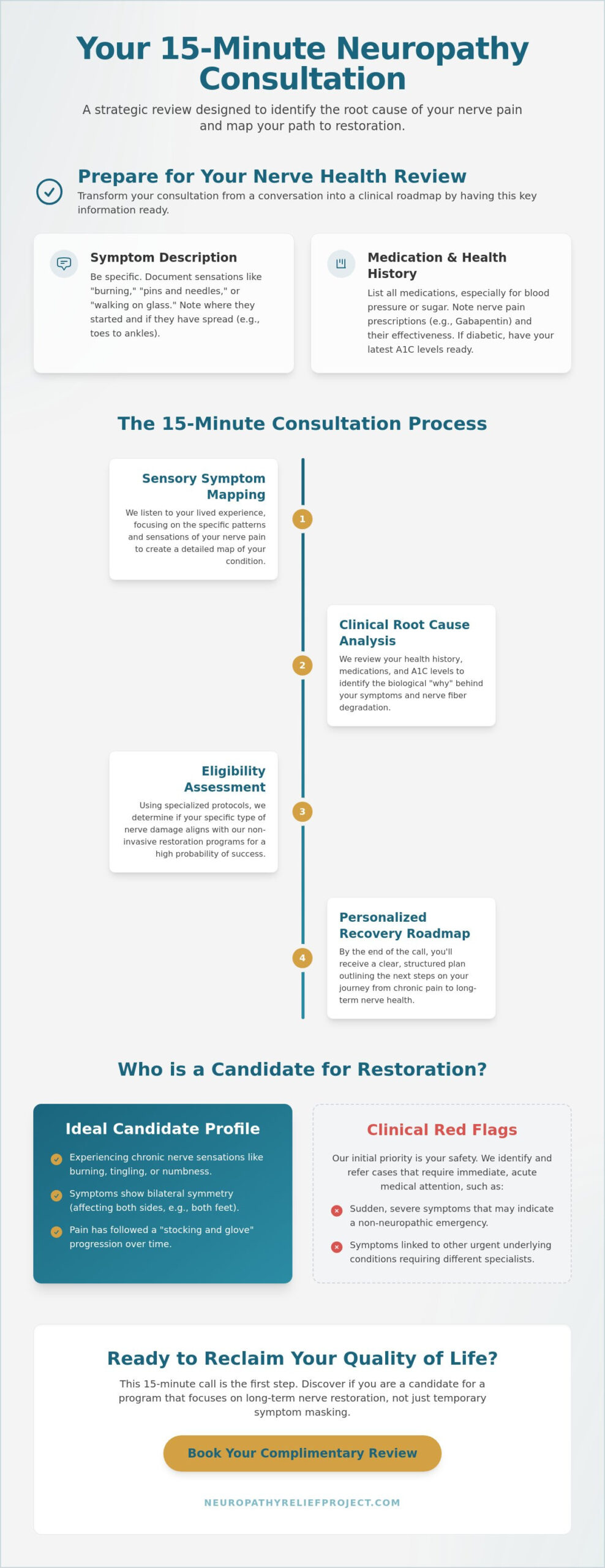
Preparation transforms a simple conversation into a clinical roadmap. Because our 15-minute window is highly focused, arriving with a clear history of your physical experiences ensures we don’t miss the subtle clues that define your condition. You’ve likely spent months, or even years, trying to explain the “walking on glass” sensation to providers who only offered a cursory glance. The neuropathy consultation process works best when we move beyond generalities and dive into the specific sensory markers of your nerve health.
Start by documenting your current medication list. We need to know if you are taking blood pressure stabilizers or managing blood sugar, as these factors directly impact nerve vascularity. If you’ve been prescribed common medications like Gabapentin or Duloxetine, note how long you’ve taken them and whether they’ve provided genuine relief or simply clouded your symptoms. While institutions like Stanford Health Care detail a complex diagnostic process involving extensive testing, our initial review focuses on the clinical history that determines your immediate eligibility for our restorative protocols.
Specific Data Points to Have Ready
If you are managing diabetes, please have your most recent A1C levels available. Since an estimated 50% of individuals with diabetes will develop neuropathy, this number is a critical indicator of your nerve environment. You should also trace the physical “migration” of your symptoms. Did the numbness start in your toes and slowly move toward your ankles? This progression, known as a “stocking and glove” pattern, provides vital evidence of how your nerve fibers are retreating. Additionally, note the frequency of nighttime flares. If electric shocks or buzzing sensations are stealing your sleep, it tells us a great deal about the current state of your peripheral nervous system.
Mental Preparation for the Call
One of the biggest hurdles to recovery is the “old age” mindset. Many patients have been told that their pain is just a natural part of growing older, but nerve death is a clinical condition, not an inevitability. Be ready to describe your pain in vivid, sensory terms. Are you feeling a stabbing sensation, a constant buzzing, or a cold numbness? Using these descriptors helps us understand the specific fibers involved. Remember, this is a collaborative effort. By providing these details, you can schedule your expert review with the confidence that you are an active partner in your own restoration journey.
Breaking Down the Neuropathy Consultation Process
Efficiency doesn’t mean brevity at the expense of care. In our 15-minute review, every second is a surgical strike for the information needed to change your clinical trajectory. While most online resources suggest you prepare for your neurologist visit by expecting a battery of physical tests, our preliminary neuropathy consultation process focuses on the diagnostic data held within your own sensory experience. We break this call into three distinct phases to ensure we capture the full picture of your nerve health without wasting a moment of your time.
The first five minutes are dedicated to symptom mapping. This is where we listen to the “language” of your nerves. If you describe a buzzing sensation that only occurs at night, or a sharp, electric shock when you stand, these are specific clues about which nerve fibers are struggling. We move quickly from these descriptions to the second phase, where we analyze the biological “Why” behind your discomfort. By the ten-minute mark, we aim to identify whether your condition is driven by poor micro-circulation, metabolic issues, or idiopathic factors that haven’t been properly addressed by previous care teams.
The Symptom Mapping Phase
We begin by tracing the geographic spread of your pain. If the numbness has traveled from your toes to your mid-calf, it suggests a progressive degradation of the sensory nerves. We also look for signs of motor nerve involvement, such as a sudden weakness in your grip or a tendency to trip over your own feet. This phase is critical for your safety. If your neuropathy is impacting your balance, your risk of a life-altering fall increases, making the need for a structured recovery roadmap even more urgent.
Identifying the Root Cause
Once we understand the “Where,” we pivot to the “Why.” We focus heavily on micro-circulation, which is the delivery of oxygen-rich blood to your nerve endings. When these tiny blood vessels fail, the nerves begin to starve and eventually die. We’ll discuss your history with known triggers like diabetes or chemotherapy, but we also look for hidden stressors that others might have overlooked. Our goal is to explain how to heal nerve damage through biological restoration rather than simply masking the pain with heavy medications. In the final minutes of the call, we provide immediate feedback on whether your specific case is a fit for our specialized protocols, ensuring you leave the conversation with a clear sense of hope and direction.
Determining Eligibility for Non-Invasive Restoration
Determining eligibility is the most critical phase of the neuropathy consultation process. Unlike traditional systems that may offer a one-size-fits-all prescription regardless of the underlying damage, we prioritize clinical integrity by selecting only those who have a viable biological path to recovery. This stage of our review focuses on the current state of your myelin sheath, the protective coating of your nerves. If this coating is completely degraded, the nerve cannot transmit signals effectively. However, if there is still a foundation to build upon, restoration becomes a clinical possibility rather than just a distant hope.
Many of our patients arrive after years of relying on Gabapentin or Lyrica. While these medications can dull the sensation of pain, they don’t address the underlying death of nerve fibers. Our collaborative initiative is designed for individuals who are ready to move away from drug dependency and toward a protocol that stimulates actual biological repair. We often hear the question, “Is it too late for my nerves to recover?” While nerve damage is a serious condition, the peripheral nervous system has a remarkable capacity for healing if the right environment is created before the damage becomes absolute.
What Makes a Good Candidate?
We look for specific markers during our review to ensure we can provide meaningful results. Generally, a good candidate meets the following criteria:
- Possession of at least 15% to 20% remaining nerve function, which provides the necessary biological “seeds” for restoration.
- A clear commitment to a drug-free management approach that prioritizes long-term health over short-term symptom masking.
- Symptoms that fall within the early to mid-stage range of peripheral neuropathy, where the nerve environment is still responsive to stimulation.
When We Might Refer You Elsewhere
Part of being a responsible specialist is knowing when our protocols are not the right fit. If your neuropathy consultation process reveals symptoms of severe spinal cord compression or structural issues requiring immediate surgical intervention, we’ll direct you to the appropriate acute care facility. We also look closely at your history of failed neuropathy treatments. If your previous experiences suggest an underlying pathology that doesn’t align with our biological restoration model, we’ll be honest about that. Our goal is your safety and the most effective path to relief, even if that path lies outside our organization.
If you are ready to find out where you stand on the path to recovery, request your 15-minute consultation today to begin your eligibility review.
Transitioning from Discovery to a Personalized Care Plan
The conclusion of your 15-minute review marks the end of the assessment phase and the beginning of the architecture of your recovery. If we determine that you are a candidate for our protocols, you won’t be left to wonder about the “how” or “when” of your next steps. We provide a “Next Steps” document immediately following a successful neuropathy consultation process. This document acts as a clinical bridge, translating the sensory data we discussed into a structured roadmap that outlines the specific biological stressors we intend to address. It ensures that you move from the phone call to your first session with a clear understanding of the goals we’ve set together.
Setting realistic expectations is a hallmark of our clinical authority. Nerve restoration is a biological process, not an overnight event. While some patients report a change in sensation early in the journey, the path to long-term relief requires a steady, methodical approach. We focus on the gradual transition from the cold numbness or “dead” feeling in your extremities back to healthy, normal sensation. By securing your spot for a free nerve pain consultation, you are taking the first strategic step toward a life defined by mobility rather than restriction.
The Road to Restoration
Our collaborative initiative utilizes the non-invasive protocols developed by Dr. Sclafani, which are designed to stimulate the body’s natural healing mechanisms. We don’t just look for a reduction in pain; we monitor your progress as your nerves begin to communicate more effectively with your brain. This journey requires consistency. Just as a starving plant needs regular water to thrive, your nerves require a consistent environment of oxygen and nutrients to rebuild their protective myelin sheaths. We’ll be with you at every milestone, adjusting your plan as your sensory mapping improves and your balance becomes more secure.
Your Action Plan
Finalizing your next steps is simple. Once the call concludes, you can use our online scheduling system to secure the time that works best for your initial in-person session. You’ll receive a confirmation email detailing everything you need to bring, including any recent lab results or health history updates. We want you to feel informed and empowered, not rushed or overwhelmed. For those living with peripheral neuropathy, the fear of permanent damage is often the heaviest burden. We are here to tell you that with a structured plan and an evidence-based approach, there is genuine hope for restoration and a return to the activities you love.
Reclaiming Your Future Through Clinical Clarity
You don’t have to accept a life defined by chronic pain and diminishing mobility. By understanding the neuropathy consultation process, you’ve already taken a vital step toward reclaiming your quality of life. This initial review is designed to move beyond the frustration of previous failed treatments and identify the biological potential for genuine nerve restoration. We focus on the health of your myelin sheath and the specific sensory markers that indicate whether your nerves are ready to respond to our specialized, non-invasive protocols. Every detail you provide during this call helps us build a more accurate picture of your path forward.
Led by Dr. Michael J. Sclafani, DC, this collaborative initiative prioritizes long-term results over the temporary masking of symptoms. We invite you to Book Your 15-Minute FREE Neuropathy Consultation Today to determine your eligibility for our restoration program. You deserve a structured roadmap that addresses the root cause of your discomfort rather than just the sensations it creates. There is genuine hope for a future where you feel more connected to your body and more confident in every step you take. Let’s begin this journey together.
Frequently Asked Questions
Is the 15-minute neuropathy consultation really free?
Yes, the initial 15-minute phone review is completely free of charge. We believe that removing financial barriers to this initial screening is essential for those who have already spent significant resources on treatments that didn’t work. This discovery call serves as a preliminary clinical assessment to see if our restorative protocols are the right fit for your specific nerve health needs without any upfront cost.
Can I speak with Dr. Sclafani directly during the consultation process?
The initial discovery call is conducted by our specialized clinical screening team, who utilize the specific triage protocols developed by Dr. Michael Sclafani. This ensures that every patient receives a methodical and expert-led review of their sensory symptoms. If your case is identified as a candidate for restoration, the next steps in your care plan will involve a deeper integration with our clinical leadership to finalize your recovery roadmap.
Do I need a formal diagnosis from a neurologist before calling?
You don’t need a formal diagnosis from a neurologist to begin the neuropathy consultation process with our team. Many of our patients come to us because they are still searching for answers or feel that their current diagnosis doesn’t fully explain their daily physical struggle. We focus on your lived experience and sensory markers to determine if our biological restoration model can help you reclaim your mobility.
How soon can I expect to start treatment after my consultation?
If you are determined to be an eligible candidate, you can typically expect to begin your personalized care plan within one to two weeks of your discovery call. Once your eligibility is confirmed, we’ll provide a “Next Steps” document and help you secure your first in-person session through our scheduling system. This quick transition ensures that we don’t lose momentum in the journey toward nerve restoration and long-term relief.
What happens if I am not a candidate for the Neuropathy Relief Project?
If our review suggests that your condition isn’t a fit for our non-invasive protocols, we’ll provide an honest and professional assessment of why. We prioritize clinical integrity and patient safety above all else. In these cases, we may suggest other clinical paths or recommend that you seek immediate acute care if we identify “red flags” that require surgical or emergency intervention beyond the scope of our restoration program.
Can the consultation process be done via video call instead of phone?
Currently, our initial 15-minute discovery call is conducted strictly via telephone. This format allows us to focus deeply on your verbal description of sensory symptoms without the technical distractions that can sometimes accompany video platforms. It provides a low-pressure environment where you can speak candidly about your history of burning, tingling, or numbness from the comfort of your own home without worrying about camera setups.
Is this consultation available for all types of peripheral neuropathy?
Yes, the 15-minute review is available for individuals experiencing various forms of peripheral neuropathy, including diabetic, idiopathic, and chemotherapy-induced cases. Our specialized protocols are designed to identify the biological triggers behind your specific nerve damage. Whether you are dealing with “stocking and glove” patterns or localized nerve pain, we’ll evaluate your sensory history to see if our restoration approach is appropriate for your unique situation. To make the most of your time with our clinical team, reviewing the key questions to ask during a neuropathy phone consultation can help you arrive fully prepared to advocate for your nerve health.
What should I do if I miss my scheduled consultation time?
If you miss your scheduled call, please use the link in your confirmation email or contact our office directly to find a new time that works for you. We understand that chronic health challenges can be unpredictable and may impact your daily schedule. Because these 15-minute windows are highly sought after, letting us know as soon as possible allows us to offer that time to another patient who is also seeking a path to recovery.