
What if the sharp, “walking on glass” sensation you feel every morning isn’t a permanent sentence, but a biological signal that your nerves are starving for the right restorative conditions? You’ve likely been told to “give it time” or offered medications that merely dull the fire without addressing the underlying damage. It’s exhausting to feel like your body is failing you while the traditional system offers little more than a way to mask the symptoms. We understand that the fear of permanent disability is a heavy burden to carry, especially when 50% of patients with diabetes face these exact challenges.
In our collaborative effort to bridge clinical evidence and holistic restoration, we believe understanding nerve damage recovery starts with seeing it as a metabolic rebuilding process rather than a waiting game. You’ll discover the specific biological requirements for peripheral nerve regeneration, including how oxygenation and myelin repair create the foundation for lasting sensation. This guide details the science behind 2026 breakthroughs and outlines a structured, drug-free path toward improving your balance and mobility. This journey shows you how your body can move from survival back into active repair, and we offer a 15 minute FREE phone Consultation to help you map out your path toward improvement.
Key Takeaways
- Learn why traditional medications often stall your progress by numbing the brain’s perception of pain instead of addressing the actual biological health of the nerve tissue.
- Gain a deeper level of understanding nerve damage recovery by exploring how Schwann cells act as specialized construction workers to rebuild damaged pathways.
- Discover the three essential pillars of restoration, nutrient delivery, oxygenation, and signal stimulation, that transform recovery from a passive hope into an active biological process.
- Explore how a mission-driven collaborative effort prioritizes long-term restoration and liberation from symptoms, providing a structured path back to improved mobility.
The Spectrum of Nerve Damage Recovery: What Does “Healing” Really Mean?
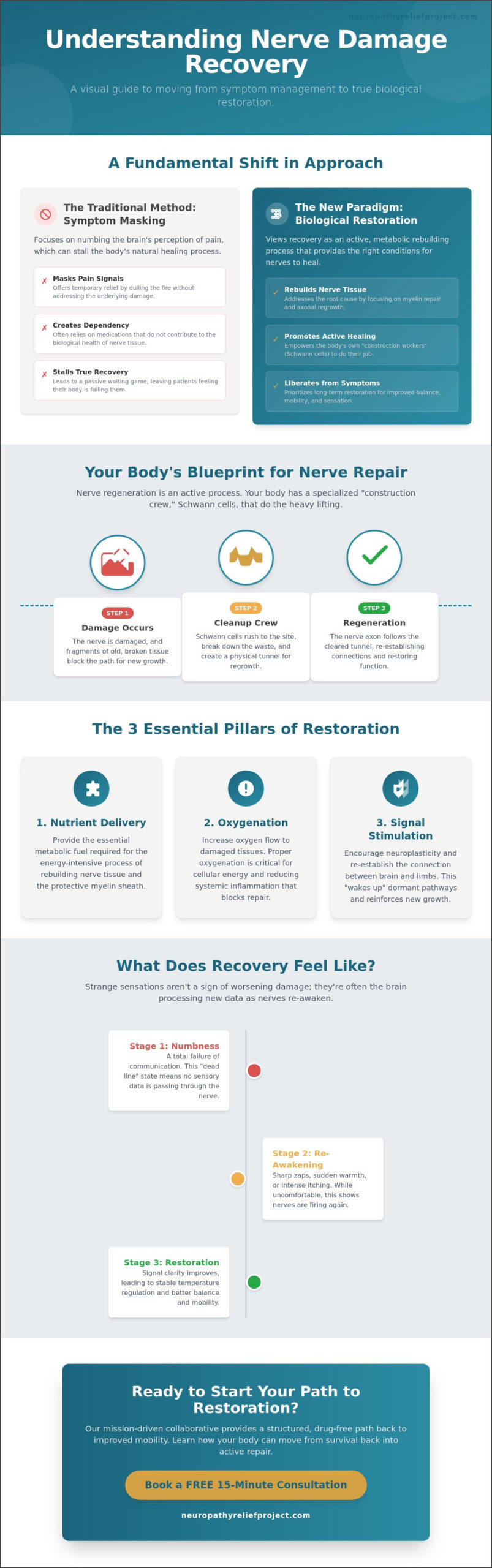
When we discuss healing, we aren’t just talking about the closure of a physical wound. In the context of your peripheral nervous system, recovery is the restoration of signal clarity between your brain and your limbs. Think of it as clearing the static from a radio broadcast until the music becomes crisp again. For many, understanding nerve damage recovery is difficult because the sensations of “getting better” often feel quite strange. We recognize the frustration of feeling dismissed by systems that only offer temporary fixes, but it’s important to know that your body is capable of profound change. You might experience sharp zaps, sudden warmth, or intense itching. These aren’t necessarily signs of worsening damage; they’re often the brain’s way of processing new data as the neuroregeneration process begins to re-establish lost connections.
It’s vital to distinguish between nerve repair and nerve restoration. Repair is often a surgical event, such as using a graft to bridge a physical gap. Restoration, however, is a biological journey. It involves the metabolic rebuilding of the nerve’s internal structure. While your central nervous system has limited regrowth capacity, your peripheral nerves possess a remarkable degree of neuroplasticity. They can adapt, reroute, and thicken their protective coatings if the right biological conditions are met. This collaborative effort between your cells and your environment is what allows for the return of true sensation.
Sensory Signals: Recognizing the Stages of Repair
If you notice your feet moving from a state of total numbness to one of intense tingling, you’re witnessing a shift in the stages of repair. Numbness represents a total failure of communication, a “dead” line where no data passes through. Sensitivity, while sometimes uncomfortable, suggests that the nerves are re-awakening. This transition often moves from “phantom” burning sensations to a more stable ability to regulate temperature. This shift indicates that the autonomic fibers are regaining their function, moving you closer to the goal of restored balance and mobility.
Traumatic vs. Chronic Neuropathy Recovery
Recovery doesn’t follow a single timeline for every person. If you’ve suffered a traumatic injury, like a deep laceration or a crush, the path is often linear. Axons in these cases typically regrow at a rate of approximately one inch per month. Chronic neuropathy, such as that caused by diabetes or chemotherapy, requires a more systemic approach. In these cases, the focus shifts from simple axonal regrowth to thickening the myelin sheath. This fatty insulation prevents signal leaks and ensures that the message from your toe actually reaches your brain. Because chronic damage often involves ongoing metabolic stress, stopping the degradation is the first step toward lasting restoration.
The Biological Mechanism of Nerve Tissue Restoration
If you’ve ever felt like your body is stuck in a cycle of pain, it’s helpful to look at the specialized “construction workers” of your nervous system: Schwann cells. These cells are essential for understanding nerve damage recovery because they do the heavy lifting of clearing away cellular debris. When a nerve is damaged, the fragments of the old, broken tissue actually block the path for new growth. Schwann cells rush to the site, break down the waste, and create a physical tunnel for the regenerating axon to follow. Recent advances in nerve regeneration research suggest that the speed of this cleanup process is a major factor in how quickly you regain sensation.
This biological rebuilding isn’t free. Nerve regeneration is an incredibly energy-intensive process. Your body must decide how to allocate its resources. If your system is flooded with chronic inflammation, your internal resources are diverted to fighting that “fire” rather than rebuilding your nerves. To prioritize restoration, the body requires specific metabolic fuel to power the cellular machinery. When systemic inflammation is low, the body can finally focus on the intricate work of axonal regrowth. This metabolic shift is a cornerstone of understanding nerve damage recovery in a way that moves beyond masking pain. If you’re curious about how your specific symptoms might respond to this biological approach, a 15 minute FREE phone Consultation can provide clarity on your unique situation.
Myelin Sheath Restoration: Rebuilding the Insulation
Think of the myelin sheath as the plastic coating on an electrical wire. When this coating becomes thin or frayed, the signals don’t just slow down; they “leak” and cause the sharp, short-circuiting sensations you know as nerve pain. Rebuilding this insulation is a critical step in restoring signal speed and clarity. You can explore the deeper science of this process in our guide on myelin sheath restoration. By focusing on the structural integrity of this sheath, we can move from temporary relief to a more permanent state of signal stability.
The Role of Micro-Circulation and Oxygenation
Nerves are among the most oxygen-hungry tissues in your body. They rely on a vast network of tiny blood vessels called micro-circulation to deliver the oxygen and nutrients required for survival. When this blood flow is restricted, your nerves essentially begin to starve, leading to the numbness and “dead” sensations in your hands or feet. This vascular starvation is often what stalls recovery in chronic cases. Improving this vascular link is non-negotiable for recovery. Detailed information on this connection is available in our resource on blood flow and nerve repair.
Why Traditional Symptom Management Often Stalls Recovery
If you’ve been told that your only option is to “live with it” or simply manage your symptoms until they inevitably worsen, you’ve been given an incomplete picture. This management-only philosophy often leads to a frustrating cycle where the dose of your medication increases while your actual mobility decreases. This happens because the standard approach focuses entirely on the sensory output, the pain itself, rather than the physical health of the nerve. Understanding nerve damage recovery requires a shift in perspective. We must look past how the brain perceives the signal and focus on the health of the physical wire. When we only treat the symptom, we ignore the starvation and cellular debris that continue to damage the nerve tissue beneath the surface.
Taking high-dose pain medications can often lead to a false sense of security. Because the “fire” feels dampened, it’s easy to assume the damage has stopped. In reality, the underlying degradation often continues unabated. Fixing the nerve is a biological process that requires active intervention, not just a chemical mute button. Our collaborative effort aims to provide a clear path toward improvement for those who have felt lost in these systems, moving away from a life of masking and toward a life of genuine restoration.
The Masking Effect of Neuropathy Medications
Many common prescriptions work by blocking calcium channels, which essentially mutes the pain signal before it ever reaches your brain. While this provides temporary relief from the sharp zaps or burning, it does nothing to rebuild the myelin sheath or support the axon. If the underlying metabolic environment remains toxic, the nerve continues to starve even if you can’t feel it. You can explore the clinical context of this phenomenon in our guide on why nerve drugs fail. Relying solely on these blockers can stall your recovery by ignoring the structural repair your body desperately needs.
The Gut-Nerve Axis: Addressing Systemic Inflammation
Your peripheral nerves don’t exist in a vacuum. A pro-inflammatory environment, often driven by intestinal permeability or “leaky gut,” creates a systemic fire that prevents Schwann cells from performing their repair duties. When your body is in a state of constant high alert, it can’t prioritize the intricate, energy-heavy work of rebuilding nerve tissue. In our work, we emphasize the gut brain nerve axis to show how your microbiome might be fueling peripheral nerve fire. Addressing this systemic connection is a non-negotiable step for anyone seeking a drug-free path to recovery.
Essential Requirements for Successful Nerve Restoration
True understanding nerve damage recovery involves shifting from a passive wait-and-see mindset to an active, biological restoration protocol. While traditional advice often suggests that you simply “give it time” or wait for a checkup, your nerves require a specific set of metabolic conditions to thrive. If these conditions aren’t met, the regenerative process remains stalled. Restoration is built upon three non-negotiable pillars: nutrient delivery, oxygenation, and signal stimulation. When these three factors work in harmony, they create a fertile environment where your Schwann cells can effectively clear debris and rebuild the myelin sheath. Consistency is the most vital element here. Because nerves grow slowly, daily micro-improvements are far more effective than high-intensity, occasional treatments.
As sensation begins to return to your hands or feet, you might experience a period of sensory confusion. This is where nerve re-education becomes essential. Your brain has spent months or years without clear data from your limbs, and it must relearn how to interpret the new signals it receives. Without this re-mapping, the return of sensation can sometimes be interpreted as itching or discomfort. If you’re ready to move beyond passive waiting and want to see how these pillars apply to your specific symptoms, we invite you to schedule a 15 minute FREE phone Consultation to discuss your path forward.
Optimizing the Metabolic Environment
Your nerves rely on a complex system of axonal transport to move nutrients from the cell body down to the furthest nerve endings in your toes. This transport system is highly sensitive to your internal chemistry. High blood sugar, even within “pre-diabetic” ranges, can cause glycation, a process where sugar molecules bond to proteins and effectively “caramelize” the nerve tissue. To prevent this, glucose stability is a primary requirement for restoration. Additionally, reducing oxidative stress is crucial. Think of oxidative stress as biological “rust” that degrades nerve endings. By flooding the system with specific micronutrients and antioxidants, we can neutralize this rust and protect the new tissue as it grows.
Targeted Stimulation and Physical Restoration
Waking up dormant nerves requires specific, non-painful sensory input to remind the nervous system how to communicate. If a nerve isn’t being used, the body may deprioritize its repair. Targeted stimulation, often using light-based or frequency-based protocols, helps jumpstart the cellular machinery. These methods are designed to increase the production of ATP within the nerve cells. Adenosine triphosphate, or ATP, is the primary energy currency your cells use to power the complex work of nerve repair. Providing this energetic boost is a fundamental component of understanding nerve damage recovery in the modern era, as it gives the cells the “fuel” they need to sustain long-term restoration.
Navigating Your Path to Relief with the Neuropathy Relief Project
If you’ve spent years searching for answers, you know the frustration of being told that your symptoms are just an inevitable part of aging or a permanent side effect of your health history. The Neuropathy Relief Project was born out of a mission-driven collaborative effort to change that narrative for those who feel dismissed by traditional systems. We believe that understanding nerve damage recovery shouldn’t be an academic exercise; it should be the foundation of a real-world plan to reclaim your life. Our philosophy of “Restoration over Medication” isn’t just a tagline. It’s a commitment to addressing the starvation and structural damage we’ve detailed throughout this guide, rather than simply turning down the volume on your pain signals with a chemical mute button.
It’s completely normal to feel a sense of hesitation or even skepticism if you’ve tried protocols in the past that didn’t deliver the results you were promised. You’ve likely felt like a number on a chart rather than a person living with a daily struggle. We’re here to act as your knowledgeable guide, moving you from a place of confusion toward a structured, evidence-based plan. This journey is about more than just physical sensation; it’s about the liberation that comes with knowing you’re finally addressing the root cause of your mobility challenges. By focusing on the biological requirements for repair, we help you shift from a state of survival back into a state of active improvement.
The 15-Minute Expert Nerve Review Process
Your journey with us begins with a low-pressure discovery call designed to validate what you’re experiencing every day. During this review, we listen to your specific sensory experiences, whether it’s the “phantom” burning, the sharp zaps, or the loss of balance that keeps you from the activities you love. We use this time to determine if you’re a candidate for our restoration protocols. It’s a conversation with a professional who truly “gets it” and understands the specialized science of the peripheral nervous system. This initial step is about clarity, helping you gain a better understanding nerve damage recovery as it applies to your unique situation and identifying which metabolic hurdles are currently standing in your way.
Moving Beyond “Wait and See” to Active Restoration
In 2026, the field of regenerative medicine is moving faster than ever. With new biologics like acellular nerve allografts becoming commercially available in the second quarter of the year, the options for recovery are expanding. However, waiting too long can lead to permanent loss of function as the nerves continue to degrade without proper support. If you’ve been stuck in a “wait and see” cycle, now is the time to pivot toward active restoration. Early intervention is the most effective way to ensure your Schwann cells have the resources they need to rebuild your myelin sheath. You don’t have to navigate this complex system alone. You can take the first step toward restoring your mobility and sensation today. Schedule your 15-Minute FREE phone Consultation here and let’s discuss how we can support your path back to health.
Your Journey Toward Lasting Restoration and Liberation
The path back to restored sensation in your hands and feet isn’t found in a pill bottle or a “wait and see” approach. By understanding nerve damage recovery as a biological process of rebuilding, you can move away from the frustration of masking pain and toward the hope of genuine improvement. We’ve explored how Schwann cells require specific metabolic conditions and how the three pillars of nutrient delivery, oxygenation, and targeted stimulation create the foundation for repair. This shift from symptom management to active restoration is what allows for improved balance and a return to the activities you love.
Our collaborative effort is led by specialists dedicated to non-invasive nerve protocols and drug-free biological restoration. We provide national support for chronic neuropathy sufferers who have felt lost in traditional systems. If you’re ready to move beyond the “walking on glass” sensation and reclaim your mobility, we’re here to guide you. Schedule your 15-Minute FREE Nerve Restoration Consultation today to discuss your symptoms with a professional who understands your daily struggle. Your body has a remarkable capacity for healing when given the right tools. It’s time to take the first step toward a future defined by restoration rather than limitation.
Frequently Asked Questions
Can peripheral neuropathy actually be reversed or just managed?
Peripheral neuropathy can often be reversed rather than just managed when the focus shifts to biological restoration. While traditional medications only mask the pain signal, understanding nerve damage recovery requires addressing the underlying starvation and cellular debris that cause the degradation. If we can restore oxygenation and nutrient flow, your nerves have the innate capacity to rebuild their myelin sheaths and re-establish clear communication with the brain.
How long does it typically take for a nerve to heal after damage?
Nerve tissue typically heals at a rate of approximately one inch per month in cases of traumatic injury, though chronic neuropathy follows a less linear path. The timeline for your specific recovery depends heavily on your metabolic health and the consistency of your restoration protocol. Because this is a biological rebuilding process, it’s a steady, methodical journey that requires patience rather than a search for an overnight fix.
Why do my nerves hurt more at night when I am trying to rest?
You likely feel more pain at night because your brain has fewer external distractions, making it hyper-aware of the “static” signals coming from damaged nerves. Changes in your body’s blood pressure and temperature as you rest can also trigger spontaneous nerve firing. This often results in the burning or zapping sensations that make sleep difficult for those struggling with chronic peripheral nerve challenges.
Is it possible to heal nerve damage without using prescription drugs?
It’s entirely possible to restore nerve health without relying on prescription drugs that merely numb the brain’s perception of pain. Biological restoration focuses on the three pillars of oxygenation, nutrient delivery, and signal stimulation to fix the physical structure of the nerve. By creating a low-inflammation environment, you allow your Schwann cells to perform the necessary construction work required for permanent signal clarity.
What are the first signs that a nerve is beginning to recover?
The first signs of recovery often include a shift from total numbness to “active” sensations like tingling, itching, or sudden warmth. While these feelings can be strange or even uncomfortable, they indicate that your nerves are re-awakening and attempting to send signals again. This transition from a “dead” line to a sensitive one is a crucial milestone in understanding nerve damage recovery and moving toward improved mobility.
Can diet and gut health really impact the pain in my feet?
Your gut health plays a massive role in the pain you feel in your feet by either fueling or dampening systemic inflammation. A “leaky” gut allows toxins into the bloodstream, creating a pro-inflammatory environment that prevents your nerves from repairing themselves. By addressing the gut-nerve axis, you can stop the internal fire that keeps your peripheral nerves in a state of constant degradation and signal interference.
What happens during the free 15-minute neuropathy consultation?
During your 15 minute FREE phone Consultation, we conduct a discovery review to validate your symptoms and see if you’re a candidate for our restoration protocol. This is a low-pressure conversation where we listen to your history and explain the science behind our approach. It’s an opportunity to speak with a professional who understands your struggle and can provide a clear path toward potential improvement.
How much does it cost to fix nerve damage through your project?
The investment required for fixing nerve damage varies based on the extent of the damage and the specific biological requirements of your case. While the average cost of peripheral nerve surgery in the U.S. is approximately $25,000, our focus is on non-invasive biological restoration protocols. We recommend discussing your specific needs during your free consultation to receive a clear, structured plan that fits your situation without the need for invasive procedures.