

What if the word “unknown” was actually an invitation to look deeper rather than a reason to give up hope? If you’ve been told your lab results are normal while you struggle with the daily reality of burning, tingling, or sharp electrical pains, you might feel like your experience is being dismissed. Understanding idiopathic neuropathy what it means is the first step toward reclaiming your quality of life. An idiopathic diagnosis doesn’t mean your symptoms lack a physical cause. It simply indicates that standard diagnostic sensitivity hasn’t yet captured the specific trigger behind your nerve damage.
It’s incredibly frustrating to feel like you’re losing mobility while being told to simply “wait and see.” We agree that your symptoms are real and that your fear of progressive disability is valid. This article promises to help you discover the true meaning of an idiopathic diagnosis and the clinical pathways we use to identify hidden triggers for nerve restoration. We will look at why up to 46% of neuropathy cases are classified as idiopathic and provide a clear plan to move forward through a collaborative effort focused on long-term results. By shifting the focus from a label to a solution, you can find a path toward liberation from chronic pain.
Key Takeaways
- Learn exactly idiopathic neuropathy what it means by moving beyond the “unknown” label to understand how specific, yet unseen, biological processes are affecting your nerves.
- Discover why standard tests like EMGs often return “normal” results and how a focus on small-fiber nerve health can provide the validation you’ve been seeking.
- Identify the hidden environmental and metabolic factors that frequently masquerade as “unknown” causes, allowing you to address the root of your discomfort.
- Shift your strategy from merely masking sensory symptoms to a proactive framework that prioritizes cellular restoration and specialized nutritional support.
- Explore how a collaborative initiative can bridge the gap between clinical evidence and holistic recovery, offering a structured path toward lasting relief.
Decoding the Label: What “Idiopathic” Really Means for Your Nerves
If you’ve spent months or years visiting specialists only to be handed a folder labeled “idiopathic,” you aren’t alone. This term often feels like a dead end, but it’s actually just a starting point. To understand idiopathic neuropathy what it means, we have to look at the Greek roots of the word. “Idio” refers to one’s own, and “pathic” stems from the word for suffering or disease. Essentially, the medical system is saying this is a “disease of its own” with no obvious external trigger like chemotherapy, traumatic injury, or diabetes.
Research shows that between 25% and 46% of all cases fall into this category. It’s a massive group of people who are often told their nerves are damaged, yet the reason remains a mystery. This label is frequently applied when a patient suffers from Peripheral neuropathy but doesn’t fit into the standard boxes doctors check during a routine physical. If you are trying to grasp idiopathic neuropathy what it means for your future, start by recognizing that “unknown” is not a synonym for “untreatable.”
The Difference Between “No Cause” and “Unknown Cause”
Every biological effect has a precursor. Your nerves don’t begin to wither or misfire without a reason. When a clinician uses the term idiopathic, they aren’t saying there is no cause; they’re admitting the cause hasn’t been found yet. The traditional medical system often uses this as a placeholder. Because they can’t see the trigger on a standard blood panel, they shift their focus to symptomatic treatment. This usually involves prescribing medications to mask the pain rather than investigating the underlying biological stressor. We believe that every patient deserves a deeper dive into their unique physiological landscape to find the “why” behind the “what.”
Common Sensations Associated with Idiopathic Damage
Living with this condition is an intensely physical experience. You might feel a persistent burning in your feet, a prickling sensation like “pins and needles,” or a strange “phantom sock” feeling where your skin feels covered even when it’s bare. Many of these cases actually present as small fiber neuropathy, which affects the tiny nerve endings responsible for pain and temperature. The emotional weight of these symptoms is heavy, especially when your tests come back clear. It’s vital to remember that your pain is biologically real. Normal lab results don’t mean the damage isn’t there; they just mean the tests weren’t sensitive enough to find it.
The Diagnostic Gap: Why Standard Testing Often Misses the Mark
If you’ve undergone an Electromyography (EMG) or a Nerve Conduction Velocity (NCV) test only to be told everything looks fine, you’re likely feeling a mix of relief and deep confusion. This is the core of the diagnostic gap. When people ask about idiopathic neuropathy what it means for their health, they’re often surprised to learn that these “gold standard” tests only measure the performance of large-diameter, myelinated nerve fibers. These are the nerves responsible for muscle control and vibration sense. If your damage is occurring in the smaller, unmyelinated fibers that signal pain and temperature, an EMG will return a perfectly normal result even while you’re in agony.
Standard blood work often falls into the same trap. A laboratory’s “normal” range for Vitamin B12 or blood glucose is a broad statistical average, not a personalized health marker. You might have a “sub-clinical” deficiency or glucose spikes that don’t yet move your A1C into the diabetic range, yet they are still high enough to cause nerve irritation. As noted in this Peripheral Neuropathy Fact Sheet, identifying the specific type of nerve damage is crucial for effective management. A brief 15-minute neurology appointment rarely allows enough time to peel back these layers of your medical history or environment. This time constraint often forces clinicians to focus on the most obvious, high-level data rather than the subtle, individual nuances of your biology.
Small Fiber Neuropathy: The Hidden Culprit
Small fiber neuropathy is frequently the silent driver behind idiopathic diagnoses. Because these fibers are too small to be measured by electrical impulses on the skin’s surface, they require a different diagnostic lens, such as a specialized skin biopsy or a detailed clinical sensory assessment. These fibers regulate your perception of heat and sharp pain. When they’re damaged, the result is often an intense, relentless burning that feels completely disconnected from your “normal” test results. It’s not in your head; it’s simply in a part of the nervous system that standard electrical tests aren’t designed to see.
The Role of Sub-Clinical Metabolic Stress
Metabolic health is rarely an all-or-nothing state. Many patients exist in a gray area of “pre-diabetes” or insulin resistance where their bodies struggle to process sugar efficiently. This creates a cascade of oxidative stress that slowly degrades the myelin sheath, the protective coating on your nerves. These causes of peripheral neuropathy are often cumulative. Small, daily stressors add up over time until the nerves can no longer repair themselves. If you feel stuck in this cycle, scheduling a 15 minute free phone consultation can help you begin to map out these hidden metabolic triggers and find idiopathic neuropathy what it means in the context of your specific biology.
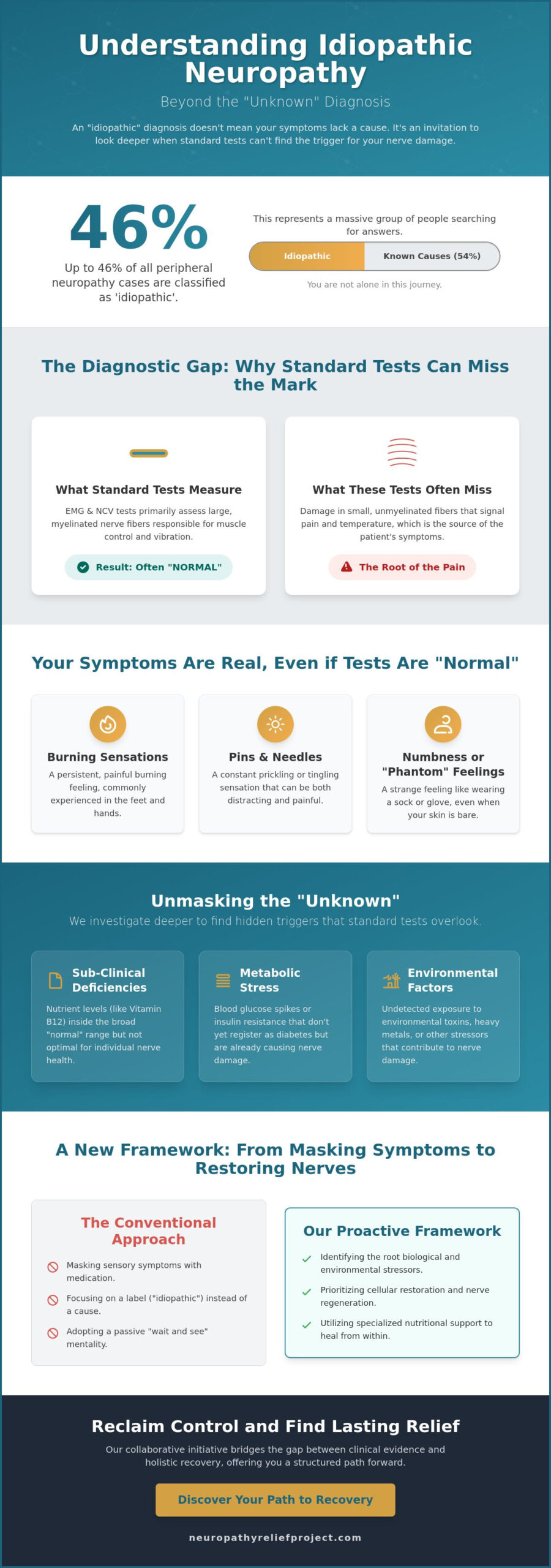
Unmasking the “Unknown”: Potential Hidden Triggers of Idiopathic Neuropathy
When you’re left wondering about idiopathic neuropathy what it means for your daily life, the answer often lies in the subtle layers of your biology that standard screenings overlook. Metabolic syndrome is one of the most frequent “hidden” contributors. While your blood sugar might not be high enough for a diabetes diagnosis, the combination of elevated blood pressure and increased waist circumference creates a pro-inflammatory environment. This state of constant irritation can slowly degrade nerve tissue over time. As Johns Hopkins Medicine explains idiopathic polyneuropathy, the condition often involves a slow progression that requires a comprehensive look at systemic health rather than a single lab result.
Environmental neurotoxins and nutritional imbalances also play significant roles in these “mystery” cases. You might be surprised to learn that excessive levels of Vitamin B6 or a subtle copper deficiency can mimic the symptoms of more common neuropathies. Similarly, long-term exposure to heavy metals or certain household chemicals can accumulate in the body, eventually reaching a threshold where the nervous system begins to fail. In other instances, an idiopathic diagnosis masks a mild autoimmune flare where your body’s defense system mistakenly targets the protective nerve lining. These triggers aren’t always visible on a standard panel, but they’re very real drivers of your physical sensations.
The Gut-Nerve Connection
Your digestive system and your nervous system are deeply intertwined. If your gut microbiome is imbalanced, it can compromise the blood-nerve barrier, allowing systemic inflammation to reach sensitive nerve endings. This “leaky” environment means that what happens in your gut doesn’t stay there; it can manifest as the sharp, electrical pains you feel in your hands or feet. In many of these cases, the label “idiopathic” is simply a placeholder for “inflammatory,” suggesting that the path to restoration begins with calming the body’s internal defenses and healing the gut lining.
Micro-Circulation and Nerve “Suffocation”
Nerves require a constant supply of oxygen and nutrients to function, which they receive through a network of tiny blood vessels called the vasa nervorum. When these microscopic vessels constrict or become damaged by lifestyle factors, your nerves effectively begin to “suffocate.” This lack of oxygen leads to the familiar burning and numbness that characterizes the condition. Understanding this process is a vital part of idiopathic neuropathy what it means because it shifts the focus toward improving blood flow and cellular health. You can learn more about understanding nerve damage recovery to see how restoring this circulation is a cornerstone of any successful clinical pathway.
Beyond the Diagnosis: A Proactive Framework for Nerve Restoration
If you’ve been managing symptoms with standard prescriptions, you might feel like you’re just treading water. Shifting your perspective is essential for long-term improvement. Understanding idiopathic neuropathy what it means for your daily routine involves moving from a “masking” mindset to a “restoration” mindset. Instead of just turning down the volume of the pain with medications that target the brain’s perception, we focus on the biological environment where your nerves actually live. This proactive approach prioritizes supporting the health of the tissue itself, creating the right conditions for the body’s natural repair mechanisms to engage.
Anti-inflammatory nutrition serves as a clinical foundation for this process. When you choose foods that lower systemic inflammation, you reduce the chemical “noise” that constantly irritates damaged nerve endings. This dietary shift works alongside movement. Movement acts as medicine by stimulating micro-circulation and improving nerve signal clarity. Specific, low-impact activities like gentle walking or swimming help re-educate the nervous system and prevent the atrophy that often follows a period of reduced mobility. As we discussed earlier regarding micro-circulation, keeping these pathways open is vital for delivering the oxygen your nerves crave.
Sleep is another critical pillar often overlooked in standard clinical models. During deep rest, the glymphatic system becomes active, clearing metabolic waste and cellular debris from the nervous system. Without this nightly “housecleaning,” the nerves remain bogged down by the byproducts of oxidative stress, making cellular repair significantly slower. If you find your symptoms flare up after a poor night’s rest, it’s often a direct result of this interrupted cleaning process.
Non-Drug Nerve Relief Strategies
Exploring non-drug nerve relief strategies can be a liberating experience for those limited by traditional medication side effects. Technologies like photobiomodulation use specific wavelengths of light to stimulate mitochondrial activity, effectively “waking up” dormant nerve fibers. When combined with specialized supplementation that supports the myelin sheath, these methods provide a multi-faceted path toward recovery that addresses the root of the problem rather than just the sensation.
Daily Habits for Nerve Safety
Consistency in small daily habits creates a protective buffer for your nervous system. If you struggle with reduced sensation, a rigorous foot care protocol is non-negotiable to prevent undetected injuries. Hydration also plays a vital role, as even mild dehydration can slow nerve conduction velocity. Finally, managing stress is essential; when your nervous system is “hyped up,” your brain is primed to perceive signals as intense pain. If you’re ready to move beyond the standard medical approach, schedule a 15 minute free phone consultation to see how we can help you navigate idiopathic neuropathy what it means for your specific recovery journey.
Reclaiming Control: How the Neuropathy Relief Project Navigates the Unknown
Navigating the medical system with a chronic condition can often feel like you’re being moved along a conveyor belt. When doctors use the label idiopathic, they often stop looking for answers and start looking for prescriptions. Dr. Michael Sclafani established the Neuropathy Relief Project to break this cycle. Our collaborative initiative is designed specifically for those who have been told there is no known cause for their suffering. We believe that identifying idiopathic neuropathy what it means for your specific body requires a more specialized, restorative lens than a standard 15 minute physical can provide. By focusing on research-driven, non-invasive protocols, we help you move beyond the “wait and see” approach toward a future of actual improvement.
Our approach differs fundamentally from traditional symptom management. Instead of just trying to dull the electrical shocks or burning sensations in your feet, we look at the underlying physiological signals that others might miss. This isn’t just about managing a condition; it’s about reclaiming a sense of agency over your own health. A specialized review of your history can completely shift your perspective on your diagnosis. It moves the conversation from a life sentence of disability to a manageable, restorable health challenge. We act as a knowledgeable guide through a complex system, providing the reliability and specialized knowledge you need to feel secure in your plan.
A Compassionate Path to Answers
We believe that empathy and clinical authority must go hand in hand. Living with a mystery condition is exhausting, and feeling heard is the first step toward healing. Our project looks at the hidden signals of nerve distress, such as micro-vascular health and metabolic markers that fall outside the typical “normal” ranges. This allows us to create a structured plan for drug-free nerve pain management that addresses your unique biology. We aren’t just looking for a label; we’re looking for a path toward liberation from the daily struggle of nerve pain.
Your Next Step: The Discovery Call
If you’re ready to stop guessing and start healing, your next step is simple and methodical. We offer a 15 minute free phone consultation to help you understand idiopathic neuropathy what it means in the context of our restorative protocols. During this call, we’ll discuss your specific symptoms and determine if you’re a candidate for our specialized approach. It’s a low-pressure way to get the clarity you’ve been seeking without the rush of a standard clinical environment. Schedule your free 15-minute nerve review today and take the first step toward a collaborative journey focused on long-term results.
Moving Beyond the “Unknown” to Restore Your Quality of Life
Living with a diagnosis of exclusion doesn’t have to be a life sentence of uncertainty. We’ve explored how the label “idiopathic” often reflects the limitations of standard diagnostic tools rather than a lack of a physical cause. By investigating hidden metabolic stressors, environmental triggers, and the health of your micro-circulation, we can begin to bridge the gap between “unknown” and actionable recovery. Shifting your focus from masking sensations to supporting cellular tissue health is the cornerstone of lasting restoration.
Now that you understand idiopathic neuropathy what it means for your diagnostic journey, it’s time to take a proactive step toward relief. Led by Dr. Michael J. Sclafani, DC, the Neuropathy Relief Project specializes in non-invasive, drug-free protocols for chronic nerve pain sufferers across the nation. Our collaborative initiative is dedicated to finding the answers that standard systems often overlook. You don’t have to navigate this maze alone. There is a clear path forward focused on long-term results and liberation from pain.
If you’re ready to explore a restorative approach tailored to your unique biology, we invite you to Book Your Free 15-Minute Neuropathy Discovery Call today. This brief conversation is the first step in determining if our specialized protocols are the right fit for your needs. Your journey toward reclaiming your mobility and comfort starts with a single, informed decision. We are here to guide you every step of the way.
Frequently Asked Questions
Is idiopathic neuropathy a progressive condition?
Yes, idiopathic neuropathy often progresses if the underlying biological stressors remain unidentified and unaddressed. Without a structured plan to support nerve health, the damage can spread from the feet upward or into the hands. The rate of this progression varies significantly for each person, which is why a proactive approach is essential. Identifying your specific triggers early is the most effective way to slow or halt the decline of nerve function.
Can idiopathic neuropathy be reversed if the cause is unknown?
Nerve restoration and significant symptom improvement are possible even when the initial cause is labeled as unknown. By focusing on the biological environment, such as improving micro-circulation and reducing oxidative stress, we create the necessary conditions for nerves to repair themselves. Understanding idiopathic neuropathy what it means involves realizing that the cause is hidden, not non-existent. Shifting the focus toward cellular support can lead to a measurable recovery of sensation.
What is the most common hidden cause of idiopathic neuropathy?
Metabolic syndrome is frequently the primary hidden driver behind these “mystery” cases. This includes a cluster of conditions like high blood pressure, elevated triglycerides, and insulin resistance that may not yet reach the threshold for a diabetes diagnosis. Even sub-clinical glucose spikes can cause cumulative damage to the protective myelin sheath. Addressing these metabolic factors through specialized nutrition often provides better long-term results than simply masking the pain with medication.
Why do my nerves hurt more at night if the cause is idiopathic?
Nighttime pain flares occur because your brain has fewer environmental distractions, making it more sensitive to the misfiring signals from damaged nerves. Additionally, your body’s natural anti-inflammatory cortisol levels naturally drop late in the evening. This physiological shift, combined with a lower core body temperature, can make burning or tingling sensations feel much more intense. It is a physical reality of the condition, regardless of whether the cause is known.
Are there specific vitamins that help with idiopathic nerve pain?
B-complex vitamins, especially B12 and B1, are essential for nerve health, but they must be managed with precision. It is a common mistake to over-supplement; for instance, excessive levels of Vitamin B6 can actually be neurotoxic and worsen your symptoms. We recommend a specialized review of your nutritional status to ensure you are supporting the myelin sheath without inadvertently causing further irritation. Proper balance is the key to effective restoration.
How is idiopathic neuropathy different from diabetic neuropathy?
The primary difference is the clarity of the diagnostic trigger. Diabetic neuropathy is directly linked to chronic high blood sugar, while idiopathic neuropathy is a diagnosis of exclusion used when standard tests don’t reveal a cause. Despite the different labels, the physical sensations and the underlying biological need for nerve restoration are often identical. Both conditions require a focus on improving the health of the tissue to achieve lasting relief.
Does an idiopathic diagnosis mean it is “all in my head”?
No, an idiopathic diagnosis confirms that your nerve damage is biologically real even if standard lab work appears normal. It indicates a limitation in current diagnostic sensitivity rather than a lack of physical evidence. Your pain and numbness are real responses to nerve fibers that are struggling to function. You deserve validation and a clinical pathway that looks deeper into the “hidden” signals of nerve distress that others might miss.
What questions should I ask my neurologist about my idiopathic diagnosis?
You should ask if your diagnostic tests evaluated small nerve fibers, as standard EMGs only measure large-fiber function. Inquire about sub-clinical metabolic markers or the possibility of environmental neurotoxins that could be contributing to your symptoms. If you feel stuck in a “wait and see” cycle, scheduling a 15 minute free phone consultation can help you prepare more targeted questions. Gaining this clarity is a vital part of understanding idiopathic neuropathy what it means for your future.