

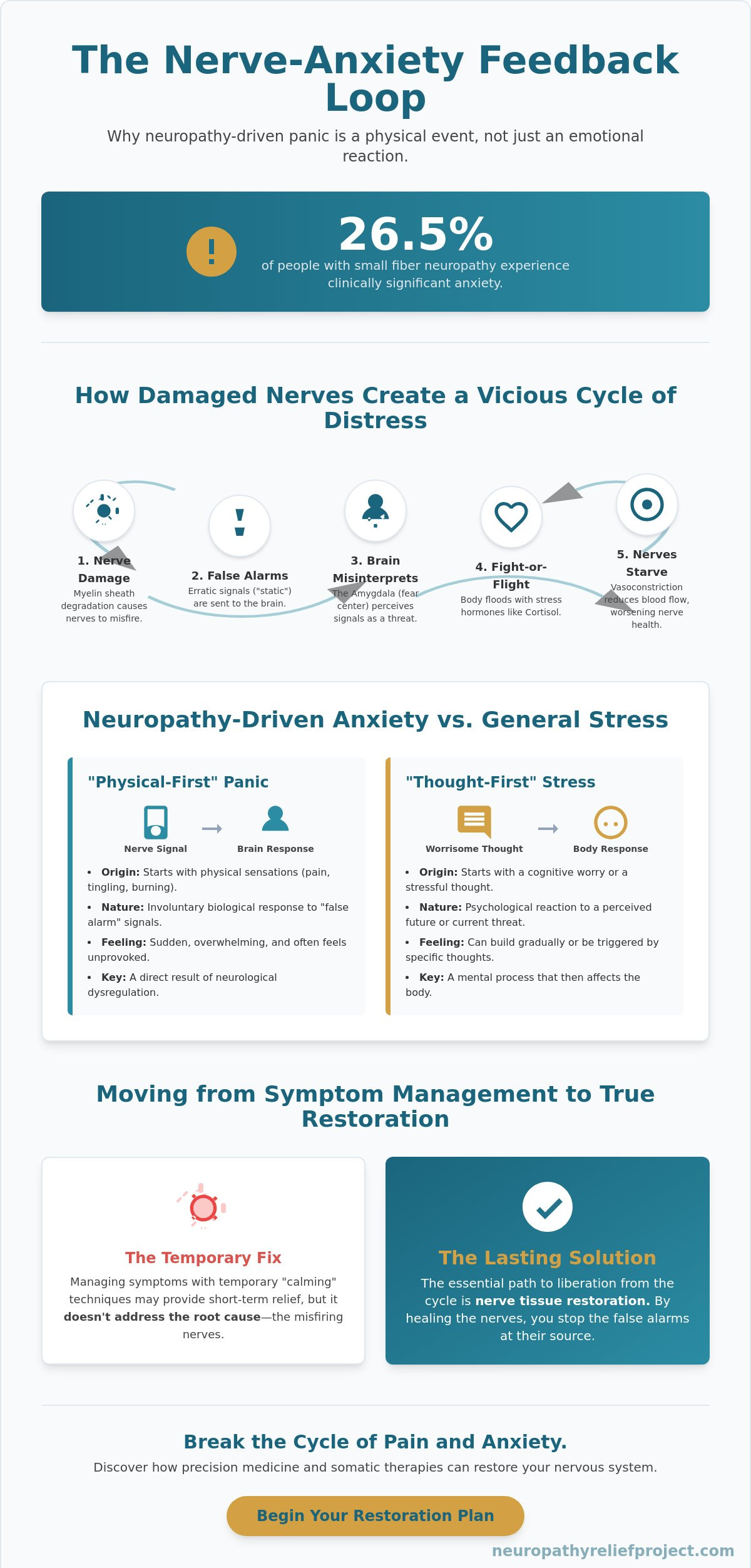
What if that sudden surge of panic you feel during a pain flare isn’t just a reaction, but a direct biological consequence of your nerves “short-circuiting”? If you’ve ever felt your heart race as a sharp jolt of pain travels down your leg, you aren’t alone. Research shows that 26.5% of people with small fiber neuropathy experience clinically significant anxiety. It’s a heavy burden to carry, especially when you’re constantly fearing the next unpredictable flare-up or worrying about losing your independence. We understand that managing anxiety from neuropathy symptoms is a physical challenge as much as an emotional one, because your nervous system is trapped in a cycle of distress.
In this guide, we’ll bridge the gap between clinical science and your lived experience. You’ll discover the biological link between nerve damage and panic, and you’ll learn evidence-based strategies to break the cycle. By understanding why your nervous system is stuck in a state of high alert, you can begin a clear plan for nerve restoration. We’ll preview the latest trends in precision medicine and somatic therapies that move beyond temporary fixes to help you restore a lasting sense of calm to your body and mind.
Key Takeaways
- Understand how myelin sheath degradation creates sensory “static” that your brain misinterprets as a reason to trigger an involuntary fight-or-flight response.
- Learn to distinguish between “thought-first” general stress and the “physical-first” panic that occurs when managing anxiety from neuropathy symptoms.
- Master immediate sensory “reset” strategies, like temperature regulation and visual grounding, to interrupt the feedback loop between your nerves and your brain.
- Discover why nerve tissue restoration is the essential path to liberation from the cycle of chronic sensory overload and emotional exhaustion.
The Invisible Feedback Loop: Why Neuropathy Triggers Chronic Anxiety
If you feel like your body is constantly shouting at you, it isn’t just in your head. For many, managing anxiety from neuropathy symptoms feels like a losing battle because the source of the distress is biological, not just psychological. When nerves are damaged, they don’t simply stop working; they often begin to misfire, sending a relentless stream of “noise” to the brain. This chronic sensory overload acts like a broken alarm system that won’t turn off. Eventually, this constant input exhausts your brain’s regulatory capacity, leaving you in a state of perpetual emotional and physical depletion. You may feel trapped in your own skin, waiting for a signal that never clarifies.
To truly understand this connection, we have to look at what peripheral neuropathy is and how it alters the communication between your limbs and your mind. It’s a collaborative effort between your nervous system and your brain to keep you safe, but when the signals are corrupted, the brain assumes there’s a threat that doesn’t exist. Calming the mind is nearly impossible without first addressing the physical “static” coming from your peripheral nerves.
When Pain Becomes a Permanent ‘Alert’ State
Every burning, tingling, or electric sensation is interpreted by your amygdala, the brain’s fear center, as a potential danger. Over time, your nervous system can undergo a process called “wind-up,” where it becomes hypersensitive to even minor stimuli. This hyper-vigilance keeps your body in a state of high alert, flooding your system with stress hormones like cortisol. The result is a profound sense of physical exhaustion. Research shows that 26.5% of people with small fiber neuropathy experience clinically significant anxiety, highlighting how these physical “alerts” translate into a measurable mental health burden.
The Emotional Toll of Unpredictable Symptoms
The most taxing part of this condition is often the unpredictability. You don’t know when the next flare-up will strike or if a sudden bout of numbness will lead to a fall. This creates a cycle of anticipatory anxiety that can be just as draining as the pain itself. The fear of losing your independence or your ability to move safely through your home can make your world feel smaller. Understanding the daily realities of living with peripheral neuropathy is the first step toward regaining control. By recognizing that your anxiety is a physiological response to nerve dysfunction, you can stop blaming yourself and start focusing on restoration.
The Biology of Fear: How Damaged Nerves Send False Alarms
Imagine your nerves as high-speed data cables. These cables are wrapped in a protective insulation called the Myelin sheath, which ensures that signals travel clearly and quickly from your limbs to your brain. When this insulation degrades, the signals begin to “leak” or cross-talk, creating a form of internal electrical static. Your brain is a master at pattern recognition, but it struggles to interpret these erratic nerve damage signals. Instead of ignoring the noise, your central nervous system treats it as a warning of physical danger. This is the biological foundation of why managing anxiety from neuropathy symptoms is so difficult. It’s not a lack of willpower; it’s a physiological surge of cortisol triggered by a misfiring system.
Even when you’re in a safe, quiet environment, your body may be behaving as if it’s under attack. This shift from acute pain to a chronic state of neurological alarm happens because your brain cannot distinguish between a real external threat and the “false alarms” coming from your damaged peripheral nerves. You’re not just dealing with “mental” anxiety. You’re experiencing a profound state of neurological dysregulation that keeps your body’s stress response on a hair-trigger.
Micro-Circulation and the Stress Response
When your brain enters this survival mode, it triggers vasoconstriction, which is the narrowing of blood vessels. This is a natural response designed to divert blood to your vital organs during a crisis. However, for someone with neuropathy, this response creates a dangerous loop. The narrowed vessels further starve your peripheral nerves of the oxygen and nutrients they need to heal. This is why traditional “calming” techniques often fall short. If your nerves are physically starving for oxygen, deep breathing alone cannot resolve the underlying distress. Addressing these biological factors is a collaborative effort. While you explore our guide on living with peripheral neuropathy, remember that personalized support like a 15 minute FREE phone consultation can help clarify your specific path to restoration.
The Central Sensitization Connection
If the peripheral signals remain loud and erratic for too long, the spinal cord and brain begin to “re-wire” themselves to accommodate the noise. This process, known as central sensitization, makes your entire nervous system hypersensitive. Even a light touch or a cool breeze can be interpreted as intense pain. Central sensitization is the process where the brain stays in “high-alert” despite no external threat. This re-wiring means your anxiety has moved from a temporary reaction to a permanent neurological state, requiring a targeted approach to restore signal clarity and quiet the mind.
Identifying Neuropathy-Driven Anxiety vs. General Stress
Distinguishing between life’s typical stresses and the panic born from damaged nerves is essential for your recovery. While general anxiety often begins with a thought, such as a worry about a deadline or a family matter, neuropathy-driven anxiety is “physical-first.” You might be sitting calmly when a sensation like walking on broken glass suddenly jolts through your feet. Your heart rate spikes instantly. Your breath becomes shallow. This isn’t a failure of your mindset; it’s your body’s survival mechanism reacting to a perceived physical threat. Effectively managing anxiety from neuropathy symptoms requires recognizing that your brain is responding to a physical stimulus, not just an abstract fear.
Treating the mind alone is often insufficient for neuropathy patients because the “alarm” is being triggered from the periphery of the body. If you only focus on cognitive behavioral techniques while your nerves are still misfiring, you’re trying to put out a fire while someone is still pouring gasoline on it. It’s vital to manage the emotional stress that follows these jolts, but you must also work toward quieting the nerves themselves.
To help you identify the source of your distress, consider these key differences:
- Neuropathy-Driven Anxiety: Triggered by physical jolts, burning, or “walking on glass” sensations.
- General Stress: Triggered by external events, deadlines, or interpersonal conflicts.
- Physical Response: Immediate heart rate spikes and shallow breathing often precede the conscious thought of being anxious.
Sensory Triggers and Physical Flashbacks
A sudden electric shock sensation can mimic a full-blown panic attack, causing a rush of adrenaline that leaves you shaking. Over time, your body develops a “body memory” associated with these severe flares. You might find yourself tensing up before even entering a room where a previous flare occurred. These episodes require a specialized non-drug nerve relief approach that focuses on calming the physical source of the signal and restoring clear communication between your limbs and your brain.
The Sleep-Deprivation Factor
Sleep is the primary time your nervous system repairs itself. Unfortunately, many patients experience intense burning pain at night, which prevents them from reaching deep REM sleep. This lack of restorative rest lowers your anxiety threshold significantly. When you’re sleep-deprived, your brain’s ability to regulate emotions is compromised, making every pain signal feel more catastrophic. Restoring sleep is a critical first step in breaking the anxiety loop and stabilizing your daytime emotional state. When you prioritize managing anxiety from neuropathy symptoms through both physical and emotional support, you begin to reclaim your peace. This is a collaborative effort, and if you’re feeling lost, a 15 minute FREE phone consultation can help you find a clear path forward.
5 Evidence-Based Strategies for Immediate Nerve and Mind Relief
When a flare hits, your first instinct might be to tense up, but this physical bracing only heightens the distress. Managing anxiety from neuropathy symptoms requires a toolkit of strategies that interrupt the signal loop before it overwhelms your central nervous system. By introducing new, non-threatening sensory inputs, you can effectively quiet the pain signals that trigger panic. These methods aren’t just distractions; they are biological interventions designed to stabilize a dysregulated system.
- Temperature Regulation: Submerging your hands or feet in cool, but not ice cold, water provides a massive, neutral sensory input. This acts as a “sensory reset” for misfiring nerves.
- Grounding with Visuals: Pick a color and find five objects of that hue in your immediate environment. This forces the brain to shift from internal pain monitoring to external observation.
- Gentle Desensitization: Retrain your nerves by lightly stroking the affected area with different textures, such as a cotton ball or a silk scarf, to teach the brain that touch is not a threat.
- Targeted Hydration: Nerve conductivity depends on electrolyte balance. Drinking water helps flush inflammatory markers that can irritate already sensitive nerve endings.
- Professional Clinical Review: Moving from self-management to a collaborative clinical review ensures you aren’t just chasing symptoms but addressing the root cause of the damage.
Tactile Grounding for Nerve Flares
Texture therapy works through the science of competing signals. Your brain has a limited capacity for processing incoming sensory data. When you introduce the distinct, safe sensation of a specific texture, you create a sensory distraction that overrides the burning or tingling noise. The brain prioritizes this new, varied tactile information over the chronic, static pain signal. For those with highly sensitive skin, start with natural fibers like bamboo or high-thread-count cotton. Focusing on the specific ridges of a textured fabric can effectively diminish the intensity of the “false alarms” your nerves are sending.
The Role of Breathwork in Nerve Conductivity
Specific breathing patterns, such as the 4-7-8 technique, directly impact your autonomic nervous system. By inhaling for four seconds, holding for seven, and exhaling for eight, you signal to your brain that the “threat” has passed. Diaphragmatic breathing increases oxygen delivery to peripheral nerve endings. This improved micro-circulation is vital for both calming the mind and supporting the biological repair of nerve tissue. If you feel lost in the complexity of your symptoms, a 15 minute FREE phone consultation can help you build a structured plan for restoration.
Moving Toward Restoration: Why Managing Symptoms Isn’t Enough
Coping is a bridge, but it isn’t the destination. If you’ve spent months or years trying to “breathe through” the panic of a pain flare, you already know that mental resilience has its limits when the body is in constant distress. Managing anxiety from neuropathy symptoms requires more than just psychological tools; it requires a fundamental shift in your biology. When the underlying nerve damage remains unaddressed, your brain stays trapped in a cycle of hyper-vigilance that no amount of meditation can fully silence. True liberation from this cycle begins when we stop merely masking the noise and start focusing on restoration.
When you prioritize nerve damage recovery, you are addressing the physical root of your anxiety. As the health of the peripheral nerves improves and signal clarity is restored, the brain naturally lowers its alarm state. The Neuropathy Relief Project acts as a mission-driven guide for those who feel dismissed by traditional systems. We view your recovery as a collaborative effort, focusing on the long-term results that come from healing the nervous system rather than just dulling its responses.
From Management to Liberation
Standard medical approaches often rely on heavy medications to numb the sensations of neuropathy. While these may provide temporary relief, they frequently leave the underlying damage untouched. A structured, science-backed peripheral neuropathy reversal program focuses on the biological path to restoration. By seeking a specialized second opinion, you move away from the frustration of “managing” a decline and toward the possibility of functional improvement. You deserve a strategy that recognizes the link between your physical sensations and your emotional well-being.
Your First Step: The 15-Minute Discovery Call
Taking the first step toward a calmer nervous system shouldn’t be overwhelming. During our free consultation, we provide a methodical symptom review and an eligibility check to determine if our specialized protocols match your needs. Speaking with a specialist who understands why your body feels like it’s “short-circuiting” can provide a profound sense of relief and a clear path forward. This conversation is designed to build trust and ensure you feel informed rather than rushed through a complex system.
Schedule your free 15-minute neuropathy consultation today. Let’s begin the journey of quietening the false alarms and restoring the peace your nervous system deserves.
Reclaim Your Peace and Nerve Health
Living with the constant “static” of nerve pain is an exhausting experience that naturally leads to a state of high alert. Effectively managing anxiety from neuropathy symptoms is more than just a mental exercise; it’s a biological necessity. Because your panic is a physiological response to misfiring signals, you can shift your focus from merely coping to actively restoring your nervous system. Sensory grounding and improved micro-circulation can help interrupt the feedback loop, but lasting liberation requires a targeted, evidence-based approach to nerve health.
Our collaborative initiative, led by Dr. Michael J. Sclafani, DC, is dedicated to providing non-invasive, drug-free restoration for those who feel lost in traditional systems. With a national reach for specialized neuropathy reviews, we act as your knowledgeable guide on the journey toward long-term results. You don’t have to navigate this path alone or settle for temporary fixes that only mask the problem.
Take the first step today. Book Your Free 15-Minute Nerve Relief Consultation to discuss your symptoms and discover a personalized plan for restoration. There is hope for a future where you feel in control of your body once again.
Frequently Asked Questions
Can anxiety actually cause physical neuropathy symptoms like tingling?
Anxiety can trigger temporary physical sensations like tingling or numbness through the fight-or-flight response, but these usually vanish once the stressor is removed. If your symptoms are persistent or localized, they likely stem from actual damage to the peripheral nerves rather than just emotional stress. It’s helpful to observe if the sensations remain even during moments of relative mental calm.
How do I know if my panic attacks are being caused by my nerve pain?
The sequence of your symptoms is the most reliable indicator. If a physical sensation like a sudden electric jolt or intense burning occurs first and is immediately followed by a racing heart, your panic is likely a physiological reaction to nerve misfiring. This “physical-first” pattern distinguishes neuropathy-driven distress from general anxiety, which usually begins with a worried thought.
Is it safe to exercise for anxiety if I have severe neuropathy in my feet?
You can still use movement to lower stress, but you must prioritize low-impact options to protect your feet. Activities like swimming, seated yoga, or using a recumbent bike allow you to improve circulation and lower cortisol without the risk of falls or increased pain from weight-bearing movements. Always check your feet for any irritation after exercise if you have significant numbness.
Why do my neuropathy symptoms and anxiety get worse at night?
Nighttime often brings a lack of external distractions, which forces your brain to focus entirely on internal pain signals. Additionally, your body’s circadian rhythms cause changes in temperature and cortisol levels that can heighten the perception of burning or tingling. This increased pain naturally leads to higher levels of nighttime anxiety and restlessness.
Can restoring my nerves actually make my anxiety go away?
When you address the underlying nerve damage, you remove the source of the “false alarms” being sent to your brain. Restoring signal clarity allows your central nervous system to finally leave its permanent high-alert state. As the physical noise from your limbs quietens, the biological triggers for your anxiety are significantly reduced, allowing for a lasting sense of calm.
What is the best way to calm down during a sudden nerve pain flare?
Immediate sensory resets are the most effective way to interrupt the pain-panic loop. Try submerging your hands or feet in cool water or focusing intensely on the texture of a soft fabric to provide your brain with a new, safe signal. These tactile grounding techniques help override the erratic pain signals before they can escalate into a full-blown panic attack.
Are there non-drug treatments that address both nerve pain and anxiety?
Yes, a collaborative approach that combines nerve restoration with somatic techniques like diaphragmatic breathing is highly effective. These non-drug protocols are essential for managing anxiety from neuropathy symptoms by quieting the peripheral nerves and the mind simultaneously. If you’re looking for a clear path toward restoration, a 15 minute FREE phone consultation can help you explore these specialized options.