

What if the very supplement you’re taking to support your nervous system is actually the source of your burning pain? If you’ve been diagnosed with “idiopathic” neuropathy while diligently taking a B-complex, you aren’t alone in your frustration. With 75% of American adults reporting daily supplement use as of May 2026, many are unknowingly crossing the threshold into vitamin b6 nerve damage. It’s a confusing reality; you’re trying to do the right thing for your body, yet your feet are tingling and your hands feel numb. You’ve likely felt dismissed by doctors who overlook your supplement cabinet, leaving you to wonder if this sensory loss is permanent.
At the Neuropathy Relief Project, we believe you deserve a clear path back to cellular health. You don’t have to live in fear of your symptoms. This guide will help you identify if your intake has exceeded the 100 mg daily tolerable upper limit and show you how to stop the progression of toxicity. We’ll explore the science of nerve regeneration and provide a structured plan to revitalize your nerves. If you’re ready for personalized guidance, we offer a 15 minute FREE phone Consultation to help you bridge the gap between clinical evidence and natural recovery.
Key Takeaways
- Understand how high levels of pyridoxine overwhelm the protective enzymes in your dorsal root ganglia, turning an essential nutrient into a neurotoxin.
- Identify subtle warning signs like “glove-and-stocking” numbness and unsteady gait that often indicate your supplement routine has crossed a safe threshold.
- Learn why vitamin b6 nerve damage can sometimes feel worse before it gets better, a biological reality known as the “coasting phenomenon.”
- Discover the clinical steps to halt sensory loss and create an environment that supports natural nerve regeneration and long-term recovery.
- Find out how a structured approach can help you move from a confusing “idiopathic” diagnosis toward a clear plan for revitalizing your peripheral nerves.
What is Vitamin B6 Toxicity-Induced Neuropathy?
Vitamin B6, also known as pyridoxine, is a water-soluble nutrient that’s absolutely vital for your neurological health. It serves as a necessary cofactor for over 100 different enzymes, helping your body produce the neurotransmitters that regulate your mood and sleep. It’s the silent worker behind your serotonin and dopamine levels. But here lies the paradox: while your nerves depend on B6 to function, an overabundance of this nutrient turns into a potent neurotoxin. When you consume more than your body can metabolize, it begins to target your sensory nerves, leading to the painful symptoms of peripheral neuropathy. Pyridoxine toxicity is a dose-dependent neurological condition occurring when intake exceeds the body’s metabolic capacity.
The Recommended Daily Allowance (RDA) vs. Toxic Levels
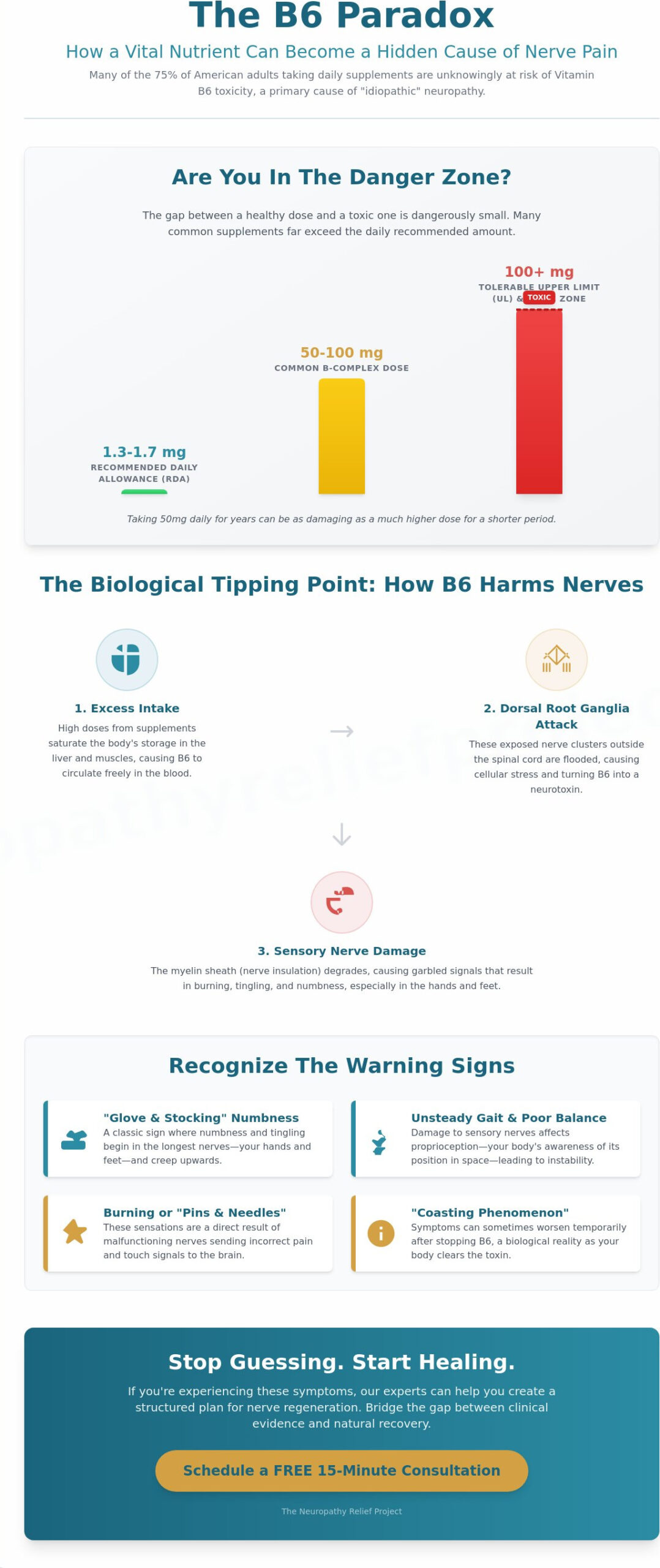
The difference between a healthy dose and a toxic one is surprisingly narrow. According to clinical standards, the RDA for adults under 50 is only 1.3 mg. Even for those over 50, it only rises to 1.7 mg. Compare this to the supplements found on most pharmacy shelves, which frequently pack 50 mg to 100 mg into a single capsule. This creates a “danger zone” where vitamin b6 nerve damage can quietly develop over months or years. Many supplement manufacturers ignore the 100 mg Tolerable Upper Limit (UL), and because these products are often labeled as “natural” or “energy-boosting,” patients don’t realize they’re putting their nerve health at risk. It’s not just about the size of the dose; it’s about the duration. Taking 50 mg daily for three years can be just as destructive as taking 200 mg for six months.
Why Vitamin B6 is Unique Among B-Vitamins
Most people assume that all B-vitamins are harmless because they’re water-soluble, believing the body simply flushes out what it doesn’t use. While this is largely true for B12, Vitamin B6 has a very different biological profile. It’s one of the few water-soluble vitamins with a well-documented toxicity profile, often categorized clinically as Megavitamin-B6 syndrome. Your body processes and stores pyridoxine primarily in your liver and muscles. Once these storage sites are saturated, the excess B6 circulates in the blood, where it interferes with the very enzymes meant to protect your nerve cells. This specific vulnerability makes it a unique outlier among the many causes of peripheral neuropathy we treat at the Project. If you’re experiencing unexplained burning or tingling, your supplement cabinet might be the first place to look for answers.
The Biological Mechanism: How Excess B6 Impacts Sensory Fibers
To understand why your body reacts so strongly to high pyridoxine levels, we must look at the dorsal root ganglia. These are clusters of nerve cell bodies located just outside your spinal cord. Unlike the rest of your central nervous system, which is shielded by a tight blood-brain barrier, the dorsal root ganglia are relatively exposed. This lack of a protective filter makes them the primary target for vitamin b6 nerve damage. When pyridoxine levels spike, these sensitive cells are flooded, leading to cellular stress and eventually, nerve death. Clinical research highlighted in the Neurotoxic risks of vitamin B6 explains how this overexposure can even mimic severe motor neuron diseases, though the damage is almost exclusively sensory in its early stages.
Excess B6 doesn’t just overwhelm the cells; it actively interferes with the enzymes responsible for maintaining your nerve health. Your body relies on a delicate balance between different forms of the vitamin. When you consume high doses of synthetic pyridoxine, it competes for the same binding sites as the active, beneficial form of the vitamin (P5P). This competition effectively “starves” the nerve of its functional nutrients. Over time, this chemical imbalance can degrade the myelin sheath, which is the insulating layer that ensures electrical signals travel clearly from your limbs to your brain. Without this insulation, signals become garbled, resulting in the “pins and needles” sensations you may be feeling right now.
Sensory Nerves: The “Canaries in the Coal Mine”
Because your longest nerve fibers require the most metabolic energy to maintain, your feet and hands are usually the first to suffer. This often leads to several specific sensory disruptions:
- Loss of Proprioception: You might feel unsteady on your feet or find yourself looking down to make sure you’re stepping correctly because your brain isn’t receiving clear data about where your limbs are in space.
- Dying Back: This is a biological process where the nerve ending slowly retreats toward the spine as it loses the ability to sustain itself.
- Sensory-Only Focus: Unlike other forms of neuropathy, you’ll likely notice that your muscle strength remains intact even as the burning and numbness intensify.
Why Toxicity Mimics Deficiency
One of the most frustrating aspects of this condition is the “vicious cycle” it creates. Because the symptoms of toxicity, like tingling and numbness, look exactly like the symptoms of a B6 deficiency, many patients respond by increasing their supplement dose. This only accelerates the damage. This confusion is why B6 is frequently identified as one of the hidden idiopathic neuropathy causes. If you suspect your supplement routine is contributing to your pain, speaking with a specialist can help you untangle these complex signals. We offer a 15 minute FREE phone Consultation to help you determine if your current protocol is helping or hindering your recovery.
Recognizing the Symptoms and the Risk of “Supplement Stacking”
Identifying the early warning signs of vitamin b6 nerve damage is often difficult because the symptoms mirror many other neurological conditions. If you experience a persistent “pins and needles” sensation in your extremities, your body may be signaling that its metabolic threshold has been breached. This sensory disruption typically follows a “glove-and-stocking” distribution, where numbness and tingling begin in the toes and fingers before slowly migrating up the limbs. You might also notice a distinct loss of balance or an “unsteady gait.” This happens because the toxicity impairs your proprioception, which is your brain’s ability to sense the position of your feet without looking at them. When these signals are garbled, even walking across a flat living room floor can feel precarious. This risk of falls and balance disruption is especially concerning when you consider the well-documented relationship between neuropathy and aging, as older adults face a significantly narrower safety margin for nerve health.
Many patients feel a sense of confusion when their blood tests reveal high B6 levels, especially if they believe they are only taking a modest supplement. This is where the modern risk of “Supplement Stacking” becomes a critical factor in your health. Supplement stacking occurs when an individual unknowingly consumes high doses of B6 across energy drinks, fortified cereals, multivitamins, and B-complex capsules. By the time you combine a morning bowl of fortified flakes, a mid-day “energy” shot, and a nightly multivitamin, you may have consumed 150 mg or more of pyridoxine. This cumulative effect quietly builds up in your tissues, pushing you well beyond the 100 mg tolerable upper limit without you ever reaching for a high-dose therapeutic bottle.
Hidden Sources of Pyridoxine in 2026
In our current health-conscious culture, B6 is added to an array of products that aren’t strictly classified as supplements. To protect your nerves, it’s vital to audit your daily intake of the following common culprits:
- Pre-workout powders: Many fitness blends contain 20 to 50 mg of B6 to support energy metabolism.
- “Stress Relief” complexes: These often use high-dose B6 to facilitate neurotransmitter production.
- Fortified plant milks: Almond, oat, and soy milks are frequently enriched with B-vitamins at levels exceeding 20% of your daily value per serving.
When reviewing labels, look specifically for “Pyridoxine HCl,” which is the synthetic form most frequently linked to toxicity. While some products use “P5P” (the active form), any concentrated source contributes to your daily total.
When Tingling Becomes Numbness: The Progression
If left unaddressed, the intermittent tingling of early toxicity often transitions into a constant, debilitating burning pain. Many of our patients describe a “walking on glass” sensation, where every step feels sharp and agonizing. This shift marks a deeper level of nerve fiber irritation. It’s worth noting that medications commonly taken alongside supplements — such as cholesterol-lowering drugs — can compound this nerve irritation, and patients managing both risks should be aware of statin induced neuropathy as an additional hidden trigger. Understanding what helps neuropathy in feet can provide much-needed symptomatic relief, but the primary goal must remain the identification and removal of the toxic trigger. Recognizing these patterns early is the most effective way to prevent permanent sensory loss and begin the process of restoration.
The Recovery Roadmap: Can B6 Nerve Damage Be Reversed?
If you’ve spent weeks or months worrying about the future of your mobility, the most important thing to know is that vitamin b6 nerve damage is often reversible if the toxic trigger is identified early. Unlike some forms of neurological decay, the sensory fibers damaged by pyridoxine have a remarkable capacity for healing once the chemical assault stops. However, you must understand that nerve regeneration is a slow, methodical process. Under optimal cellular conditions, peripheral nerves typically grow at a rate of approximately 1mm per day, which translates to about one inch per month. This means that if you’re experiencing numbness in your toes, it may take several months for the healing process to fully reach the furthest extremities of your body.
When you stop taking B6 supplements, you might encounter a confusing hurdle known as the “coasting phenomenon.” For a period of 2 to 4 weeks after cessation, your symptoms might actually feel slightly worse. This happens because the excess B6 stored in your muscle and liver tissue continues to circulate in your bloodstream as your body attempts to clear the backlog. Don’t let this temporary flare-up discourage you. It’s a sign that your body is beginning the work of detoxification, and it’s a critical phase where professional guidance can help you manage the discomfort without reaching for the very supplements that caused the issue.
Immediate Steps to Halt Progression
The first step in your recovery is establishing a clinical baseline through blood testing. You should request a fasting B6 serum level test to confirm the extent of the toxicity. Once the results are in, work closely with a healthcare provider to safely stop all non-essential supplements, including those “hidden” sources like energy drinks or pre-workout powders mentioned earlier. Increasing your daily water intake is also essential, as hydration helps your kidneys process and flush out these water-soluble vitamins more efficiently. This isn’t just about stopping a pill; it’s about clearing the path for your nerves to breathe again.
Creating an Environment for Nerve Repair
Stopping the toxin is only the first half of the battle. To truly revitalize your sensory health, you must create an internal environment that supports micro-circulation and oxygenation. Your nerves require a steady supply of oxygen and nutrients to fuel the 1mm-per-day growth cycle. Simply “waiting and seeing” is often not enough for those with severe sensory loss, as the nerves need active support to overcome the damage. Exploring non-drug nerve relief protocols can provide the structural and metabolic support your body needs during this delicate transition. If you’re ready to move beyond the frustration of “idiopathic” pain and start a targeted plan for restoration, we invite you to schedule your 15 minute FREE phone Consultation to discuss your specific path to recovery.
Navigating Your Nerve Health with the Neuropathy Relief Project
The journey through vitamin b6 nerve damage can feel incredibly isolating, especially when you’ve been doing everything “right” for your health. If you feel lost in a healthcare system that provides only vague answers or prescription masks for your pain, the Neuropathy Relief Project is here to act as your knowledgeable guide. We don’t view your symptoms as a series of disconnected complaints; we see them as a complex puzzle that requires a specialized, research-driven approach. By framing our work as a “Project,” we emphasize that your recovery is a collaborative, ongoing effort toward a specific goal: restoring the cellular health of your peripheral nerves. You shouldn’t have to navigate the “post-B6” recovery journey alone.
Our protocols are built on a foundation of clinical authority and natural restoration. We understand that stopping a supplement is just the first step in a much longer process of nerve regeneration. While traditional medicine often stops at the diagnosis, we focus on the science of revitalization. This means looking at how oxygenation, micro-circulation, and specific metabolic supports can speed up that 1mm-per-day growth rate we discussed earlier. You don’t have to live in the anxiety of a slow recovery timeline without an expert advocate by your side to ensure your body has the tools it needs for success.
Why a Specialized Review Matters
It’s a common story: a patient presents with burning and tingling, but because their blood sugar is normal, a general practitioner labels the case as “idiopathic.” In many instances, the simple question of daily supplement intake is never asked. This oversight can lead to years of unnecessary suffering as the vitamin b6 nerve damage continues to progress. Our specialized review looks beyond the standard tests to identify the hidden triggers that others miss. We believe in treating the whole person, ensuring that your unique history and lifestyle are factored into a plan that aims for long-term freedom from pain rather than temporary relief.
Your Next Step Toward Relief
The path to recovery begins with a single, focused conversation. We invite you to step away from the frustration of “idiopathic” labels and move toward a structured, scientific solution. During our 15 minute free phone consultation, you’ll experience a calm, professional review of your symptoms and history. We’ll listen to your story, validate your physical sensations, and help you understand the next clinical steps for your specific situation. This isn’t a high-pressure sales tactic; it’s a methodical first step toward regaining your mobility and quality of life.
Schedule your free 15-minute Neuropathy Discovery Call today and take the first step toward reclaiming your sensory health and revitalizing your nerves.
Reclaiming Your Path to Sensory Freedom
Living with the burning and instability of vitamin b6 nerve damage can feel like an endless cycle of frustration, especially when your efforts to stay healthy are what caused the harm. You’ve learned that identifying the “supplement stacking” in your daily routine is the first step to stopping the toxic assault on your sensory fibers. By addressing the 100 mg tolerable upper limit and understanding the 1mm-per-day rate of nerve growth, you can move away from fear and toward a methodical plan for recovery.
The Neuropathy Relief Project, led by Dr. Michael J. Sclafani, DC, provides a specialized focus on these complex cases where traditional medicine often falls short. Dr. Sclafani’s expertise in non-invasive nerve protocols offers a clear alternative for those struggling with “idiopathic” symptoms that are actually tied to nutritional toxicity. Our national reach ensures that no matter where you are, you have access to expert patient education and a dedicated advocate for your cellular health.
You don’t have to wait for the numbness to disappear on its own. Book Your Free 15-Minute Neuropathy Consultation today to discuss your history and begin your journey toward restoration. There is hope for relief, and we’re ready to help you revitalize your nerves and regain your freedom.
Frequently Asked Questions
How much Vitamin B6 is too much per day?
The official Tolerable Upper Intake Level for adults is 100 mg daily from supplements. However, many patients experience vitamin b6 nerve damage at much lower doses when taken over long periods. Since your body’s daily requirement is only 1.3 mg to 1.7 mg, taking a 50 mg supplement every day means you’re consuming nearly 30 times what your nervous system actually needs to function.
Can Vitamin B6 nerve damage be reversed?
Yes, sensory damage caused by B6 toxicity is usually reversible if you identify the trigger and stop supplementation early. Because the damage primarily impacts the sensory fibers rather than the motor nerves, the body can often repair the myelin sheath and regenerate the nerve endings. The key is to act before the irritation leads to permanent cell death in the dorsal root ganglia.
How long does it take for B6 toxicity symptoms to go away?
Most patients begin to feel a noticeable reduction in burning and tingling within 6 to 12 months after stopping the supplement. Because peripheral nerves grow at a methodical rate of about 1mm per day, the total recovery time depends on the distance the nerve must regrow. If your symptoms reached your toes, it simply takes longer for the healing process to reach those furthest points.
What are the first signs of Vitamin B6 toxicity?
The earliest warning signs are typically intermittent tingling or “pins and needles” in your feet or hands. You might also notice a subtle loss of balance or find yourself tripping more often. This happens because the excess pyridoxine interferes with your proprioception, which is your brain’s ability to know exactly where your limbs are positioned without you having to look at them directly.
Does Vitamin B6 toxicity show up on a standard blood test?
No, a standard metabolic panel or complete blood count won’t reveal your B6 status. You must specifically ask your doctor for a Vitamin B6 Plasma test. It’s best to perform this as a fasting test to ensure the results reflect your body’s stored levels rather than just the B6 from your most recent meal or morning energy drink.
Why do some people get B6 toxicity and others don’t?
Individual metabolic capacity varies greatly based on your genetics, kidney health, and liver function. Some individuals have a harder time converting synthetic pyridoxine into the active P5P form your body uses. When this conversion is slow, the inactive pyridoxine builds up in the blood and begins to irritate the nerve cells, while others may flush the excess more efficiently. Older adults are particularly vulnerable to this metabolic slowdown, which is one reason the connection between neuropathy and aging is so important to understand when evaluating your supplement risks.
Can I still eat foods with B6 if I have toxicity?
You should continue to eat a balanced diet including whole foods like salmon, poultry, and chickpeas. It’s nearly impossible to reach toxic levels through food alone because the concentrations are so much lower than in capsules. Vitamin b6 nerve damage is almost exclusively a result of concentrated supplementation, energy shots, and the “stacking” of multiple fortified products throughout the day.
What is the “coasting effect” in B6 recovery?
The coasting effect is a temporary phase where your neuropathy symptoms may slightly intensify for 2 to 4 weeks after you stop taking B6. This occurs because your muscles and liver are releasing their stored B6 back into your bloodstream to be processed. While this flare-up can be frustrating, it’s a normal part of the detoxification process as your body works to clear the backlog.