

What if the constant burning in your feet isn’t a permanent life sentence, but a biological SOS signal that your body is finally ready to repair? If you’re living with the relentless “pins and needles” of nerve damage, it’s natural to fear you’ve waited too long to change. You’ve likely felt the deep frustration of maintaining sobriety while your legs still feel like they’re buzzing with electric shocks. Understanding the alcoholic neuropathy recovery timeline is the first step in moving from a place of fear to a collaborative effort toward restoration.
We recognize that simply stopping the toxic assault of alcohol is only the beginning. True healing requires a structured approach to help your nervous system rebuild its signal clarity. In this guide, we’ll provide a clear roadmap of what to expect as your body enters different stages of nerve restoration in 2026. You’ll learn about the biological milestones of healing, how to navigate sensory symptoms that seem to linger, and the latest evidence-based protocols that can help speed up your progress toward lasting relief. If you’re ready to discuss your specific symptoms and explore a personalized path forward, we offer a 15 minute FREE phone Consultation to help you find your footing again.
Key Takeaways
- Identify how the cessation of ethanol exposure serves as the essential catalyst for halting nerve degradation and initiating biological repair.
- Gain clarity on the alcoholic neuropathy recovery timeline and how your historical consumption patterns influence the speed of your healing journey.
- Explore the specific roles of thiamine and B12 in restoring the protective coating of your nerves to reduce persistent burning and tingling.
- Implement a structured, multi-stage roadmap that transitions from stopping the toxic influx to intensive nutritional and metabolic support.
- Discover how a collaborative initiative can provide the clinical authority and specialized knowledge needed to navigate complex nerve restoration.
Understanding the Alcoholic Neuropathy Recovery Timeline
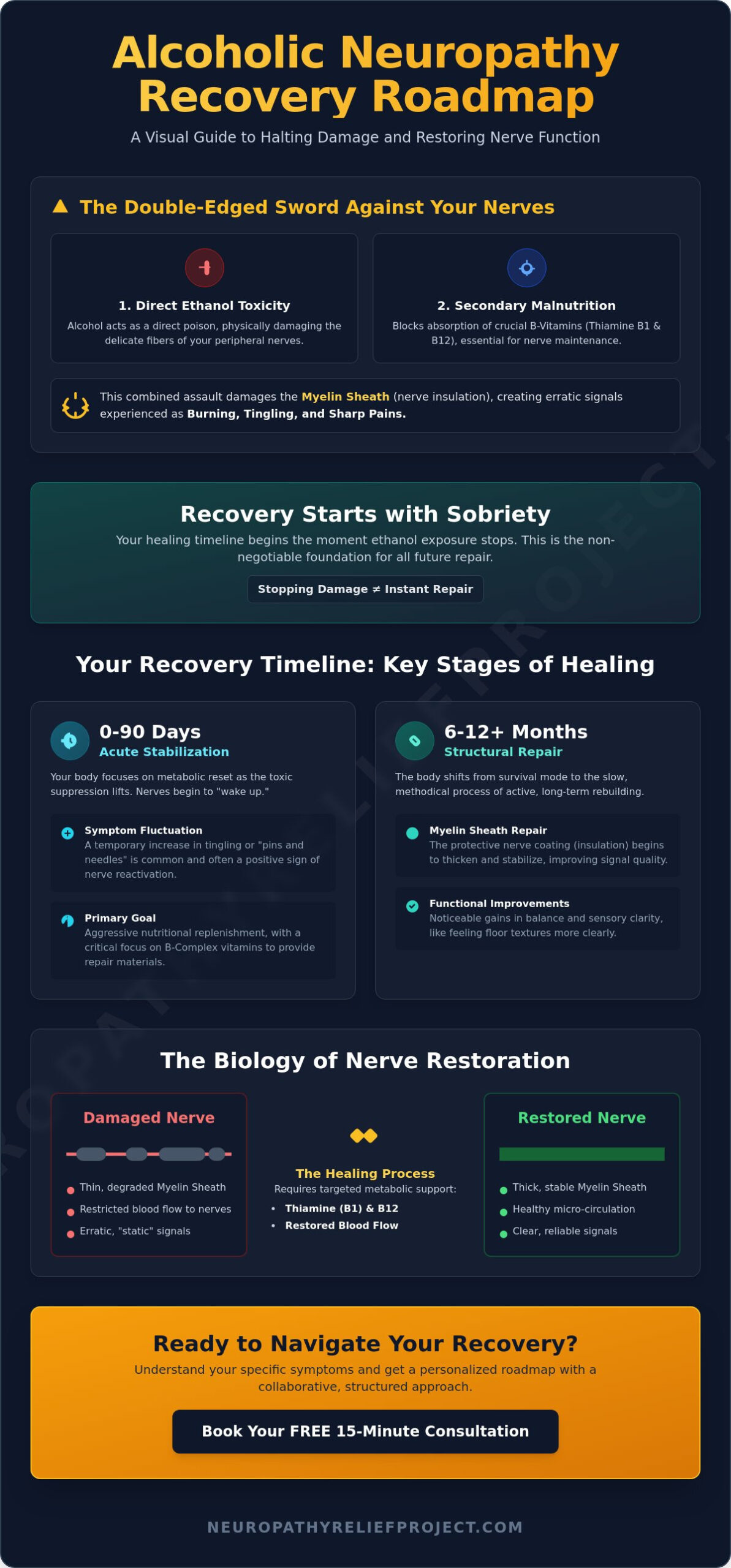
If you’re feeling a persistent buzzing in your feet or a sharp, electric jolt when you take a step, you’re experiencing the physical manifestation of a complex toxic-metabolic process. Understanding Alcoholic Polyneuropathy is essential because it helps you see that your symptoms aren’t just a side effect of lifestyle; they’re the result of direct ethanol toxicity combined with severe nutritional gaps. The alcoholic neuropathy recovery timeline doesn’t actually begin until the exact moment ethanol exposure stops. This distinction is vital for your peace of mind. While sobriety immediately halts the ongoing chemical assault on your peripheral nerves, it doesn’t automatically flip a switch to a restored state. There’s a profound difference between stopping the damage and actively restoring function. Think of it like putting out a house fire. Extinguishing the flames prevents further loss, but the charred remains of the structure still require a deliberate, multi-stage rebuilding effort.
One of the most confusing aspects of this journey is that sensory nerves often signal healing through temporary, heightened sensations. You might feel more pain or more intense tingling as your nerves begin to fire again. It’s a phenomenon that can feel like a setback, but it’s often the biological evidence of a system trying to find its baseline. If you’re struggling to interpret these signals, we offer a 15 minute FREE phone Consultation to help you understand where you stand on this path.
The 0-90 Day Window: Acute Stabilization
During this initial window, your body focuses on acute stabilization. Once the constant influx of ethanol is removed, your metabolic pathways begin to reset. Many patients feel a frustrating increase in tingling or “pins and needles” during these first few weeks. This isn’t necessarily a sign of worsening damage. Instead, it’s often your sensory nerves “waking up” as the toxic suppression lifts. This phase requires aggressive nutritional replenishment, specifically targeting the B-complex vitamins that alcohol has depleted. Without these building blocks, the biological machinery required for repair remains stalled. You’re not just waiting; you’re stabilizing the environment so repair can eventually occur.
The 6-Month to 1-Year Mark: Structural Repair
By the six-month mark, the body shifts from survival to structural repair. This is the period where the myelin sheath, the protective coating around your nerve fibers, begins to thicken and stabilize. You might notice that your balance feels slightly more secure or that you can feel the texture of the floor more clearly. Even if the burning sensation hasn’t fully vanished, these subtle improvements in signal velocity are clear indicators that the alcoholic neuropathy recovery timeline is moving in the right direction. True restoration is a slow, methodical process that rewards patience and consistent metabolic support. It’s about moving from the fear of permanent damage to the reality of gradual, biological improvement.
The Biology of Healing: How Nerves Repair Themselves
Alcohol acts as a double-edged sword against your nervous system, creating a hostile environment that persists long after your last drink. On one side, direct ethanol toxicity acts as a poison, physically damaging the delicate fibers of your peripheral nerves. On the other, chronic consumption triggers secondary malnutrition by blocking the absorption of essential micronutrients in the gut. If your body lacks thiamine (B1) and B12, it loses the ability to maintain the myelin sheath, which is the protective coating of your nerves. Without this insulation, nerve signals become erratic. Instead of clear communication from your brain to your limbs, you experience “static” noise that manifests as burning, tingling, or sharp jolts. Understanding the alcoholic neuropathy recovery timeline requires looking at how we can quiet this static and restore signal clarity through biological intervention.
Healing isn’t just about waiting. It’s about restoring blood flow to the vasa nervorum, the microscopic vessels that act as the “nerves of the nerves.” Chronic alcohol use restricts this micro-circulation, effectively starving your nerve tissue of the oxygen and glucose it needs to survive. By viewing this process as a collaborative initiative between your body’s natural repair mechanisms and targeted metabolic support, you can shift the focus from the pain to the potential for restoration.
Myelin Sheath Restoration: The Path to Sensation
Think of the myelin sheath as the plastic insulation on a copper wire. When alcohol strips this away, the “electricity” of your nervous system leaks out, causing the erratic sensations you feel daily. Your body can rebuild this insulation, but it requires a steady supply of specific lipids and B-vitamins. This process is a cornerstone of Understanding Nerve Damage Recovery. As the sheath thickens over months of sobriety, the “static” begins to fade. Your brain starts receiving accurate data from your limbs again, which is a key milestone in the alcoholic neuropathy recovery timeline.
Micro-Circulation: Feeding the Healing Nerve
Oxygenation is the primary requirement for any tissue restoration. Alcohol-induced inflammation often creates a bottleneck in the tiny vessels supplying your nerves. To support healing, we must focus on strategies that promote healthy blood flow to the extremities. Research into How Nerves Repair Themselves shows that when micro-circulation improves, nerve cells receive the metabolic fuel necessary to repair structural damage. If you’re unsure if your current symptoms are part of this healing process, a 15 minute FREE phone Consultation can offer the clinical clarity you need to move forward with confidence.
Factors That Determine Your Personal Recovery Speed
If you’re wondering why a peer’s tingling vanished in weeks while your own sensations persist after months of sobriety, it’s because the alcoholic neuropathy recovery timeline is highly individualized. Several biological variables dictate how quickly your peripheral nerves can move from a state of toxic shock to one of active restoration. The most obvious factor is the duration and volume of your historical alcohol consumption. Long-term exposure often results in more significant structural degradation of the nerve fibers, requiring a longer period of metabolic stability before repair becomes visible. Your age also plays a role in 2026, as the body’s natural regenerative capacity and stem cell activity tend to slow over time, though they never truly cease.
Individual metabolic health is another critical friction point. If you have underlying blood sugar imbalances or insulin resistance, your nerves are essentially fighting a two-front war. High glucose levels create oxidative stress that can stall the healing process even when ethanol is no longer present. Following A Proactive Roadmap for Nerve Restoration involves identifying these secondary hurdles early. Sometimes, there are “hidden” triggers or Idiopathic Neuropathy Causes that overlap with alcohol damage, making it feel like your progress has hit a plateau. Consistency in non-drug supportive protocols is what eventually tips the scales toward improvement.
The Role of Nutritional Bioavailability
Simply taking a generic multivitamin isn’t a silver bullet for nerve repair. If years of heavy drinking have damaged your gut lining, your body may not be effectively absorbing the “nerve fuel” you provide. You must assess nutritional bioavailability. Are the B-vitamins you consume actually reaching your bloodstream? Without proper absorption, the alcoholic neuropathy recovery timeline can stretch indefinitely. Additionally, hydration plays a massive role in nerve signal clarity. Dehydrated nerve tissues are more prone to erratic firing, which your brain interprets as sharp pain or buzzing.
Identifying and Removing Secondary Nerve Stressors
External factors can also act as “brakes” on your recovery. High levels of cortisol from chronic stress can physically impair the body’s ability to repair cellular damage. Similarly, smoking or the use of other vasoconstrictors restricts the very micro-circulation your nerves need to receive oxygen. Understanding what helps neuropathy in feet requires a multi-front battle against these stressors. If you feel like you’ve done everything right but still aren’t seeing results, we offer a 15 minute FREE phone Consultation to help you identify what might be stalling your specific journey.
A Proactive Roadmap for Nerve Restoration
While sobriety stops the fire from spreading, restoration is the process of rebuilding the home. If you’ve felt lost in a cycle of “waiting for things to get better,” it’s time to shift from a passive observer to an active participant in your healing. The alcoholic neuropathy recovery timeline is not just a calendar of days; it’s a sequence of biological requirements that must be met to facilitate repair. By following a structured roadmap, you can provide your peripheral nerves with the specific environment they need to regain signal clarity and function.
- Step 1: Immediate Cessation. You must stop the toxic influx entirely. This allows your metabolic pathways to redirect energy from processing ethanol to cellular repair.
- Step 2: Intensive Nutritional Support. Focus on high-bioavailability B-complex vitamins and potent antioxidants. These act as the raw materials for rebuilding the myelin sheath we discussed earlier.
- Step 3: Stimulate Micro-Circulation. Use non-invasive protocols to encourage blood flow to the hands and feet. Oxygen is the lifeblood of nerve restoration.
- Step 4: Structured Assessment. Monitor your sensory changes weekly. Tracking small shifts helps you stay motivated when the overall progress feels slow.
- Step 5: Specialist Collaboration. Engage with a dedicated initiative like the Neuropathy Relief Project to access expert-led guidance tailored to your specific nerve health needs.
If you’re ready to move beyond the “wait and see” approach and want to discuss a personalized strategy, we invite you to schedule a 15 minute FREE phone Consultation to explore your options for restoration.
Managing Daily Symptoms During the Timeline
If you’ve ever felt the sharp, electric stabs that seem to peak just as you’re trying to sleep, you’re experiencing “night flares.” These occur as the brain receives fewer external distractions, making the “static” from damaged nerves feel louder. You can often calm these sensations through gentle movement or temperature-neutral stimulation. Movement is essential because it naturally encourages circulation and prevents the stiffness that can exacerbate nerve compression. For a deeper look at managing these challenges without heavy sedatives, explore our guide on Non-Drug Nerve Relief.
Measuring Progress: Beyond the Pain Scale
One of the most counterintuitive aspects of the alcoholic neuropathy recovery timeline is how progress actually looks. Many patients expect pain to vanish first, but “less numbness” is often a much more significant sign of healing. If you can suddenly feel the coldness of a tile floor or the texture of a rug, your nerves are successfully transmitting data again. This return of sensation can sometimes be accompanied by temporary itching or buzzing, which indicates the nerve is no longer dormant. Use a sensory diary to track your balance and temperature sensitivity. These objective markers provide a more accurate picture of your restoration than a simple pain scale ever could.
Navigating Recovery with the Neuropathy Relief Project
If you’ve been told to “just wait” for your nerves to heal, you know how hollow those words can feel when your feet are burning in the middle of the night. It’s deeply frustrating to be met with passive advice when you’re looking for a clear path out of the sensory static. The Neuropathy Relief Project was founded as a mission-driven collaborative effort to provide the clinical authority and hope that patients often find lacking in traditional systems. We believe that understanding your specific alcoholic neuropathy recovery timeline shouldn’t be a guessing game. Our approach centers on drug-free, non-invasive protocols designed to support the biological processes of restoration we’ve detailed throughout this guide.
We act as a knowledgeable guide for those who feel lost in complex health systems. By focusing on the underlying causes of nerve degradation rather than just masking the symptoms, we help you shift your focus from the problem to the potential outcome. This journey toward liberation from chronic pain is methodical and requires patience, but you don’t have to navigate it alone. Our goal is to provide a sense of reliability and specialized knowledge to ensure you feel informed rather than rushed.
Why Specialized Intervention Matters
General practitioners provide essential care, but they may sometimes overlook the specific metabolic nuances required for alcoholic nerve repair. A specialized peripheral neuropathy reversal program in 2026 focuses on more than just dampening the pain with standard medications. It’s about moving from a mindset of simple symptom management to one of active, structural restoration. By addressing the micro-circulation and nutritional bioavailability issues unique to your history, we help you move through the alcoholic neuropathy recovery timeline with more clarity and less anxiety about the future of your mobility.
Your Next Step: The Free 15-Minute Review
The bridge between your current confusion and a structured recovery plan is a simple, professional conversation. During your discovery call, we’ll conduct a brief review of your sensory history and current physical sensations. This isn’t a high-pressure environment; it’s a calm, expert-led assessment to help identify exactly where you stand on your journey toward improvement. You’ll gain a better understanding of the biological milestones you should be watching for and the actionable steps you can take to support your body’s natural repair mechanisms. If you’re ready to stop waiting and start restoring, Schedule your 15-minute FREE phone Consultation today to take your first step toward a clearer path forward.
Empowering Your Path to Lasting Relief
If you’ve spent years feeling like your feet were trapped in a permanent state of buzzing or sharp pain, it’s time to recognize that your body possesses a remarkable capacity for repair. We’ve explored how sobriety acts as the essential first step to halt toxicity, while targeted metabolic support and improved micro-circulation provide the fuel for structural nerve restoration. Moving through your alcoholic neuropathy recovery timeline requires patience, but it’s a journey that becomes much clearer when you stop guessing and start following a clinical roadmap. True healing is a collaborative effort between your commitment to health and the right biological interventions.
You don’t have to face this frustration alone. At the Neuropathy Relief Project, we offer a specialized, drug-free focus on nerve restoration under the expert guidance of Dr. Michael Sclafani. Our mission-driven approach is designed to bridge the gap between traditional symptom management and true biological healing. If you’re ready to gain clarity on your specific situation, Book your 15-minute FREE phone Consultation to discuss your recovery timeline today. There’s a path toward restoration, and it starts with a single, informed decision to seek specialized support. You deserve to move through the world with comfort and confidence once again.
Frequently Asked Questions
Can alcoholic neuropathy be completely reversed if I stop drinking now?
Reversal depends on whether the nerve cell body remains intact despite the damage. If you stop drinking now, you halt the toxic-metabolic process, allowing the alcoholic neuropathy recovery timeline to finally begin. While “complete reversal” isn’t guaranteed for everyone, most patients experience significant restoration of function when they combine sobriety with intensive nutritional support. It’s about shifting your body from a state of active degradation to one of biological repair.
How long does it take for the burning sensation in my feet to stop?
You may notice a reduction in burning sensations within 3 to 6 months, though this depends heavily on your individual metabolic health. The initial 90 days are often characterized by stabilization, where the body clears residual toxins and begins to reset. As the myelin sheath starts to thicken and insulate the nerve fibers, the erratic “static” noise of burning sensations gradually quiets. Consistency in your restoration protocol is the primary factor in achieving long-term comfort.
Why does my nerve pain feel worse after I stopped drinking alcohol?
It’s common to feel a temporary increase in pain because your sensory nerves are “waking up” from a state of toxic suppression. Ethanol acts as a central nervous system depressant that masks the true extent of the damage while you’re drinking. Once it’s removed, the damaged fibers begin to fire signals more intensely as they attempt to find their biological baseline. This period of heightened sensation is often a sign that the nerves are still viable and attempting to repair.
What are the first signs that my nerves are starting to heal?
The first signs of healing often include a return of temperature sensitivity and improved balance during daily activities. You might notice that you can feel the texture of your socks more clearly or that the constant “pins and needles” have become intermittent rather than continuous. These changes indicate that signal velocity is improving across the peripheral nervous system. If you’re unsure how to interpret your progress, a 15 minute FREE phone Consultation can help you identify these subtle milestones.
Can certain vitamins speed up the recovery timeline for neuropathy?
Targeted vitamins like thiamine (B1), B6, and B12 act as the essential raw materials for nerve restoration. They’re critical for rebuilding the protective myelin coating that alcohol strips away during active use. While they don’t “cure” the damage instantly, they provide the metabolic fuel necessary to support the alcoholic neuropathy recovery timeline. Ensuring high bioavailability is key, as your gut may still be recovering from alcohol-induced absorption issues that limit nutrient uptake.
Is it possible for nerve damage to continue even after I’ve quit drinking?
Nerve damage can persist if underlying nutritional deficiencies or micro-circulation issues aren’t properly resolved. Sobriety removes the primary toxin, but it doesn’t automatically fix the secondary malnutrition or inflammation alcohol left behind. If your body lacks the building blocks for repair, the nerves remain in a state of metabolic stress. Addressing these secondary stressors is a vital part of moving from simply stopping the damage to actively restoring your function.
How do I know if my neuropathy is from alcohol or something else like diabetes?
Distinguishing between these causes requires a clinical review of your metabolic markers and health history. While both alcohol and diabetes damage peripheral nerves, the underlying mechanisms differ; one is a toxic-metabolic process and the other is primarily microvascular. We often look for specific signs of thiamine depletion or blood sugar instability to determine the primary driver of your symptoms. Identifying the root cause is the only way to build a reliable plan for restoration.
What happens if I don’t see any improvement after six months of sobriety?
A lack of progress after six months often suggests that a “hidden” trigger or metabolic bottleneck is stalling your biological repair. This could be anything from undiagnosed insulin resistance to persistent micro-circulation issues in your extremities. If you feel stuck, it doesn’t mean the damage is permanent; it simply means your current protocol needs adjustment to overcome this plateau. We recommend a 15 minute FREE phone Consultation to help you pinpoint the specific friction preventing your nerves from healing.