

Imagine waking up in the middle of the night because your feet feel like they’re pressing into shards of broken glass. You’ve likely wondered, “does statin use cause neuropathy,” after mentioning these sensations to a doctor who might have dismissed them as a natural part of aging. It’s incredibly frustrating to feel like you must choose between protecting your heart and keeping your mobility. You deserve validation that your symptoms are real and an explanation that doesn’t leave you feeling dismissed or unheard.
While a major meta-analysis published in February 2026 in The Lancet suggests there isn’t a direct causal link for most patients, your physical discomfort is a signal that your body needs specialized support. We’ll explore the latest clinical connection between cholesterol-lowering protocols and nerve health, including how the new 2026 PREVENT-ASCVD guidelines change the landscape of cardiovascular care. You’ll discover how to support your nervous system and find relief without compromising your heart. We’ll examine the science of nerve restoration and provide a clear, evidence-based path toward reclaiming your quality of life through a collaborative, research-driven approach.
Key Takeaways
- Understand the latest 2026 clinical findings regarding whether does statin use cause neuropathy and how these insights impact your current treatment plan.
- Identify the specific sensory signals of nerve damage, such as burning or “pins and needles,” which may indicate your myelin sheath needs additional biological support.
- Gain clarity on how to balance your cardiovascular goals with nerve health without making the dangerous choice to stop prescribed medications on your own.
- Explore how a mission-driven approach to restoration, focusing on oxygenation and specialized nutrition, can help you move toward a life free from chronic discomfort.
- Take the first step toward clarity by scheduling a 15 minute FREE phone Consultation to discuss your unique path to relief.
Does Statin Use Cause Neuropathy? Examining the Clinical Evidence
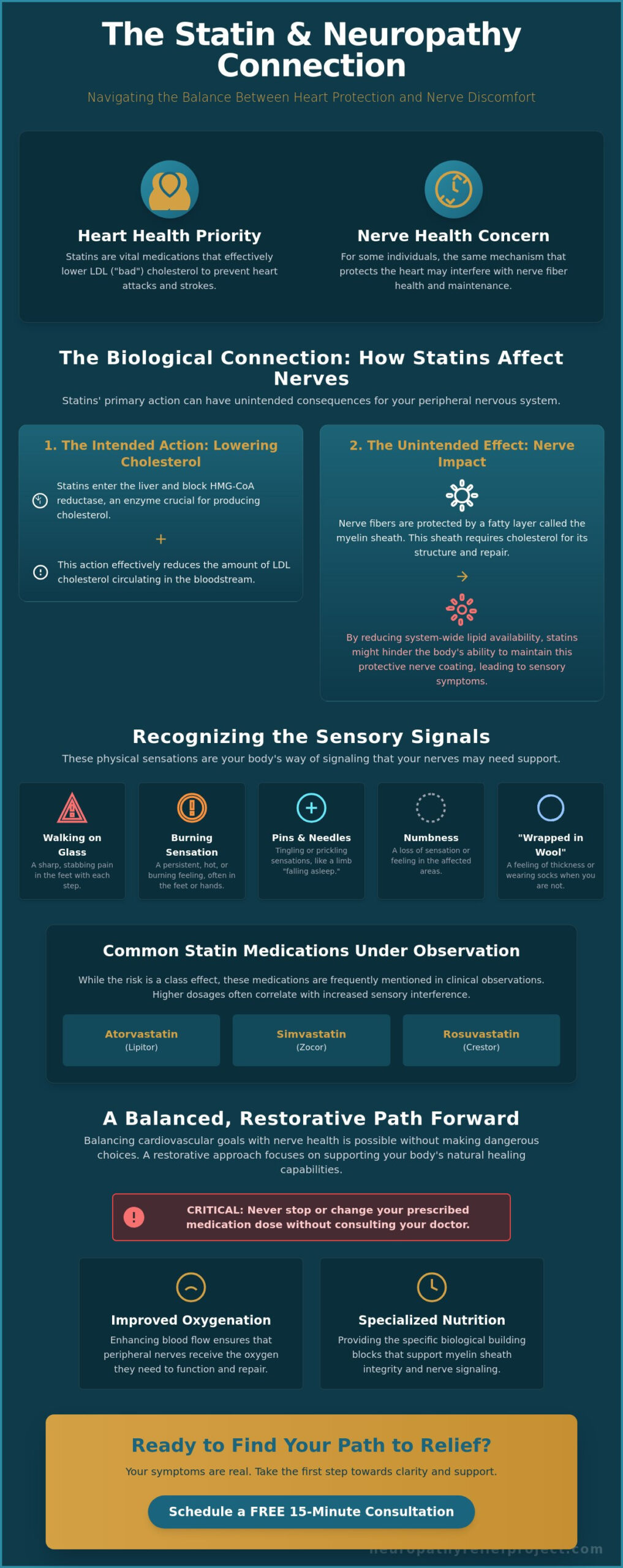
You’ve likely seen your cholesterol numbers drop significantly, yet your feet feel like they’re on fire or wrapped in thick wool. This disconnect is where many patients find themselves today. So, does statin use cause neuropathy? While these medications are a cornerstone of cardiovascular health, they are not without complex side effects. Statins, scientifically known as HMG-CoA reductase inhibitors, work by blocking an enzyme in the liver that produces cholesterol. While effective for the heart, this process can inadvertently disrupt the delicate environment surrounding your peripheral nerves.
The medical consensus acknowledges that statins are vital for preventing major cardiac events, but there’s a growing understanding of how they impact nerve fibers. A landmark study in Denmark previously highlighted this concern, finding that long-term users had a significantly higher risk of developing polyneuropathy compared to non-users. For some individuals, achieving what doctors call “safe” cholesterol levels through medication might correlate with a disruption in the electrical signals sent by their nerves. This suggests that the very mechanism used to protect your arteries might, in specific cases, interfere with nerve health.
The “Rare but Real” Statistic
Medical literature often labels statin-induced nerve damage as “rare,” yet this description provides little comfort when you’re the one losing sleep from a “walking on glass” sensation. These cases are frequently underreported because symptoms are subtle at first or are dismissed as part of the aging process. Many patients are told they have idiopathic neuropathy causes, which is essentially a way of saying the trigger remains unknown. If your tingling or numbness began shortly after starting a new prescription, your suspicion isn’t just a guess; it’s a valid observation of your body’s response to a chemical change. We believe that when you ask, does statin use cause neuropathy, your lived experience deserves a clinical answer rather than a dismissal.
Common Statin Medications Linked to Nerve Symptoms
The risk of nerve interference appears to be a class effect, meaning it isn’t limited to just one brand or manufacturer. Whether you’re taking a high-intensity dose or a maintenance level, the biological impact on your nerves remains a possibility. Common medications in this category include:
- Atorvastatin (Lipitor)
- Simvastatin (Zocor)
- Rosuvastatin (Crestor)
Clinical observations suggest that higher dosages often correlate with increased sensory interference. While your healthcare provider focuses on the life-saving benefits for your heart, it’s vital to acknowledge the sensory trade-off that can occur. Understanding this clinical link is the first step toward finding a restorative path that protects both your cardiovascular system and your mobility.
The Biological Connection: How Cholesterol Meds Impact Nerve Fibers
To truly understand why you feel these sensations, we have to look beneath the surface at the cellular level. When patients ask, does statin use cause neuropathy, they’re often seeking a reason for why their body feels like it’s failing them. The answer lies in the biological trade-off your system makes when you take cholesterol-lowering medication. While statins are remarkably effective at reducing the LDL cholesterol that can clog your arteries, they don’t only target the liver. They affect the entire body’s lipid profile, including the essential fats your nerves rely on to function and repair themselves.
This biochemical shift is documented in a 2018 case-control study, which explores how the inhibition of certain metabolic pathways can lead to peripheral nerve interference. It isn’t necessarily that the medication is “attacking” your nerves, but rather that it can create an environment where your nerves are unable to maintain their own structural integrity. If you’re feeling overwhelmed by these changes, you can schedule a 15 minute FREE phone Consultation to discuss your specific symptoms and concerns.
The Myelin Sheath and Cholesterol
The myelin sheath is the protective insulation of your nerves. Just like the plastic coating on an electrical wire, this fatty layer ensures that signals from your brain reach your feet without being lost or distorted. Cholesterol is a primary building block of this insulation. When systemic cholesterol is aggressively lowered, your body may struggle to find the “good” fats needed for nerve repair. Instead of a clean signal, you experience the “static” of damaged insulation, which your brain interprets as burning, tingling, or numbness.
Mitochondrial Energy and Nerve Health
Your nerves are the most energy-hungry cells in your entire body, requiring a constant supply of fuel to transmit signals over long distances. Statins can inadvertently deplete Coenzyme Q10 (CoQ10), a vital nutrient that acts as a spark plug for your cell’s power plants, the mitochondria. When CoQ10 levels drop, your nerve cells enter a state of metabolic crisis. This energy deficit is one of the primary causes of peripheral neuropathy seen in clinical settings where medication side effects are present.
Without sufficient energy, the long fibers of your nerves, called axons, begin to wither. This process, known as axonal degeneration, is less like a sudden injury and more like a slow starvation of the tissue. Your nerves aren’t necessarily broken; they’re starving for the metabolic support they need to thrive. By shifting our focus from “irreversible damage” to “cellular starvation,” we can begin to see a clear path toward restoration and recovery. If you’re wondering if does statin use cause neuropathy in your specific case, recognizing this energy gap is a crucial first step toward healing.
Identifying Statin-Induced Neuropathy: Key Symptoms and Timing
If you’ve noticed a strange buzzing in your toes or a persistent coldness that won’t go away, you’re likely searching for answers to a specific question: does statin use cause neuropathy? Recognizing these symptoms early is critical because nerve interference often presents differently than the common muscle aches many patients expect. While muscle pain, or myalgia, usually feels like a deep, heavy soreness in the thighs or back, nerve damage is distinctly sensory. It manifests as burning, tingling, or the classic “pins and needles” sensation that seems to come from nowhere.
This discomfort typically follows a “stocking-glove” pattern. It often begins at the furthest points of your nervous system, usually the tips of your toes, before slowly progressing up the feet and toward the ankles. In some cases, it may eventually affect the hands. This isn’t a sudden injury but a cumulative process. Because the damage is metabolic, as we discussed regarding the myelin sheath, the symptoms often take months to appear after starting a new prescription or increasing a dose.
Sensory Warning Signs in the Feet and Hands
Many people describe the early stages as feeling like they’re walking on cotton wool or, more painfully, as if they’re walking on shards of broken glass. These sensations often flare up at night. When your body is at rest and external distractions fade, your nervous system attempts to process the “static” from damaged fibers, leading to intense burning that can prevent sleep. If you’re experiencing this, understanding what helps neuropathy in feet becomes a priority for restoring your quality of life. These sensory signals are your body’s way of asking for help before the damage becomes more extensive.
The Timeline of Nerve Interference
Nerve interference from cholesterol medication is rarely instantaneous. Because it involves the slow depletion of vital nutrients and the thinning of protective insulation, the onset is gradual. You might not connect the dots at first. It’s helpful to track the correlation between your prescription history and your pain levels. Did the tingling start three months after your dosage doubled? Does the burning intensify on days you’re most consistent with your medication? Even if you switch medications, the symptoms may persist for a time as the nerves require a specific restorative environment to heal. Knowing that does statin use cause neuropathy in a cumulative way helps you advocate for your health with more clarity and confidence.
The Heart-Nerve Dilemma: Balancing Cardiovascular Health with Nerve Restoration
If you’re wrestling with the question, does statin use cause neuropathy, you likely feel trapped between two vital systems: your heart and your nervous system. We call this the “Heart-Nerve Dilemma.” It’s the agonizing fear that choosing to soothe your burning feet might somehow endanger your life. This binary choice, heart health or mobility, is one no patient should have to make alone. You deserve a strategy that respects the necessity of your cardiovascular protection while actively addressing the sensory interference you’re living through every day.
It’s vital to remember that you should never stop or alter your medication without direct medical supervision from your prescribing physician. Abruptly halting a statin can lead to significant cardiovascular risks. Instead, we advocate for a “co-management” approach. This is a collaborative effort where your heart remains protected under the guidance of your cardiologist, while a nerve specialist works to restore the metabolic environment your nerve fibers need to thrive. If you’re ready to find a path that protects both your heart and your mobility, you can schedule a 15 minute FREE phone Consultation today to discuss your options.
Why Traditional Painkillers Often Fail
Many patients find that standard prescriptions like gabapentin or lyrica don’t provide the relief they expect for statin-related symptoms. These drugs are designed to quiet the nervous system by blocking pain signals, but they don’t fix the underlying starvation of the nerve tissue we discussed earlier. Masking the “static” of damaged insulation doesn’t help the myelin sheath rebuild itself. This is why many are turning to a non-drug nerve relief framework. By focusing on biological restoration rather than symptom suppression, you can address the root cause of the discomfort rather than just turning down the volume on the pain.
Advocating for Your Nerve Health
Being your own advocate is the most powerful tool in your recovery journey. When you meet with your cardiologist, come prepared with specific questions to bridge the gap between your heart and your nerves. Ask if there are non-statin alternatives that might be appropriate for your risk profile, or if high-quality CoQ10 supplementation could help mitigate the metabolic depletion you’re experiencing. Seeking a peripheral neuropathy reversal program that focuses on the root cause is essential. Early intervention is the key to ensuring that the metabolic “starvation” your nerves are feeling doesn’t progress into permanent damage. You don’t have to sacrifice your ability to walk and sleep well just to keep your cholesterol in check.
Beyond Medication: A Restorative Path with the Neuropathy Relief Project
If you’ve spent months or even years asking, does statin use cause neuropathy, you’re likely tired of being told there’s nothing that can be done. You’ve navigated the conflicting advice of heart health versus nerve health, often feeling like your mobility is the price you must pay for a healthy heart. The Neuropathy Relief Project exists as a mission-driven initiative to end this conflict. We don’t view your symptoms as an inevitable trade-off; we see them as a biological challenge that requires a specialized, research-driven solution. Our focus is on understanding nerve damage recovery through the lens of cellular restoration, specifically targeting the oxygenation and nutrition your nerves have been lacking.
By positioning ourselves as a knowledgeable guide in your journey, we help you move past the frustration of being dismissed. We provide a bridge between evidence-based clinical protocols and the holistic support your body needs to heal. This collaborative effort is designed to give you clarity on whether your damage is reversible and how to achieve that goal without compromising your cardiovascular safety. You aren’t just another patient in a complex system; you’re a partner in a mission to reclaim your physical independence.
The Science of Nerve Restoration
The “starvation” of nerve tissue caused by metabolic interference can be addressed by improving micro-circulation. When blood flow to the tiny vessels surrounding your nerves is optimized, it delivers the essential oxygen and nutrients required to rebuild the myelin sheath. Our drug-free nerve pain management protocols are designed to stimulate this natural repair process. Instead of simply masking the burning or numbness, we aim for the liberation of the nerve fiber from its state of metabolic crisis. This science-backed path focuses on long-term results rather than the temporary, often disappointing, relief found in standard pharmaceutical options.
Your First Step Toward Sensation
Taking the first step toward healing shouldn’t feel overwhelming or high-pressure. We invite you to a 15 minute FREE phone Consultation, which serves as a low-pressure discovery call. During this time, you’ll speak with a team that truly understands the daily struggle of living with chronic nerve challenges. Dr. Michael J. Sclafani and his dedicated specialists take an empathetic, patient-centered approach to every conversation. We’ll listen to your history, validate your experiences with does statin use cause neuropathy, and help you determine if our restorative protocols are the right fit for your specific needs. This is your invitation to join a collaborative effort focused on restoring your sensation and your quality of life.
Reclaiming Your Mobility and Peace of Mind
You’ve explored the complex clinical landscape to answer the question, does statin use cause neuropathy, and you now understand that your burning and tingling aren’t just part of “getting older.” We’ve discussed how cholesterol medication can inadvertently lead to the metabolic starvation of your nerve fibers by depleting CoQ10 and thinning the myelin sheath. Recognizing the specific “stocking-glove” pattern of these symptoms is the first step toward advocating for a heart-safe restoration plan that doesn’t force you to choose between your arteries and your ability to walk without pain.
Led by Dr. Michael J. Sclafani, DC, our collaborative initiative provides specialized non-invasive neuropathy protocols designed to stimulate repair while respecting your cardiovascular needs. We offer national reach for nerve restoration guidance, ensuring you have access to expert knowledge regardless of where you live. It’s time to shift from simply masking the “static” of nerve pain to actively nourishing the tissue. Book Your 15-Minute FREE Phone Consultation to Discuss Your Nerve Health and take the first step toward liberation from chronic discomfort. You deserve a future where your heart is strong and your steps are steady.
Frequently Asked Questions
Is statin-induced neuropathy permanent or can it be reversed?
Nerve damage from cholesterol medication isn’t always a permanent sentence. While the thinning of the myelin sheath can cause significant discomfort, the body possesses a remarkable ability to heal when provided with the right metabolic support. By focusing on improving micro-circulation and providing targeted nutrition, we can often help the nerves move from a state of starvation to a state of restoration. Recovery is a collaborative effort that depends on how quickly you address the underlying cellular energy gap.
How long after starting statins do neuropathy symptoms usually appear?
You might not notice changes immediately because the process is cumulative. Most patients report that symptoms like burning or tingling begin to surface within three to six months of starting a new prescription or increasing their dosage. If you’ve been asking, “does statin use cause neuropathy,” tracking your symptoms alongside your medication timeline is essential. This gradual onset mirrors the slow depletion of vital nutrients your nerve fibers need to maintain their protective insulation.
Should I stop taking my statin if I feel tingling in my feet?
You should never stop your medication without first speaking to your prescribing physician. Abruptly halting a statin can lead to a sudden spike in cardiovascular risk, which is why a supervised transition is necessary. Instead of making a binary choice between your heart and your feet, work with a specialist to develop a co-management strategy. This ensures your heart remains protected while you actively seek a restorative path for your sensory symptoms.
Are some statins safer for nerves than others?
The risk of nerve interference is widely considered a class effect, meaning it applies to all HMG-CoA reductase inhibitors regardless of the brand name. Whether you take Atorvastatin, Simvastatin, or Rosuvastatin, the biological mechanism that lowers cholesterol can still impact your nerves. However, the intensity of the dose often matters more than the specific brand. Higher dosages are more likely to interfere with the metabolic processes that support the myelin sheath’s structural integrity.
Can taking CoQ10 prevent nerve damage from statin use?
CoQ10 is a vital nutrient for mitochondrial energy, and its depletion is a known factor in why does statin use cause neuropathy for some patients. Supplementing can help support the energy needs of your nerve cells, but it isn’t always a complete shield. If the medication is significantly lowering the fats needed for your nerve insulation, CoQ10 alone might not be enough. It works best as part of a comprehensive protocol that addresses both energy and structural repair.
What is the difference between muscle pain and neuropathy from statins?
It’s easy to confuse the two, but they feel very different. Muscle pain, or myalgia, usually presents as a deep, heavy ache in the large muscles of the legs or back. In contrast, neuropathy is sensory and typically starts in the toes or fingers. If you’re experiencing “pins and needles,” burning sensations, or the feeling of walking on cotton wool, your nerves are signaling for help. These sensory markers distinguish nerve damage from simple muscle soreness.
How is statin-induced neuropathy diagnosed by a specialist?
Specialists look for a specific “stocking-glove” pattern of sensory loss that correlates with your medication history. Unlike standard tests that might only look for large-fiber damage, a specialized evaluation focuses on the health of the small fibers and the metabolic environment of the nerve. We prioritize your lived experience, acknowledging that your burning feet are a real clinical signal. This diagnostic process is a discovery phase that helps us map out your specific path to relief.
Will my nerve pain go away if I switch to a different cholesterol medication?
Switching medications might prevent further thinning of the myelin sheath, but it doesn’t always repair the damage that has already occurred. Think of it like putting out a fire; the flames are gone, but the structure still needs rebuilding. Many patients find that their symptoms persist even after changing prescriptions. True relief often requires a targeted restorative approach to help the starved nerve fibers regain their strength and function through improved oxygenation and nutrition.