

What if the persistent burning in your hands and the heavy, unsteady feeling in your legs aren’t just signs of exhaustion, but a signal that your immune system has mistaken your nerves for an enemy? It’s deeply frustrating to live with “invisible” pain while standard blood tests come back inconclusive, leaving you to worry about your future mobility. You deserve to know why your body’s defense system is attacking its own wiring. Understanding the specific autoimmune diseases that cause neuropathy is the first step toward moving from a state of constant defense to one of active restoration.
We recognize the daily struggle of living with these sensory challenges and the anxiety that comes with a lack of clear answers. This article will help you identify the specific autoimmune conditions that trigger nerve pain and explain how a specialized, research-driven approach can help you reclaim your quality of life. We’ll preview the latest 2026 clinical insights, from the NIH’s new strategic research plan to emerging targeted therapies, and show you how to begin a collaborative journey toward healing. If you’re ready for a specialist who truly understands your physical reality, you can start with a 15 minute FREE phone Consultation to discuss your path forward.
Key Takeaways
- Learn how “molecular mimicry” causes your immune system to mistake vital nerve coatings for foreign invaders, triggering the chronic pain you feel every day.
- Identify the specific autoimmune diseases that cause neuropathy, such as CIDP and Sjögren’s Syndrome, to finally put a clear name to your “invisible” symptoms.
- Map your physical sensations, from the feeling of “walking on glass” to sudden muscle weakness, to understand the specific sensory and motor signals your body is sending.
- Understand why standard treatments like gabapentin often only mask the pain and explore how a restorative approach addresses the underlying immune error instead.
- Discover a collaborative path toward nerve health that moves beyond temporary fixes and offers a clear, expert-led strategy for reclaiming your quality of life.
The Silent Connection: How Autoimmune Diseases Target Your Nerves
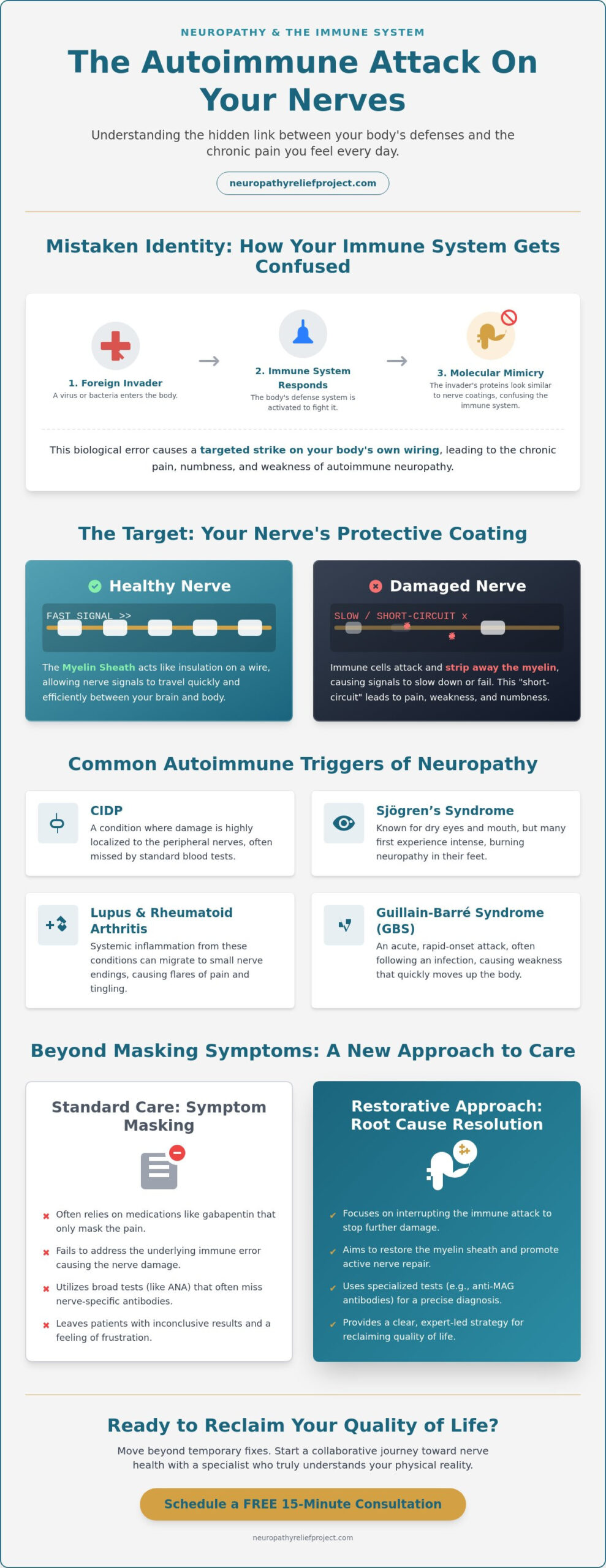
Imagine your immune system as a highly trained security team. Usually, it protects you from viruses and bacteria. However, in the case of autoimmune diseases that cause neuropathy, this security team suffers from a case of mistaken identity. This biological error is known as “molecular mimicry.” It occurs when certain proteins in your peripheral nervous system look almost identical to a foreign invader. Consequently, your immune system launches an aggressive, localized attack on your nerves, mistakenly believing it’s defending your health. This isn’t just general inflammation; it’s a specific, targeted strike on the communication lines of your body.
Distinguishing between systemic inflammation and localized nerve sheath degradation is vital for your recovery. While conditions like lupus can cause body-wide issues, some autoimmune diseases that cause neuropathy focus their energy specifically on the protective coatings of your nerve fibers. If this process isn’t interrupted early, the damage can move beyond the coating and lead to permanent axonal loss. This is why identifying the “silent” connection between your immune system and your sensory symptoms is the only way to prevent long-term mobility issues and reclaim your physical freedom.
The Role of the Myelin Sheath
Think of your nerves as electrical wires carrying vital messages between your brain and your body. The myelin sheath acts as the protective insulation on these wires. When immune cells target this coating, they effectively “strip” the insulation, causing the signal to short-circuit. This often manifests as the electric shocks or stabbing pains you feel in your feet or hands. A deep understanding nerve damage recovery is essential here, as the biological path to restoration depends on stopping this stripping process before the underlying nerve fiber is destroyed. By focusing on myelin restoration, we can help shift your body from a state of breakdown to one of active repair.
Why Traditional Blood Work Often Misses the Mark
Many patients feel a deep sense of frustration when their standard blood panels come back “normal” despite their very real, daily pain. Traditional tests like the Antinuclear Antibody (ANA) screen are designed to catch broad systemic issues, but they often lack the precision to identify nerve-specific attacks. You might have a condition like Chronic inflammatory demyelinating polyneuropathy (CIDP) where the damage is highly localized to the peripheral nerves. In these cases, specialists look for more nuanced markers, such as anti-MAG or ganglioside antibodies. These specific tests can reveal the immune activity that standard labs miss, providing the clear name for your condition that you’ve been searching for.
Common Autoimmune Triggers: From CIDP to Sjögren’s Syndrome
Identifying the specific catalyst for your pain is the first step toward reclaiming your mobility. While many factors can lead to nerve damage, autoimmune diseases represent a significant portion of cases where the body’s own defense mechanisms turn inward. These autoimmune diseases that cause neuropathy often present with distinct sensory patterns that go beyond simple numbness. For instance, Sjögren’s Syndrome is widely known for causing dry eyes and mouth, yet many patients experience intense burning in their feet long before a formal diagnosis is reached. In systemic conditions like Lupus or Rheumatoid Arthritis, the inflammation isn’t just confined to your joints. It can migrate to the small nerve endings, causing flares of tingling that coincide with your systemic fatigue.
Guillain-Barré Syndrome (GBS) serves as the acute, rapid-onset version of this immune misfire. It often follows a viral infection and requires immediate clinical intervention as weakness quickly climbs from the feet upward. While GBS is a medical emergency, other triggers act with more stealth, gradually eroding your quality of life over months or years. If you feel lost in a sea of conflicting symptoms, a 15 minute FREE phone Consultation can help you begin to sort through the sensory evidence and find a clear path forward.
CIDP: The Slow-Motion Nerve Attack
Chronic Inflammatory Demyelinating Polyneuropathy (CIDP) is often described as the chronic cousin of GBS. Unlike an acute flare, CIDP is a progressive, slow-motion attack on your nerves. You might notice a symmetrical weakness in your legs or a gradual loss of deep tendon reflexes that makes climbing stairs feel increasingly difficult. Because the onset is so gradual, CIDP is frequently mislabeled as one of the many idiopathic neuropathy causes. Distinguishing CIDP from “unknown” triggers is essential because it requires a specific, immune-modulating approach to stop the progression and begin the process of restoration.
Vasculitic Neuropathy: Starving the Nerves of Oxygen
When inflammation targets your blood vessels rather than the nerves themselves, it’s called vasculitis. This condition effectively starves your nerves of the oxygen-rich blood they need to survive. It often creates a pattern known as “Mononeuritis Multiplex,” where you might feel sharp, stabbing pain in seemingly random, unrelated areas, like your left wrist and right ankle simultaneously. This isn’t a standard “glove and stocking” distribution; it’s a scattered map of distress. Treating the underlying vascular inflammation is urgent to prevent permanent tissue death and restore vital blood flow to these critical pathways.
Recognizing the Patterns: Sensory, Motor, and Autonomic Signals
If you’ve ever felt like you’re walking on invisible shards of glass or experienced a sudden, jolting electric shock in your toes, you’re not alone. These sensations aren’t just in your head; they’re the physical manifestation of your immune system miscommunicating with your peripheral nerves. Recognizing these patterns is a vital step in identifying which autoimmune diseases that cause neuropathy are active in your body. While the pain can feel chaotic, it often follows a predictable “stocking-glove” distribution, starting at the furthest points of your limbs and gradually moving upward as the immune attack progresses.
This holistic perspective is necessary because many autoimmune diseases that cause neuropathy don’t stop at the skin’s surface. Research into autoimmune diseases’ impact on the nervous system shows that your internal systems can also be caught in the crossfire. Autonomic neuropathy can disrupt your heart rate, blood pressure, and digestion, leading to symptoms like lightheadedness when standing or unexplained bloating. These aren’t separate, unrelated issues. They’re part of the same systemic “miscommunication” that requires a specialized, restorative approach to resolve.
The Sensory Reality: When Your Brain Receives False Signals
Living with allodynia, where even the weight of a soft bedsheet feels like a painful abrasion, can be incredibly isolating. This heightened sensitivity often peaks at night when the distractions of the day fade, leaving you alone with the sensory distortion. It’s a heavy burden to carry, but understanding that these are false signals from damaged nerves is the first step toward relief. For those seeking immediate comfort strategies, exploring what helps neuropathy in feet can provide practical, specialist-backed ways to soothe these nightly flares and improve your sleep quality.
Motor Nerves and the Risk of Falls
When the attack shifts from sensory to motor nerves, the frustration turns into a serious safety concern. You might find yourself suddenly tripping over a rug or struggling to button a shirt as your fine motor skills decline. This often presents as “foot drop,” where the muscles in the front of your foot become too weak to lift properly, significantly increasing your risk of falls. Over time, if the nerve signal remains interrupted, muscle atrophy can set in as the tissue loses its vital stimulation. Maintaining balance and strength is a cornerstone of living with peripheral neuropathy, ensuring you stay mobile and safe while we focus on the underlying immune cause.
The Limitations of Standard Care and the Search for Restoration
If you’ve spent months or even years taking gabapentin or Lyrica, you’ve likely noticed a frustrating pattern. These medications act like a volume knob on a radio; they turn down the static of your pain without actually fixing the broken transmitter. They don’t address the fundamental reason your immune system is attacking your nerves. Because autoimmune diseases that cause neuropathy are driven by a specific error in your body’s defense system, simply muting the signal allows the underlying damage to progress quietly in the background. You deserve a strategy that does more than just mask the sensory reality of your struggle.
The traditional reliance on steroids like prednisone often creates what we call the “steroid trap.” While these drugs are effective at dampening acute inflammation, they can be double-edged swords. Long-term use may lead to tissue thinning, bone loss, and a metabolic environment that actually hinders the body’s natural repair mechanisms. To move beyond this, we must transition from a strategy of suppression to one of restoration. This means focusing on the vasa nervorum, the microscopic blood vessels that act as the life-support system for your nerves. When these vessels are compromised by inflammation, your nerves are effectively starved of oxygen, making recovery impossible until micro-circulation is restored.
Beyond Symptom Masking
Many patients feel they’re constantly chasing symptoms, adding new prescriptions as old ones lose their efficacy. This cycle is exhausting and disheartening. Shifting toward non-drug nerve relief strategies allows us to prioritize oxygenation and specialized nutrient delivery to the damaged areas. True relief requires quieting the immune fire while simultaneously rebuilding the scorched nerve earth. By providing the specific biological building blocks your body needs, we can create an environment where healing is finally possible.
The Science of Myelin Repair in 2026
Current research in 2026 highlights the remarkable potential of Schwann cells, the specialized cells responsible for rebuilding the myelin sheath. These cells require a specific metabolic environment to begin the work of re-insulating your nerves. Implementing a drug-free nerve pain management framework focuses on triggers that encourage this natural repair process. By improving blood flow and reducing the oxidative stress caused by autoimmune diseases that cause neuropathy, we can support the biological path to restoration. If you’re ready to stop just “managing” your symptoms and start addressing the cause, we invite you to schedule a 15 minute FREE phone Consultation to explore your options.
Reclaiming Your Quality of Life: A Collaborative Path Forward
If you’ve spent years bouncing between a rheumatologist who manages your blood work and a neurologist who monitors your nerve conduction, you likely feel like a puzzle with missing pieces. This “specialist hopping” is exhausting. It’s especially difficult when you’re dealing with the daily reality of heavy limbs or persistent unsteadiness. Most traditional systems treat the immune system and the nervous system as separate entities, leaving you stuck in the middle. We believe that a truly effective approach to autoimmune diseases that cause neuropathy must be a collaborative effort that bridges this gap, treating your body as the integrated system it is.
A diagnosis of an immune-mediated condition isn’t a life sentence or a permanent label of “broken.” Instead, it’s the specific starting point for a journey toward restoration. By moving beyond the “wait and see” model of traditional medicine, we can begin to address the biological miscommunication that led to your pain in the first place. This transition from being a passive patient to an active participant in your recovery is where hope begins to take root. Our goal is to act as your knowledgeable guide, helping you move away from a state of constant defense and toward a future of physical liberation.
The Discovery Call: Your First Step Toward Clarity
The path to healing begins with a simple, methodical conversation. During your 15 minute FREE phone Consultation, we take the time to listen to the sensory reality of your experience. We want to hear about the specific way the burning moves through your feet or the anxiety you feel about your future mobility. This isn’t a rushed clinical intake. It’s a dedicated review of your history and symptoms. Dr. Michael Sclafani’s protocol is designed as a specialized alternative for those who haven’t found relief in standard care, focusing on the underlying triggers of autoimmune diseases that cause neuropathy rather than just masking the discomfort with temporary patches.
Designing Your Personal Restoration Roadmap
Every person’s immune system is unique, which is why a “one size fits all” approach often fails to provide lasting results. Choosing a peripheral neuropathy reversal program means looking for a strategy tailored to your specific biological needs and sensory patterns. We focus on long-term results by addressing the vasa nervorum and supporting the natural repair of the myelin sheath. This collaborative initiative ensures that your roadmap leads toward genuine restoration rather than a cycle of symptom management.
You don’t have to navigate this complex system alone. If you’re ready to stop the cycle of frustration and start a structured, science-backed journey toward reclaiming your quality of life, we’re here to help. Schedule your 15-minute FREE phone Consultation today and let’s discuss how we can work together to restore your health and your hope.
Moving Beyond Management Toward True Restoration
You’ve seen how the biological error of molecular mimicry can turn your body’s defense system into a source of persistent pain. By recognizing the specific patterns of your sensory and motor signals, you can finally move past the frustration of inconclusive tests and “invisible” symptoms. Understanding the autoimmune diseases that cause neuropathy is the essential first step in shifting your focus from simply muting the pain to actively rebuilding your nerve health. You don’t have to settle for a life of temporary patches that ignore the underlying immune miscommunication.
The Neuropathy Relief Project, led by Dr. Michael J. Sclafani, DC, offers a specialized approach centered on non-invasive protocols and drug-free restoration. This collaborative initiative is designed to help you reclaim the physical freedom you thought was lost. If you’re ready to explore a science-backed path tailored to your unique sensory reality, we invite you to take the next step. Schedule Your 15-Minute FREE Phone Consultation today to discuss your restoration roadmap. There is hope for a future where you feel steady, strong, and truly understood.
Frequently Asked Questions
Can an autoimmune disease cause permanent nerve damage?
If the immune system continues to strip the protective myelin coating without intervention, the underlying nerve fiber, or axon, can eventually wither and die. This leads to permanent axonal loss. However, if you catch the damage in the early stages of demyelination, the body often retains the biological capacity to repair the insulation and restore function before the damage becomes irreversible. Focusing on restoration early is the key to protecting your long-term mobility.
What is the most common autoimmune disease that causes neuropathy?
Sjögren’s syndrome and systemic lupus erythematosus are among the most frequent systemic autoimmune diseases that cause neuropathy, often affecting a significant portion of patients. While diabetes remains the leading cause of neuropathy overall, these immune conditions are the primary drivers when the body’s own defense system is the culprit. Identifying these specific triggers is vital for choosing a restorative path rather than a general pain management plan that only masks the issue.
How do I know if my neuropathy is autoimmune or diabetic?
Diabetic neuropathy typically follows a slow, predictable pattern related to blood sugar levels over many years. In contrast, autoimmune-related nerve pain may appear more suddenly or present in asymmetrical patterns, such as pain in one wrist and the opposite ankle simultaneously. If your blood sugar is stable but you still experience sharp, “electric” flares or rapid muscle weakness, your immune system may be the underlying cause of your sensory distress.
Is autoimmune neuropathy reversible with treatment?
Restoration is often possible when the focus shifts from masking symptoms to quieting the immune fire and supporting cellular repair. If the nerve fibers remain intact, Schwann cells can be stimulated to rebuild the myelin sheath. Our collaborative approach prioritizes oxygenation and micro-circulation to create the ideal environment for this natural healing process, helping you reclaim the physical sensations and the quality of life you thought were gone forever.
What kind of doctor should I see for autoimmune nerve pain?
You should seek a specialist who looks beyond standard neurological exams to understand the immunological roots of your pain. While a general neurologist monitors nerve conduction, a neuropathy expert focuses on the intersection of immune health and nerve restoration. This specialized perspective is essential for patients who feel “stuck” between medical departments and need a clear, integrated roadmap toward healing rather than just another prescription for symptom management.
Can stress trigger an autoimmune neuropathy flare-up?
Yes, emotional or physical stress can act as a catalyst for increased inflammation. High stress levels trigger the release of cortisol and increase oxidative stress, which can dysregulate an already sensitive immune system. This often leads to a “flare,” where your burning or tingling sensations feel significantly more intense. Managing these lifestyle triggers is a key component of a comprehensive, non-invasive plan designed for long-term nerve health and stability.
Are there specific blood tests for autoimmune neuropathy?
Standard blood work often misses the mark because it doesn’t look for nerve-specific markers. Specialists frequently order panels for ganglioside antibodies, such as anti-GM1, or anti-MAG antibodies to identify the exact proteins your immune system is attacking. These precise tests provide a clear name for your condition, which is a vital step for patients who have previously been told their labs are “normal” despite their very real daily struggle.
How does the Neuropathy Relief Project differ from standard neurology?
We move away from the “wait and see” model of traditional medicine that relies heavily on drugs like gabapentin. Instead, we utilize a collaborative, research-driven protocol that emphasizes non-invasive restoration and cellular health. By focusing on improving the vasa nervorum and supporting the body’s natural repair mechanisms, we aim for long-term results rather than temporary patches. You can explore this difference firsthand by scheduling a 15 minute FREE phone Consultation to discuss your specific situation.